


Jaipur’s Desert Mirage: Rajasthan Royals’ Season Flounders in Economic Crucible of IPL
POLICY WIRE — Jaipur, India — The pink city of Jaipur, usually a tableau of historic resilience and vibrant trade, played host on Saturday night to less a cricket match and more a clinical...

POLICY WIRE — Jaipur, India — The pink city of Jaipur, usually a tableau of historic resilience and vibrant trade, played host on Saturday night to less a cricket match and more a clinical demonstration of competitive breakdown. This wasn’t merely the Rajasthan Royals succumbing to the Gujarat Titans; it was a near-total implosion, a startling collapse under pressure that lays bare the brutal economics and unforgiving nature of the Indian Premier League’s business end. For the Royals, once perched precariously close to playoff certainty, this defeat was a cold shower—a reckoning, really—doused with ice water.
It began as a forecast of storms, thanks to Gujarat openers Shubman Gill — and Sai Sudharsan. They weren’t just batting; they were carving, dismantling the Royals’ bowling attack with a kind of surgical dispassion. Their 118-run stand, punctuated by a bruising 82-run powerplay, set an intimidating 230-run target that felt less like a score and more like a psychological barrier. Gill’s 84 runs off 44 balls—pure timing, absolute command—epitomized this offensive. Sudharsan’s 55 off 36 mirrored that cold efficiency. It truly makes you wonder if they even felt the desert heat. But they didn’t, clearly.
And then there was Jofra Archer, or rather, the specter of his past dominance. His opening over alone stretched to 11 deliveries, bleeding 18 runs, full of misplaced aggression, wides, and ill-fated no-balls. An abysmal return of 0/46 from just three overs—it was a telling moment, highlighting that even premium talent can fray under duress. This singular statistic, detailed by ESPN Cricinfo analysts, serves as a stark reminder of the unforgiving margins at play. This isn’t just about individual performance, either. It’s about the team-wide contagion of missteps.
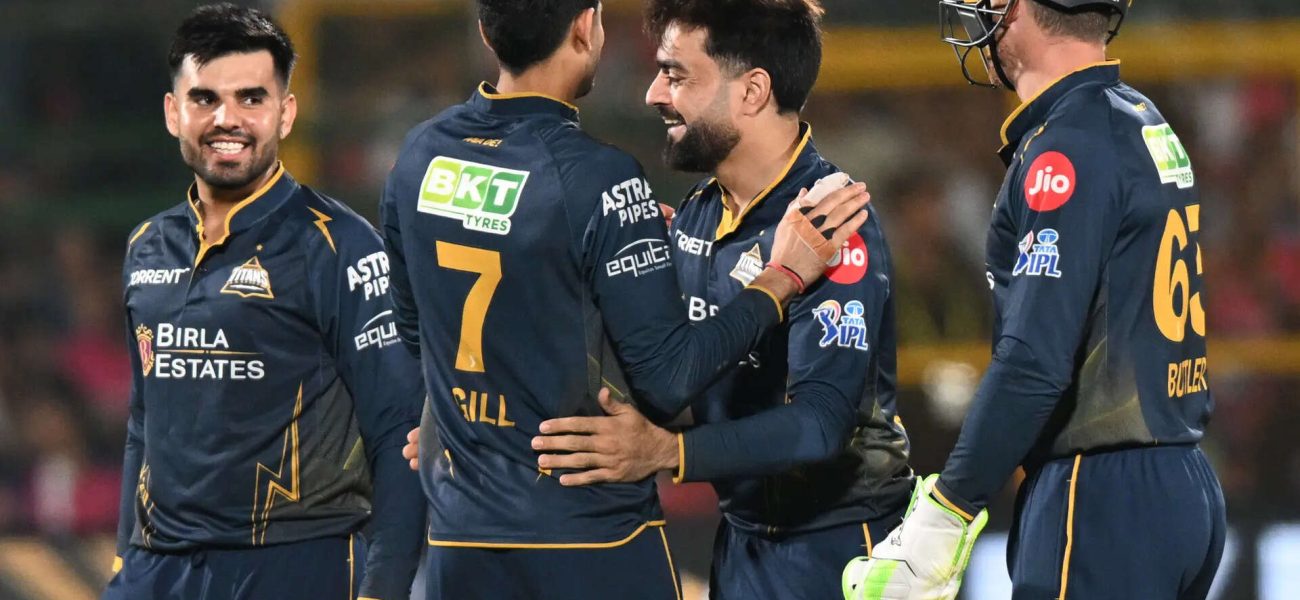
The Royals’ chase—if you can call it that without a trace of irony—was a slow, agonizing surrender. Vaibhav Sooryavanshi — and Dhruv Jurel offered brief flickers of defiance, a momentary belief in magic. But magic, it seems, wasn’t on the roster. When Rashid Khan, the Afghan maestro, spun his way into the narrative, the contest simply evaporated. His googlies and leg-breaks weren’t just deliveries; they were economic policy statements, decimating morale with every turn. Two balls, two wickets—Jurel and Donovan Ferreira gone in the eighth over—and what had been a rollicking 78/3 in the powerplay spiraled to 91/5. Rashid finished with 4/33; a masterclass in controlled devastation. It doesn’t get much cleaner than that.
“You prepare all season, you drill, you strategize. But when the heat’s on, sometimes the boys just…they freeze. It’s not about skill at that point; it’s a test of nerve, and tonight, ours just wasn’t there,” a dejected Royals official, speaking anonymously off-record to Policy Wire, admitted after the thrashing. It’s the kind of frank, frustrated assessment that you don’t often hear on live TV, but that rings true in the post-game quiet of the locker room. Contrast that with the composed perspective from the victors. “We came here to do a job. No frills, no fuss. Every match is a final for us now, — and frankly, I expect nothing less than absolute focus. This team, it’s got grit. We know what it takes,” Gujarat Titans coach, Ashish Nehra, told this publication, his words devoid of triumphalism, perhaps knowing the tightrope still ahead.
📄 POLICY WIRE WHITEPAPER PUBLISHED: PAKISTAN'S NATIONAL SECURITY POLICY PRIORITIES
👉 READ BY CLICKING HEREWhat This Means
The IPL, beyond its glitz and raw athletic spectacle, is a multi-billion dollar enterprise, an economic engine that reverberates far beyond India’s borders. These matches aren’t just games; they’re high-stakes investment opportunities, each boundary, each wicket, a fluctuating data point on a broader financial ledger. The Royals’ significant defeat isn’t merely a blip on a score-sheet; it’s a dent in perceived team stability, potentially affecting broadcast rights valuations and future sponsorship appeal for the franchises. Investor confidence, after all, doesn’t distinguish between a bad quarterly report and a team that capitulates for 152 runs when chasing 230.
Because, in the hyper-competitive ecosystem of T20 cricket, a weak performance in the business end of the tournament—like that seen in Jaipur—can signal vulnerabilities. It’s not just about the local Jaipur crowd going home disappointed; it’s about the countless eyes in Karachi, Dhaka, and beyond, tuning in. Cricket in South Asia, including countries like Pakistan — and Bangladesh, shares a deep, almost religious, fervor. The IPL, despite its geographic origins, draws a significant portion of its viewership and indeed, a pipeline of aspiration, from this broader region. Consider players like Rashid Khan, hailing from Afghanistan, becoming a megastar in this Indian league. His success isn’t just a win for Gujarat; it’s a narrative that resonates deeply across the Muslim world, where cricket transcends political friction and represents a unifying cultural current, drawing billions in viewership and inspiring a shared identity, for better or worse, across the regional chessboard.
This result, therefore, shifts more than just the immediate standings; it subtly alters the perception of power dynamics within the league, impacting playoff odds and team branding. The brutal economic realities dictate that every point matters, every run counts, and every collapse carries a financial and reputational weight far heavier than a mere match outcome. It’s a fragile empire, this one, always threatening to unravel under its own weight.