


AI in the Desert: New Mexico’s Quiet Battle for Digital Supremacy
POLICY WIRE — Albuquerque, New Mexico — It wasn’t the roar of combustion engines or the glint of chrome that recently filled an Albuquerque high school gymnasium, but the barely perceptible...

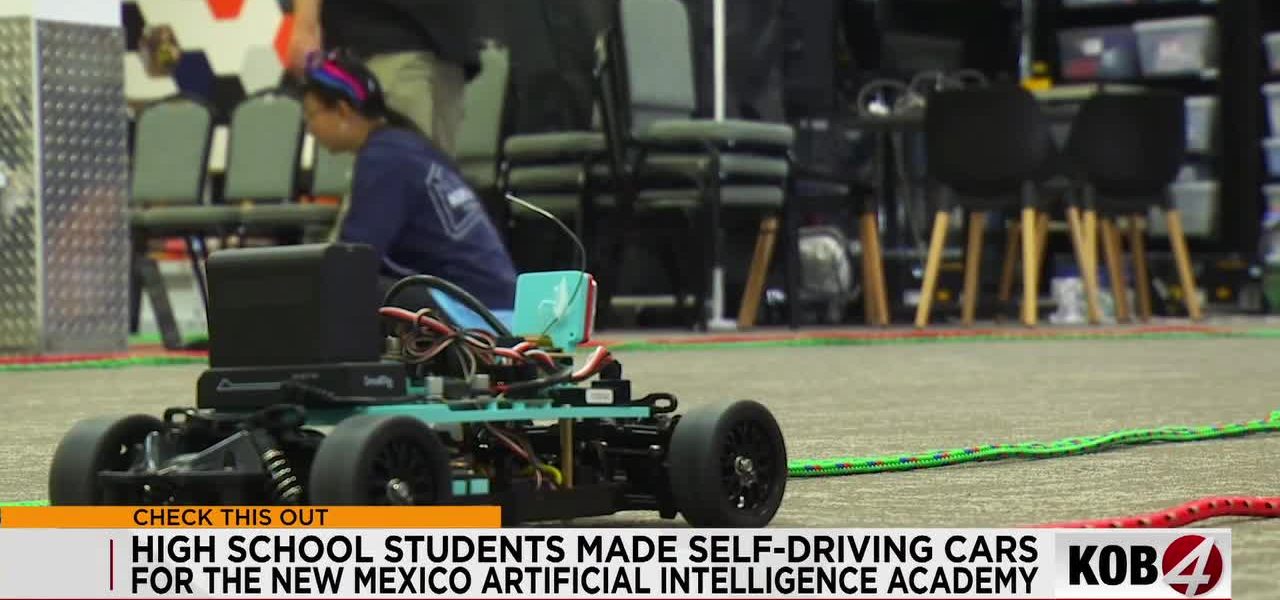
POLICY WIRE — Albuquerque, New Mexico — It wasn’t the roar of combustion engines or the glint of chrome that recently filled an Albuquerque high school gymnasium, but the barely perceptible whir of miniature motors and the quiet, almost conspiratorial hum of young minds at work. Ten teams of teenagers, eyes glued to pint-sized self-driving cars, were navigating a competition track built for machines programmed by their own hands. A deceptively innocuous scene, really. But beneath the surface of this localized contest lies a frantic, global scramble for digital literacy—a quiet war being waged in classrooms, far from the polished boardrooms where AI’s future is usually debated.
This wasn’t a science fair for hobbyists. No, this was the culmination of a 10-week boot camp hosted by the New Mexico Artificial Intelligence Academy, a local outfit determined to drag the Land of Enchantment, perhaps kicking and screaming, into the AI era. They’d armed these high schoolers with tools: lessons in robotics, machine learning algorithms, and enough software development concepts to make a seasoned programmer blush. The mission? To train the next generation to *build* with AI, not just consume its glossy outputs.
George Gorospe, co-founder of the Academy, isn’t prone to hyperbole, but you can feel the urgency in his voice. He told Policy Wire, “Everyone’s talking AI, right? But making it real, making it something you can use to actually solve problems, that’s where the rubber meets the road. We’re giving these kids the toolkit to not just observe it, but to actually do something with it.” He’s right; there’s a distinct difference between watching a drone fly and coding its autonomous path.
The academy’s underlying philosophy sounds almost quaint: AI as a ‘helpful tool,’ not a replacement for human thought. A charming sentiment, sure, particularly when you consider the Silicon Valley titans are regularly floating doomsday scenarios for the global workforce. Here in New Mexico, however, they’re teaching students to gather data, train networks, and deploy those networks to tackle very specific, very local problems. It’s pragmatic, really.
But the stakes extend far beyond the deserts of the Southwest. Dr. Aisha Khan, an educational policy advisor with Albuquerque Public Schools, sees it plain as day. She observes, “We’re not just training future software engineers here; we’re cultivating a form of resilience. Because whether you’re fixing a local supply chain or — God forbid — navigating international market volatility, understanding how these systems work, how data informs action, well, that’s just survival in this economy. We can’t afford to leave any kids behind, not when Karachi is churning out tech talent faster than we can say ‘algorithm’.”
Her point is stark. In Lahore or Karachi, the burgeoning tech sectors—despite infrastructural challenges and uneven access—are pushing hard into AI, knowing it’s their economic lifeline. They’re investing in youth, perhaps not always with glossy academies, but through sheer necessity. That competitive pulse echoes even in Albuquerque.
And these are big bets. Global consultancies are predicting staggering growth. For instance, the global artificial intelligence market size, valued at approximately $241 billion in 2023, is projected to surge to over $1.8 trillion by 2030, according to Grand View Research. That’s not just a trajectory; it’s a gravity well pulling everything into its orbit.
What This Means
The Albuquerque experiment isn’t just about teaching kids to code mini-cars; it’s a micro-snapshot of a macro-challenge. Economically, regions that don’t rapidly cultivate AI-savvy workforces will simply be left behind. We’re not talking about minor dislocations here, but wholesale obsolescence of regional economies and national ambitions. And for New Mexico, a state historically reliant on energy and defense, diversifying its human capital is more than a good idea—it’s an imperative. It’s about securing future jobs, attracting new industries, and ensuring its populace can thrive in a world that’s gone thoroughly digital.
Politically, such initiatives are a minefield. Funding for cutting-edge education often collides with traditional curricula — and budgetary constraints. How do you convince taxpayers to invest in autonomous vehicle programming when basic literacy scores are, shall we say, less than stellar? It requires foresight, — and perhaps a degree of political courage. But then, leaving it all to Silicon Valley is a policy choice, too—one that guarantees a permanent technological dependency for most. Because if local institutions don’t empower their own, someone else surely will. This challenge resonates globally, from New Mexico’s arid landscape to the sprawling tech hubs of Pakistan, where similar, often underfunded, efforts are trying to seize a sliver of that massive, looming trillion-dollar AI pie.
The subtle irony? A program designed to teach young people to control machines also underscores just how little control governments, schools, and even industries might have over the broader march of AI if they don’t jump in, feet first, right now.