

The Unscripted Snag: When Empathy Met a Crowd’s Giggles on the Political Stage
POLICY WIRE — Washington D.C. — Political theater, by its very design, relies on a delicate suspension of disbelief. Audiences, regardless of their allegiances, expect a certain performance, a script...

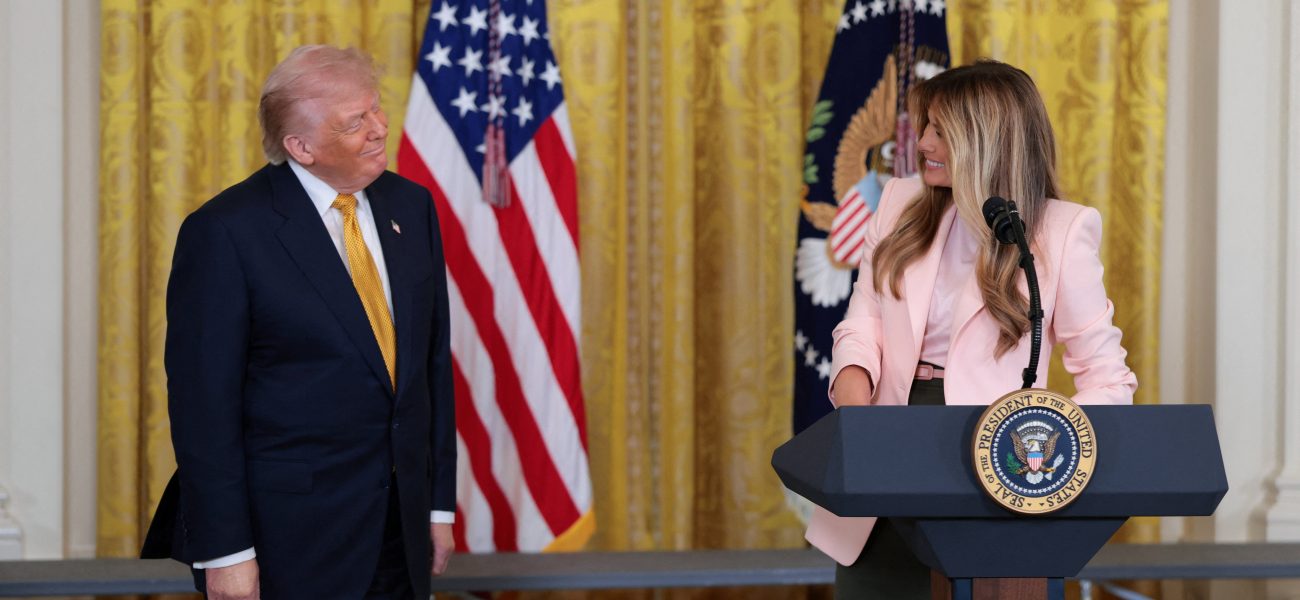
POLICY WIRE — Washington D.C. — Political theater, by its very design, relies on a delicate suspension of disbelief. Audiences, regardless of their allegiances, expect a certain performance, a script adhered to, a persona maintained. But sometimes, a single, unscripted beat—a collective ripple of unexpected laughter—can unravel the whole illusion, laying bare the raw, often unforgiving, realities of public perception. It’s what happened recently when former First Lady Melania Trump spoke about her husband’s, well, ‘empathy,’ to an assembled crowd in Washington.
It wasn’t an overtly hostile reaction; it wasn’t a jeer, not a protest. Just a ripple. A chuckle, really, that bloomed into open mirth as Mrs. Trump described her husband, the ex-President, as possessing a “good heart” and a spirit capable of great “empathy.” The scene, caught on video and replayed endlessly, offered a jarring collision of carefully crafted political narrative and spontaneous public response. And it happened during a planned moment for her to champion his virtues. Awkward. Painful, even, for those on stage. You can bet they weren’t expecting it.
Because that moment, short as it was, cut straight through the typical political niceties. It didn’t matter what she said next; the narrative had already shifted. The intended message — a softening of the former President’s image — became overshadowed by an unexpected truth universally acknowledged (at least by that specific audience). Political strategists spend fortunes on message discipline, on curating exactly how leaders are perceived, on preempting precisely this kind of unscripted human moment.
“It was a minor blip,” offered a senior Republican strategist, who declined to be named but is close to the Trump operation. “She simply misspoke, or perhaps the wording just caught them off guard. This whole thing is just the media blowing up a molehill, trying to manufacture controversy where there isn’t any. Don’t fall for it.” But sometimes, a molehill, if located in the right place, can become a pretty effective tripping hazard. That’s just how public discourse works these days.
The incident wasn’t isolated. It fits into a broader pattern of how the former President’s public persona — often combative, sometimes indifferent to convention — clashes with attempts to soften it for broader appeal. An image built on ‘toughness’ often finds itself poorly suited for conversations about tender feelings. The perception gap is massive. And the public, it seems, isn’t always willing to play along with the fantasy. It’s like asking an audience to believe a grizzled action hero would rather spend his downtime crocheting kittens than exploding things. They just won’t buy it.
“Modern political communication is a performance art,” explained Dr. Lena Khan, a political sociologist specializing in media — and public opinion at a prominent East Coast university. “But it’s one where the audience carries an increasingly active role in co-creating the narrative. When there’s such a pronounced disconnect between the presented persona and existing public understanding, you get these moments of dissonance. Laughter isn’t necessarily hostility; it’s often disbelief, a reflexive human response to the absurd or the incongruous.” Dr. Khan points to Gallup data from recent years, which consistently shows that only around 30% of Americans believe politicians are generally ‘trustworthy’—a stark indicator of deep-seated cynicism in political sincerity.
📄 POLICY WIRE WHITEPAPER PUBLISHED: PAKISTAN'S NATIONAL SECURITY POLICY PRIORITIES
👉 READ BY CLICKING HEREEven across continents, in places like Pakistan, a country often grappling with its own brand of robust, often fiery, political rhetoric, such an event doesn’t pass unnoticed. Local media in Islamabad — and Karachi picked up on the clip, albeit with varying degrees of interpretive commentary. For some, it confirmed a Western media narrative of a leader out of touch; for others, it might have been shrugged off as just another theatrical element of American politics. But the underlying message — about a leader’s capacity for genuine human feeling — resonates differently in cultures where the perceived morality and familial standing of a leader are often discussed as openly as their policy positions. Diplomacy itself is often about perception. A strongman perceived as lacking empathy on the domestic front can be a diplomatic liability, or perhaps, ironically, an asset, depending on the particular geopolitical dance on the global stage. What might seem like a mere gaffe in Washington takes on new dimensions thousands of miles away.
What This Means
This incident, seemingly small, serves as a sharp reminder of the brutal calculus of political perception in a hyper-connected, socially fractured world. For the Trump campaign, it means another obstacle in the perennial struggle to broaden appeal beyond the loyal base. Efforts to ‘humanize’ figures whose public brand is built on a specific, often confrontational, identity often backfire precisely because those attempts feel inauthentic. Audiences, regardless of their political leanings, can sniff out artifice. They crave congruence. This particular snarky snicker underscored a persistent challenge: how do you pivot a political narrative when the public has already written their own ending? The incident offers no economic implications directly, but its political reverberations could affect donor confidence and volunteer enthusiasm if such attempts at image rehabilitation continually fall flat. In an election year, every laugh counts.
So, as the political silly season continues its grind, moments like these aren’t just fodder for late-night talk shows. They’re miniature case studies in the struggle for narrative control. Because sometimes, no matter how carefully you write the script, the audience decides what’s truly believable. And sometimes, what’s believable is just… funny.