


The Captain’s Albatross: Mumbai’s Billion-Dollar Blunder and Pandya’s Precarious Perch
POLICY WIRE — Mumbai, India — It wasn’t the searing heat of Mumbai that sent shivers down the spine of cricket purists this IPL season, but rather the glacial descent of the five-time...

POLICY WIRE — Mumbai, India — It wasn’t the searing heat of Mumbai that sent shivers down the spine of cricket purists this IPL season, but rather the glacial descent of the five-time champions, Mumbai Indians. Their once-unassailable aura? Now a mere whisper, dissolving into the humid air with each successive defeat. This isn’t just about a few poor performances; it’s about the brutal, unforgiving machinery of a multi-billion-dollar sporting enterprise grinding against its own gears, epitomized by a captain’s visibly unraveling form.
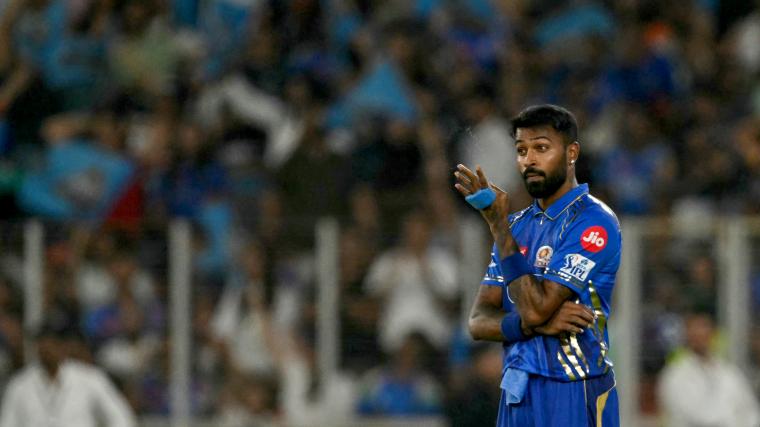
Hardik Pandya, the architect of countless past triumphs, now finds himself at the vortex of this swirling tempest. His bat, once a weapon of mass destruction, has yielded a paltry 146 runs across eight innings, averaging a dispiriting 20.85. Worse still, his strike rate of 136.44 — a measure of scoring aggression pivotal in T20s — signals a hesitancy, a loss of the explosive flair that defined his meteoric rise. And it’s not just the willow; his bowling, usually a reliable source of breakthroughs, has been alarmingly porous, conceding runs at an exorbitant 12.26 per over, snatching just four wickets across seven outings.
But it’s not simply Pandya’s individual metrics that have soured the Mumbai Indians’ campaign. Indeed, the team’s abysmal run – seven losses in nine games – paints a picture of collective disarray. They’d begun with such swagger, chasing down an imposing 221 against Kolkata, only to plunge into an abyss. This isn’t the formidable unit that dominated previous seasons; it’s a squad whose ‘world-class’ moniker feels increasingly like a cruel jest. Even stalwarts like Jasprit Bumrah have seemed uncharacteristically subdued, a rare sight that suggests the rot runs deeper than a single player’s slump. Rohit Sharma, battling an injury, has been largely absent, further complicating an already tangled tactical web.
“We assembled a formidable squad, a roster brimming with proven match-winners, and made strategic decisions we believed were pivotal,” opined a Mumbai Indians executive, speaking off the record about the season’s downturn. “Performance, however, remains the ultimate arbiter, — and it’s clear this season hasn’t met our collective aspirations.”
Still, the focus invariably lands on the captain. And it’s a heavy burden, especially when the team’s fortunes crater. Cricket pundit — and former international player, Ramiz Raja, offered a more unvarnished assessment. “In the unforgiving crucible of the IPL, especially with the sheer financial outlay involved, a captain’s fortunes are inextricably linked to the team’s trajectory. Hardik’s current form isn’t just a blip; it’s symptomatic of a deeper malaise, a collective failure under the glare of unparalleled scrutiny.”
📄 POLICY WIRE WHITEPAPER PUBLISHED: PAKISTAN'S NATIONAL SECURITY POLICY PRIORITIES
👉 READ BY CLICKING HEREThe IPL’s gravitational pull extends far beyond India’s borders, captivating millions across South Asia. From Dhaka’s bustling streets to the quiet villages of Sri Lanka, and yes, even in cricket-mad Pakistan — where political realities preclude direct involvement — the league’s narratives, its triumphs and spectacular implosions, are devoured with fervent intensity. The fortunes of players like Pandya aren’t just local gossip; they become region-wide talking points, analyzed with a passion bordering on obsession. This phenomenon underscores how deeply entwined cricket remains with the cultural fabric of the subcontinent, a powerful, albeit informal, bridge across sometimes fraught national divides.
So, what does it truly mean when a titan stumbles?
What This Means
At its core, the Mumbai Indians’ predicament and Hardik Pandya’s struggle transcend mere sporting statistics; they offer a stark lens into the political economy of modern sports. The IPL isn’t just entertainment; it’s a colossal economic engine. Brand Pandya, brand MI – these are multi-million dollar entities. A slump like this impacts not just playoff hopes but sponsorship deals, merchandise sales, and even the future valuation of players in an increasingly globalized market. The sheer scale of investment — billions flow into player auctions, broadcast rights, and team ownership — means that on-field performance has tangible, immediate financial consequences.
Behind the headlines of dropped catches — and missed wickets lies a deeper narrative of economic pressure. This spectacle, watched by hundreds of millions (as detailed in Beyond the Boundary: How India’s IPL Rivalries Fuel a South Asian Economic Crucible), isn’t merely a distraction; it’s a soft power projection. India’s economic might and cultural influence are amplified through the IPL, making its success a point of national pride and regional dominance. A team’s decline, especially one as iconic as MI, reverberates through media cycles, sparking debates that transcend mere sporting analysis. It can, quite literally, affect national mood, however fleetingly, underscoring the intrinsic link between sporting spectacle and broader socio-economic currents. It’s a brutal reminder that even in sports, the market demands results, and quickly, from its most expensively acquired assets.
📖 GET YOUR FREE COPY NOW OF POLICY WIRE DIGITAL MAGAZINE JULY 2026 EDITION
👉 READ & DOWNLOAD FREE MAGAZINE