

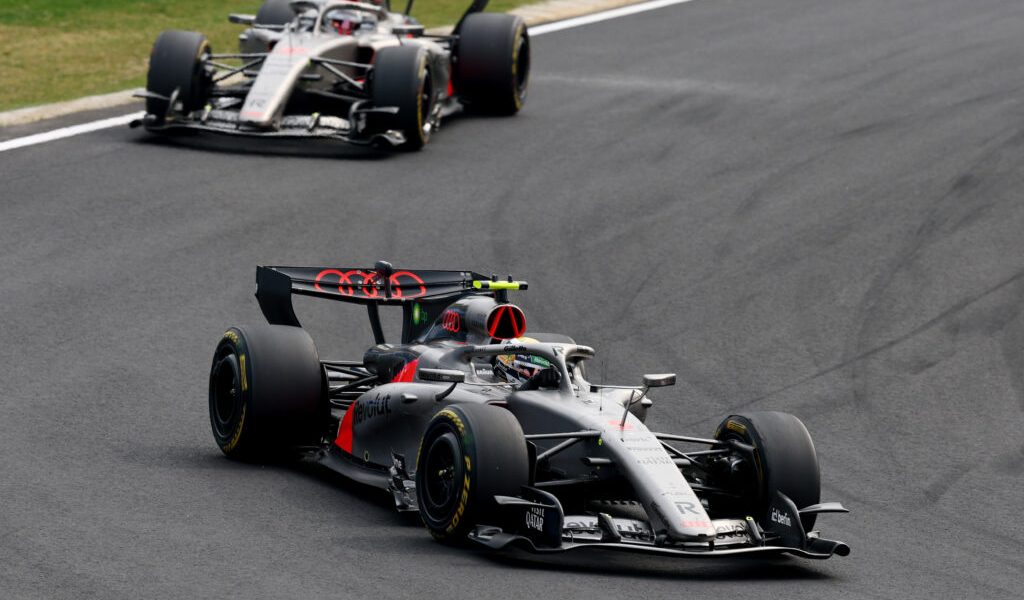
The Scorched Ambition: Audi’s F1 Dream Confronts a Fiery Reality in Miami
POLICY WIRE — Miami, United States — It’s never easy, this business of global spectacle, especially when billions are at stake and brand reputation hangs by a carbon-fiber thread. For Audi, a titan...

POLICY WIRE — Miami, United States — It’s never easy, this business of global spectacle, especially when billions are at stake and brand reputation hangs by a carbon-fiber thread. For Audi, a titan of German engineering and luxury, its audacious foray into Formula 1 has been heralded as a game-changer, a declarative statement of intent on the world’s most advanced motorsport stage. But in Miami, that meticulously crafted narrative briefly – and quite literally – went up in smoke, casting a harsh, if ephemeral, glare on the gargantuan challenges inherent in such an enterprise.
Nico Hulkenberg, the German marque’s seasoned pilot, found himself a reluctant protagonist in this fiery drama just before the sprint race. His machine, an intricate ballet of horsepower and aerodynamics, began to belch flames from its rear section while en route to the grid. One minute, he was preparing to conquer the asphalt jungle; the next, he was bailing from a burgeoning inferno, his Miami weekend – and Audi’s immediate aspirations – already compromised. It wasn’t the debut anyone envisioned, nor was it a particularly unique setback for the unfortunate Hulkenberg.
This incident wasn’t an isolated anomaly, you see. It’s part of a burgeoning pattern for Hulkenberg, whose F1 tenure this season feels less like a pursuit of glory and more like a Sisyphean struggle against mechanical malefaction. He’d already missed the season-opener in Australia due to an unscheduled technical tantrum from his car. And then, during the Chinese Grand Prix sprint, another fire forced an early retirement. Three races, three major reliability woes – it’s a statistic that doesn’t just sting; it screams. The driver’s frustration, palpable even through the stoic veneer of professional motorsport, is understandable. He’s navigating a season that’s proving a veritable crucible of resilience.
Allan McNish, Audi’s racing director, offered a distinctly sober assessment in the immediate aftermath. He disclosed to Sky Sports F1 that the team had, in fact, harbored suspicions before the ill-fated vehicle even departed its garage. “We had something in the garage which we thought was sorted out,” McNish declared, a hint of weariness in his tone, “but clearly there was a problem going to the grid. We need to get the car back to have a look at it.” That ‘look’ would entail a forensic examination, a desperate scramble to diagnose and rectify systemic vulnerabilities before the next qualifying session, let alone the main race. Still, the prospect of missing subsequent sessions loomed large, a further blow to Audi’s precarious position.
Behind the headlines, beyond the dramatic visuals of a flaming F1 car, lies a deeper narrative of immense corporate pressure and unyielding technological demands. Audi’s entry into Formula 1 isn’t merely about sporting prowess; it’s a multi-billion-dollar strategic play to burnish its global image, push technological boundaries, and ultimately, sell more cars. For a brand that trades on precision, reliability, and engineering superiority, these public, fiery failures are deeply problematic. And it’s not just about the European or American markets; F1’s surging popularity extends to rapidly developing economies where brand perception translates directly into sales, particularly in regions like South Asia and the Middle East, where luxury car markets are expanding. This global reach means every technical glitch plays out before an enormous audience.
Consider the sheer scale: in 2023, Formula 1 reported a cumulative global TV audience of 1.59 billion viewers, according to official F1 reports. That’s a staggering platform, making every triumph a global endorsement — and every failure a worldwide embarrassment. For Audi, currently a name synonymous with meticulous German engineering, these repeated technical fiascos risk eroding a painstakingly built reputation. It isn’t just a race car failing; it’s an embodiment of the brand, a rolling billboard of ambition (or, as it were, breakdown) that’s watched by hundreds of millions. This is the brutal ballet of talent acquisition and technological advancement, played out on the grandest stage.
📄 POLICY WIRE WHITEPAPER PUBLISHED: PAKISTAN'S NATIONAL SECURITY POLICY PRIORITIES
👉 READ BY CLICKING HERENico Hulkenberg, reflecting on an earlier, equally frustrating incident in Australia where a technical problem scuppered his race before it even began, conveyed a sentiment that many would echo. “We’re not exactly sure yet,” he’d lamented, a shadow of disappointment crossing his face. “It developed some sort of technical problem on the laps to the grid. We made it there, but it was something we couldn’t fix quickly. They’re obviously taking the car apart now, investigating what happened. Very unfortunate to not make the start at all.” That same sense of unfortunate helplessness now pervades the Miami paddock, as Audi’s engineers race against the clock and the merciless gaze of global media.
What This Means
At its core, this string of reliability setbacks represents more than just a bad run of luck for one driver. For Audi, which is investing a colossal sum – reportedly in the hundreds of millions of dollars – to become a factory F1 team, these incidents are a highly visible, public challenge to their fundamental brand identity. Formula 1 isn’t just a sport; it’s a hyper-accelerated R&D laboratory — and a premium marketing platform. Repeated breakdowns, especially fiery ones, can profoundly damage public perception of a brand that prides itself on engineering excellence and innovation. It suggests a chasm between aspirational performance — and tangible execution.
Economically, such issues can trigger investor jitters — and potentially impact long-term sponsorship attractiveness. Brands align with F1 teams for prestige — and reliability; when those are compromised, the calculus changes. Politically, within the high-stakes world of automotive giants, it creates an uncomfortable narrative for Audi, especially as it seeks to rival Mercedes-Benz and Ferrari on motorsport’s pinnacle. It’s not just about race points; it’s about market share, technological bragging rights, and the perception of a formidable global presence. The incident also subtly reminds us of F1’s growing economic footprint in regions like the Middle East, with races in Bahrain, Saudi Arabia, and Qatar, and its surging popularity in India’s burgeoning sports economy. Reliability failures in such a globally televised spectacle reverberate across diverse, lucrative markets, potentially dulling the appeal of luxury vehicles from a brand struggling with basic operational integrity on track.
So, while Hulkenberg’s Miami sprint race may have been a wash, the true fallout for Audi is far from over. It’s a stark reminder that in the high-octane world of Formula 1, ambition alone simply isn’t enough; flawless execution, under immense pressure, is the ultimate determinant of success – and reputation.