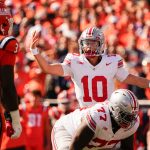



Gridiron Gamble: A&M Star’s Precarious Arc Mirrors High-Stakes Talent Economy
POLICY WIRE — College Station, TX — The glittering promise of five-star potential often obscures a far more brutal reality: that talent, however prodigious, is a currency constantly devalued by...

POLICY WIRE — College Station, TX — The glittering promise of five-star potential often obscures a far more brutal reality: that talent, however prodigious, is a currency constantly devalued by expectation, injury, and the relentless churn of collegiate competition. Such is the precarious perch of Rueben Owens, the Texas A&M junior running back, now designated by ESPN as an ‘under-the-radar’ player—a label that, for a recruit once ranked among the nation’s elite, signals less a stealth ascent and more a desperate scramble for relevance.
It’s a narrative familiar across high-stakes endeavors, but particularly acute in the hyper-commercialized world of American college football. Owens, who amassed more than 7,000 rushing yards and 100 touchdowns in high school (a truly dizzying sum for a teenager), arrived in College Station not as an underdog, but as a presumed savior. Yet, his collegiate tenure has been a fraught tapestry of tantalizing flashes and frustrating setbacks, exacerbated by a foot injury that sidelined him for much of the 2024 season. Even after a junior season where he amassed a respectable 639 rushing yards and five touchdowns, averaging a robust 5.4 yards per carry, the narrative remained one of unfulfilled prophecy.
And now, with the 2026 season looming, the spotlight finds Owens again, not for past glories, but for the stark imperative of future performance. Head Coach Mike Elko, entering his third season, hasn’t sugarcoated the stakes. “We’re building something significant here, and that requires every player to seize their opportunity—not just with physical prowess, but with mental fortitude,” Elko remarked during a recent press conference. “Rueben’s journey isn’t unique; it’s the crucible through which champions emerge, or, frankly, don’t.”
Behind the headlines — and the spring game theatrics, there’s a deeper, more granular economic truth at play. College athletes today aren’t just players; they’re valuable assets in a multi-billion dollar enterprise, their future earnings potential tied directly to their on-field production. Dave Wilson, an ESPN analyst, didn’t mince words on the broader context. “It’s not just about what these kids do on the field anymore; it’s about their marketability, their NIL valuation, their projected NFL draft stock. Owens has the raw tools, sure, but the margin for error in this ecosystem is razor-thin.” His assessment underscores the brutal commodification of young talent—a system where a single sprained ankle or an inconsistent stretch can send a player’s stock plummeting, with multi-million dollar implications.
Still, Owens isn’t alone in this crucible. The addition of former Alabama wide receiver Isaiah Horton and the emergence of sophomore running back Jamarion Morrow suggest a renewed offensive identity under new Offensive Coordinator Holmon Wiggins, who reportedly favors a run-heavy scheme. This strategic shift could either provide Owens the stage he needs to finally ignite, or simply add more pressure in an already crowded backfield vying for carries. It’s a make-or-break moment, not just for Owens, but for a program desperate to climb back into national championship contention.
📄 POLICY WIRE WHITEPAPER PUBLISHED: PAKISTAN'S NATIONAL SECURITY POLICY PRIORITIES
👉 READ BY CLICKING HERESuch pressure isn’t confined to American college football; it’s a ubiquitous narrative across global sporting arenas. From the immense national scrutiny faced by a cricketer in Karachi, whose every shot carries the weight of a nation’s hopes, to the high-stakes world of European football academies, the parallels are striking. It’s a stark reminder that beneath the glamour, professional sports, wherever they’re played, operate on a ruthless meritocracy that mirrors broader global precarity. The relentless pursuit of exceptional talent, often from humble origins, and its subsequent commodification, forms a global economic undercurrent, where the promise of upward mobility is balanced precariously against the risk of spectacular failure. It’s a story played out in countless forms, from Silicon Valley startups to the sprawling bazaars of Lahore, where talent is discovered, cultivated, and then either elevates its possessor or leaves them behind, often due to circumstances beyond their immediate control.
What This Means
At its core, the Rueben Owens saga isn’t merely a sports story; it’s a policy parable. The NCAA’s shift towards Name, Image, and Likeness (NIL) deals, while ostensibly empowering athletes, has dramatically heightened the economic stakes for individuals and institutions alike. Players like Owens are now, by definition, brands, — and their performance is directly tied to their market value. This creates an intense, almost Darwinian environment where ‘under-the-radar’ can quickly devolve into ‘overlooked’—a significant risk given the average NFL career is notoriously short. For universities, the ability to recruit and retain such talent impacts not just athletic success, but also alumni donations, media rights, and broader institutional prestige.
And so, Texas A&M’s investment in Owens—financial, emotional, and strategic—represents a microcosm of the larger, often unspoken economic contract between athlete and institution in the modern era. His redemption, if it comes, won’t just be a personal triumph; it’ll be a vindication of a system that promises immense rewards for peak performance, but also metes out unforgiving consequences for anything less. It’s a brutal calculus, perpetually recalibrated, and endlessly fascinating for those who understand that beneath the touchdowns and tackles lies a significant economic engine, driving policy and futures in ways few truly comprehend.