


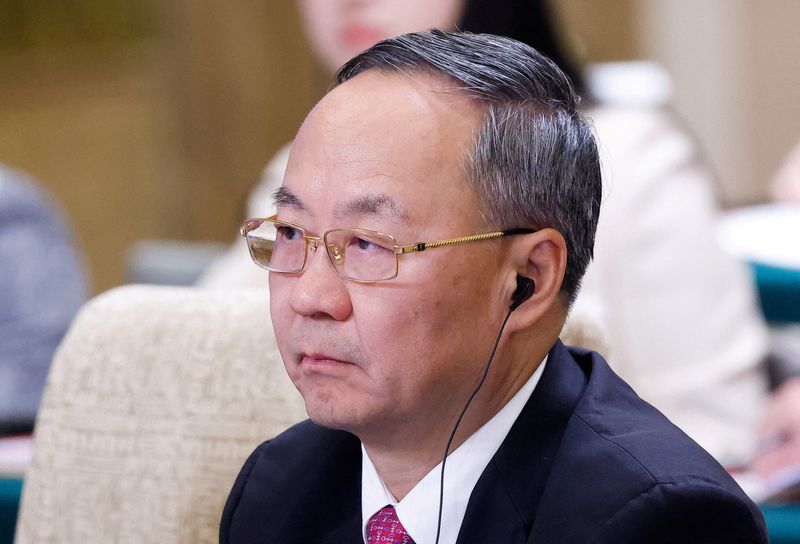
Beijing’s Financial Citadel Shaken: Top Regulator’s Reported Demotion Signals Deeper Currents
POLICY WIRE — Beijing, China — The whispers began quietly, as they always do in Beijing’s labyrinthine corridors of power, before congealing into a palpable hum. What started as...

POLICY WIRE — Beijing, China — The whispers began quietly, as they always do in Beijing’s labyrinthine corridors of power, before congealing into a palpable hum. What started as unconfirmed chatter has now taken on the unmistakable gravity of an impending earthquake within China’s meticulously controlled financial apparatus. Li Yunze, the ostensibly unassailable head of the National Financial Regulatory Administration (NFRA)—the nation’s powerful financial watchdog—is reportedly being demoted, sources privy to internal party deliberations have conveyed to Policy Wire. It’s a move that, while not yet officially announced, reverberates far beyond the gilded offices of the People’s Bank, signaling a potentially profound shake-up in how the world’s second-largest economy navigates its tempestuous financial seas.
This isn’t merely a personnel reshuffle; it’s a symbolic recalibration. Li, appointed just last year to lead the NFRA – a body forged from a merger of banking and insurance regulators – was touted as a key architect in stabilizing China’s precariously balanced financial sector. His reported departure, therefore, casts a long shadow over the efficacy of recent regulatory efforts and, perhaps more pointedly, over the political fortunes of those tasked with steering China through its property crisis, burgeoning local government debt, and a generally tepid post-pandemic recovery. It suggests a leadership dissatisfied, perhaps even unnerved, by the current trajectory.
And it’s not hard to see why. China’s economic landscape remains fraught. The property sector, a perennial concern, continues to sputter, whilst consumer confidence falters. This year, the International Monetary Fund projects China’s economic growth to decelerate to 4.6% in 2024, a figure that, while respectable by global standards, marks a continued downward trend from previous years and falls short of the ambitious targets Beijing often hints at. Such a backdrop makes any perceived regulatory misstep or leadership failure particularly consequential.
“Accountability is paramount,” observed a senior party official, who spoke on condition of anonymity, referring to the broader imperative for economic stability rather than specific individuals. “The Party demands unwavering commitment to safeguarding the financial system from systemic risks. Where deficiencies arise, adjustments – even difficult ones – must be made.” This boilerplate declaration, stripped of its diplomatic veneer, essentially confirms the internal pressure cooker Beijing’s financial leadership operates within.
Still, the timing here is intriguing. It follows a period where Beijing has attempted to reassure foreign investors, even as it tightens domestic ideological control. The demotion of such a high-profile figure, regardless of the precise rationale, invariably sends a chill through market observers. It underscores the opacity of China’s political-economic decision-making, where personnel changes often arrive as stark, unexplained pronouncements, leaving analysts to parse the tea leaves for meaning. It’s a familiar dance, frankly, one that makes genuine transparency a scarce commodity.
Behind the headlines, this shift could portend a renewed emphasis on state control over market mechanisms, a further centralization of power, and potentially more aggressive interventions in financial markets. For global players, particularly those in developing economies heavily reliant on Chinese investment, this isn’t just an internal Beijing affair. Consider Pakistan, a linchpin in China’s sprawling Belt — and Road Initiative (BRI). The health and stability of China’s financial system directly impact its capacity and willingness to fund colossal projects like the China-Pakistan Economic Corridor (CPEC). A shaky financial leadership in Beijing could easily translate into delayed disbursements, renegotiated terms, or a general cooling of investment appetite – a scenario that could ripple through the broader South Asian economic landscape, where Chinese capital has become increasingly crucial.
📄 POLICY WIRE WHITEPAPER PUBLISHED: PAKISTAN'S NATIONAL SECURITY POLICY PRIORITIES
👉 READ BY CLICKING HERE“Investors crave predictability, especially in a market as vast — and complex as China’s,” posited Dr. Eleanor Vance, a senior fellow at the Peterson Institute for International Economics. “Sudden, opaque shifts at the highest echelons of financial regulation – even if framed as internal corrections – erode that confidence. It makes allocating capital a much riskier proposition, regardless of the fundamentals.” She’s not wrong; businesses don’t like uncertainty, and Beijing seems to consistently dole it out in spades.
What This Means
At its core, Li Yunze’s reported demotion symbolizes Beijing’s deep-seated anxiety about its economic future and its leadership’s willingness to swiftly replace officials deemed insufficient in addressing those concerns. Politically, it reinforces President Xi Jinping’s absolute authority; even senior figures are expendable if they don’t deliver precisely on the Party’s mandates. It shows that personal loyalty alone isn’t enough; demonstrable results – or the appearance of them – are now paramount. Economically, this move could signal a renewed tightening of financial controls, potentially stifling the very market liberalization that some international observers had hoped to see. For foreign companies and investors, it underscores the inherent political risk of operating in China, where policy pivots can be sudden and profound, often without clear explanation. It might also mean a tougher stance on debt management and asset quality, pushing struggling entities closer to state intervention or outright collapse. Don’t expect a sudden surge of transparency; rather, anticipate a more muscular, state-centric approach to economic governance, with all its accompanying unpredictability.
The global ramifications aren’t insignificant either. A less stable, more opaque Chinese financial system inevitably translates into heightened risk for international trade and investment partners, not least those in the developing world who’ve embraced Chinese capital – countries whose own economic destinies are increasingly intertwined with Beijing’s fortunes. What seemed like a solid, long-term strategic bet on China’s growth suddenly feels a little less certain, doesn’t it?