


Beyond the Pitch: India’s Cricket Extravaganza and the Unseen Diplomatic Scorecard
POLICY WIRE — New Delhi, India — The clamor surrounding a particularly incisive spell of fast bowling in India’s Premier League (IPL) often eclipses the colossal, almost unfathomable, economic...

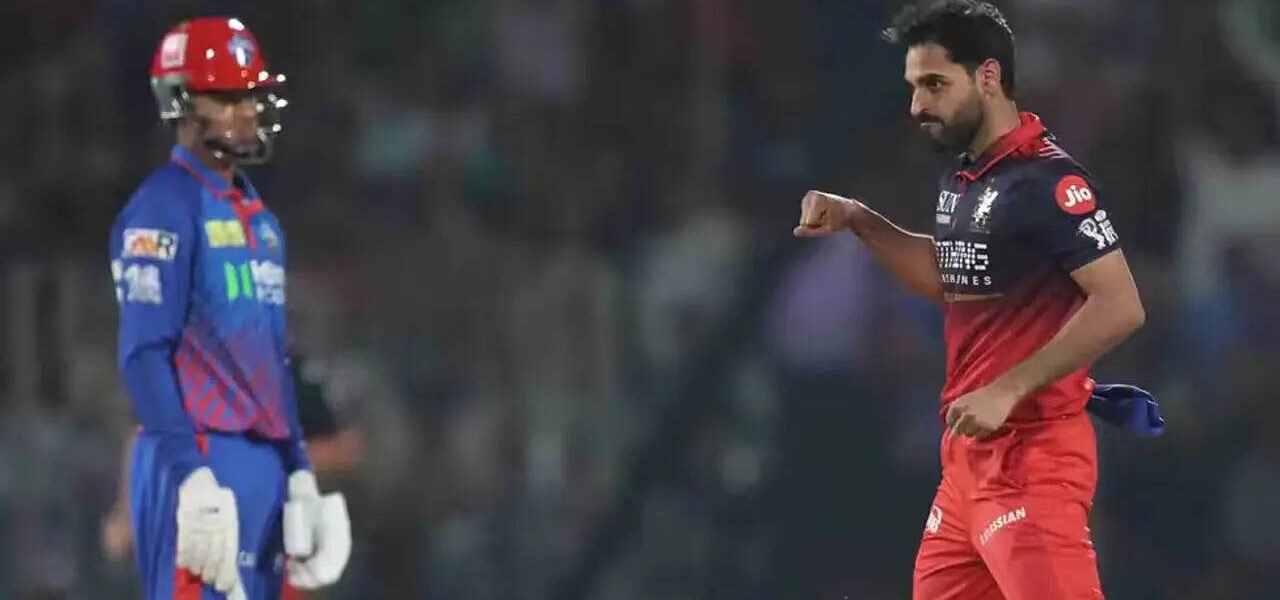
POLICY WIRE — New Delhi, India — The clamor surrounding a particularly incisive spell of fast bowling in India’s Premier League (IPL) often eclipses the colossal, almost unfathomable, economic and political apparatus that underpins it. For many, the sight of veteran seamer Bhuvneshwar Kumar dismembering an opposition batting lineup — a spectacle in itself, reminiscent of other global entertainment juggernauts — is merely a fleeting moment of sporting brilliance. But for those dissecting the sinews of regional power and economic projection, it’s another data point in an accelerating narrative of India’s soft power ascendancy, draped in the colorful raiment of a sports league.
Kumar, pitching for the Royal Challengers Bengaluru (RCB), delivered a performance that wasn’t just statistically aberrant but psychologically pulverizing. His three wickets for a paltry five runs across three overs didn’t merely propel RCB to a commanding victory over the Delhi Capitals; it vaulted him atop the Purple Cap standings for the IPL 2026 season. And this, we’re told, matters. He’s tied with two others, sure, but his superior economy rate—a lean 7.61 against Anshul Kamboj’s 8.56 and Eshan Malinga’s 9.44—bestowed upon him the symbolic crown. Such granular distinctions, seemingly trivial, fuel a billion-dollar ecosystem.
At its core, this particular contest was a demolition. The Capitals, once formidable, folded under an onslaught, slumping to a desultory 13 for 6 during the powerplay, a statistical nadir for the season. Kumar, with Josh Hazlewood providing a menacing complement, sliced through the top order, dismissing debutant Sahil Parakh, Tristan Stubbs, and even skipper Axar Patel with a surgeon’s precision. That they chased a paltry 75 runs in just 6.3 overs, with Virat Kohli applying the finishing flourish, underscores the almost brutal efficiency. It wasn’t just a win; it was a statement. A statement that, in the high-stakes theater of the IPL, sometimes individual brilliance can momentarily overshadow the corporate behemoth it serves.
But what does this all signify beyond the boundary ropes? And how does one reconcile the fervent adulation for such athletic feats with the more prosaic, yet foundational, policy discussions often taking a backseat? Dr. Meena Sharma, a distinguished economist specializing in emerging markets and a keen observer of South Asian dynamics, didn’t mince words. “The IPL isn’t just cricket; it’s a meticulously crafted economic engine, a soft power beacon for India that projects influence far beyond traditional diplomatic channels,” she recently posited. “Its sheer scale and commercial magnetism are unparalleled in the sporting world, (and it’s something other nations eye with envy).”
Still, the spectacle, for all its glitter, carries an unspoken weight. India’s geopolitical posture, particularly regarding its neighbors, finds subtle expression even here. Consider the palpable absence of Pakistani players in the IPL, a direct consequence of enduring political friction. This self-imposed exclusion, while perhaps strategically rationalized by New Delhi, represents a significant cultural and economic chasm within the broader South Asian sporting landscape. While fans in Pakistan avidly follow the league through unofficial channels, the formal barrier persists, denying both talent and opportunity. It’s a poignant reminder that even globalized sports can’t always transcend entrenched national rivalries.
“We’ve long advocated for a more inclusive approach to regional sporting events, one that fosters people-to-people connections, not just commercial gains,” remarked Ambassador Tariq Javed, a retired Pakistani diplomat with decades of experience in bilateral relations. “The shared passion for cricket, especially in the subcontinent, remains an untapped reservoir for de-escalation, a potential bridge that’s deliberately left unbuilt.” His observations, often understated, hit at a fundamental truth about how much common ground is sacrificed at the altar of political expediency.
📄 POLICY WIRE WHITEPAPER PUBLISHED: PAKISTAN'S NATIONAL SECURITY POLICY PRIORITIES
👉 READ BY CLICKING HEREThe financial gravity of this enterprise is, quite simply, staggering. A 2023 report by Brand Finance, a leading brand valuation consultancy, valued the IPL at an astonishing $10.9 billion, marking a significant annual growth. This valuation underscores not just its commercial prowess but its critical role as a cultural export, drawing viewership and investment from across the globe – though with clear, politically delineated boundaries.
What This Means
The IPL, epitomized by moments like Kumar’s recent masterclass, functions as more than mere entertainment; it’s a robust instrument of economic projection and cultural diplomacy for India. Its massive commercial success provides a glittering veneer over complex geopolitical realities, allowing New Delhi to assert its regional dominance through soft power. For one, the league’s immense financial pull attracts top international talent and global sponsorships, firmly cementing India’s position as a sporting and economic powerhouse in Asia. But it’s not without its critics. The continued exclusion of players from Pakistan, a major cricketing nation with a shared passion for the sport, highlights the political fissures that persist, even as other South Asian populations remain voracious consumers of IPL content. This selective engagement implies a calculated strategic decision, prioritizing national policy over regional sporting camaraderie. Consequently, while the IPL generates immense revenue and global viewership, its full potential as a unifying force across the subcontinent remains constrained by state-level politics. It’s a paradox: a global brand, yet one rigidly defined by national borders — and diplomatic impasses.
So, as the league barrels towards its crescendo, and individual accolades are bestowed, it’s imperative to peer beyond the brightly lit stadiums and choreographed celebrations. Because the true score is often kept in the silent ledgers of geopolitical influence and economic might, where a single three-wicket haul, however devastating, is just another drop in a very deep, very profitable ocean.