


Child’s Unvarnished Query Jolts House Leadership: Are Democrats Losing the Narrative?
POLICY WIRE — Washington D.C., USA — It wasn’t the seasoned political correspondent, armed with pointed policy questions, who managed to momentarily flummox House Minority Leader Hakeem...

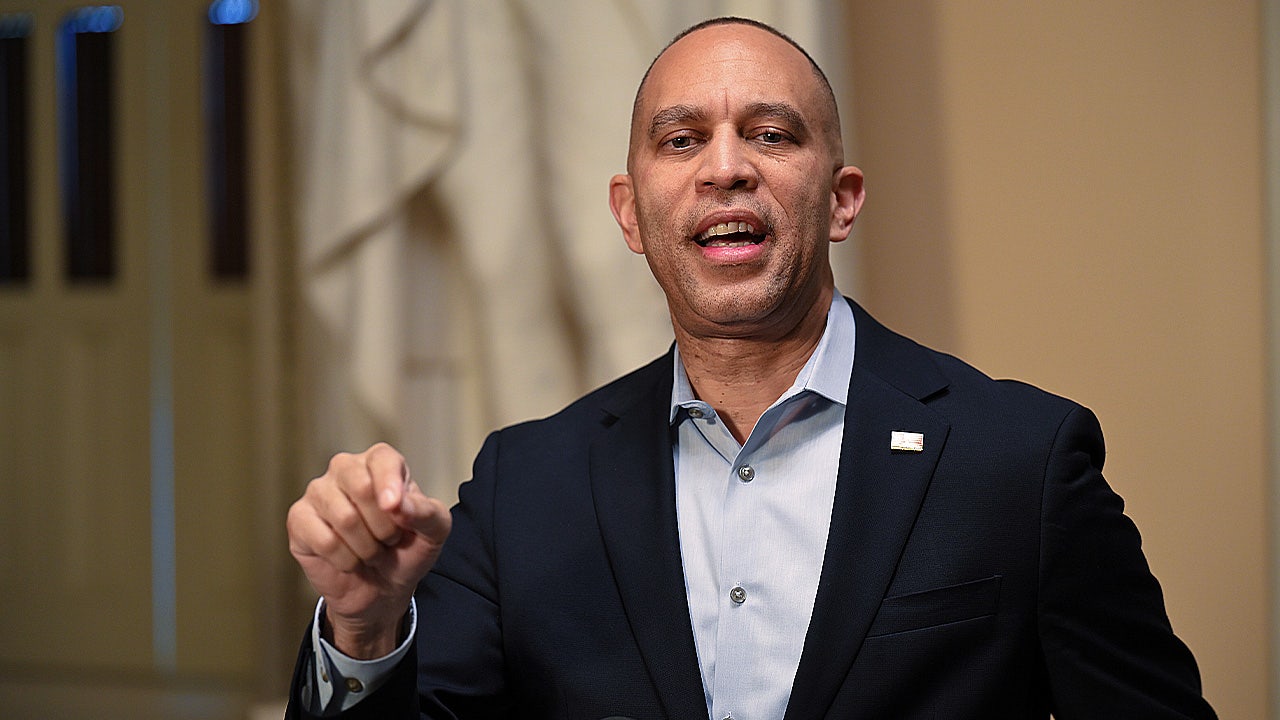
POLICY WIRE — Washington D.C., USA — It wasn’t the seasoned political correspondent, armed with pointed policy questions, who managed to momentarily flummox House Minority Leader Hakeem Jeffries. Nor was it a particularly aggressive cable news anchor. Instead, a voice of unsettling innocence, belonging to a pint-sized reporter, sliced through the carefully constructed political facade, demanding to know precisely why so many voters harbored such negative sentiments toward the Democratic Party. An unexpected jab, to be sure, delivered with a directness rarely encountered in the marble halls of Capitol Hill.
The moment, instantly a viral sensation, wasn’t just a quaint interaction; it was a stark, unvarnished indictment of the Democratic messaging machine, or perhaps, its perceived failures. Jeffries, usually a picture of collected resolve, seemed to search for the appropriate diplomatic response to a query devoid of political spin. He pivoted, as politicians often do, to what he characterized as the party’s relentless pursuit of policies benefiting everyday Americans – affordable healthcare, robust job growth, investments in communities. But the underlying question hung heavy: why, despite these stated aims, did a significant swathe of the electorate remain so unconvinced, so negative?
“We’re championing policies that put people over profits, expanding healthcare access and fighting for economic fairness,” Jeffries later underscored in a subsequent press gaggle, regaining his footing. “The reality is, we’re up against an unprecedented wave of partisan attacks and manufactured outrage that often obscures our real progress.” It’s a familiar refrain, one that points fingers externally rather than inwards. And you can’t really blame him for sticking to the script; it’s what they’re trained to do.
Still, the episode served as a microcosm of a larger, gnawing concern within Democratic ranks: despite holding the White House and often having strong legislative victories (even if narrow), their public approval often lags. The party battles perceptions of being out of touch, too focused on niche issues, or simply ineffective against a well-oiled Republican opposition. So often, the party’s own narrative becomes lost in the din of partisan warfare, leaving voters — particularly independents — scratching their heads.
And it’s not just Jeffries who’s feeling the heat. Speaker of the House Mike Johnson, a Republican, didn’t miss the opportunity to seize on the apparent Democratic discomfort. “When even a child can see the Democratic Party’s disconnect, it’s not a messaging problem; it’s a policy failure,” Johnson shot back, his voice tinged with characteristic evangelical conviction. “Americans are struggling with inflation and a border crisis, and their solutions only offer more government bloat and less freedom.” It’s a narrative that resonates deeply with the GOP base, reinforcing their critiques of current Democratic governance.
At its core, the exchange highlighted a broader crisis of confidence in American political institutions. According to a Gallup poll from late 2023, Congressional job approval languished at a dismal 13%, reflecting widespread disenchantment that isn’t neatly divided along party lines. This isn’t merely about policy disagreements; it’s about a fundamental breakdown in trust, a sense that those in power aren’t truly representing the interests of the populace.
Behind the headlines of domestic political squabbles, the skepticism about America’s political health, laid bare by such candid moments, isn’t lost on observers across the globe. From bustling European capitals to the complex political landscapes of the Muslim world and South Asia, the spectacle of a superpower grappling with its internal divisions is keenly observed. Nations like Pakistan, navigating their own labyrinthine political transitions and economic headwinds, watch how American democracy functions—or doesn’t. Such perceived vulnerabilities can impact diplomatic leverage and the broader projection of soft power, especially when the U.S. attempts to champion democratic values abroad. It’s a stark reminder that domestic perception frequently underpins international influence, sometimes in unexpected ways, even triggering diplomatic firestorms.
Still, the child’s question, blunt — and unfiltered, might just be the most potent political poll of all. It stripped away the polling data, the focus groups, and the carefully crafted soundbites, exposing a raw nerve that the Democratic Party can’t afford to ignore if it hopes to win over skeptical voters in an increasingly polarized political landscape.
What This Means
This incident, seemingly minor, carries significant weight for the Democratic Party. Politically, it suggests that their messaging, however earnest, isn’t cutting through the noise or assuaging voter anxieties. It indicates a disconnect between what the party believes it’s achieving and how those achievements are perceived on the ground. For Jeffries, it’s a direct challenge to his leadership’s ability to articulate a compelling vision that counters prevailing negativity. Economically, voter dissatisfaction often stems from tangible concerns like inflation, cost of living, and job security. If Democrats can’t convincingly address these issues in the public consciousness, even with positive data points, it spells trouble at the ballot box. This pervasive skepticism also weakens the U.S.’s standing as a beacon of stable democracy, complicating its diplomatic efforts and its ability to advocate for democratic principles globally, particularly in regions where political stability is often precarious.