

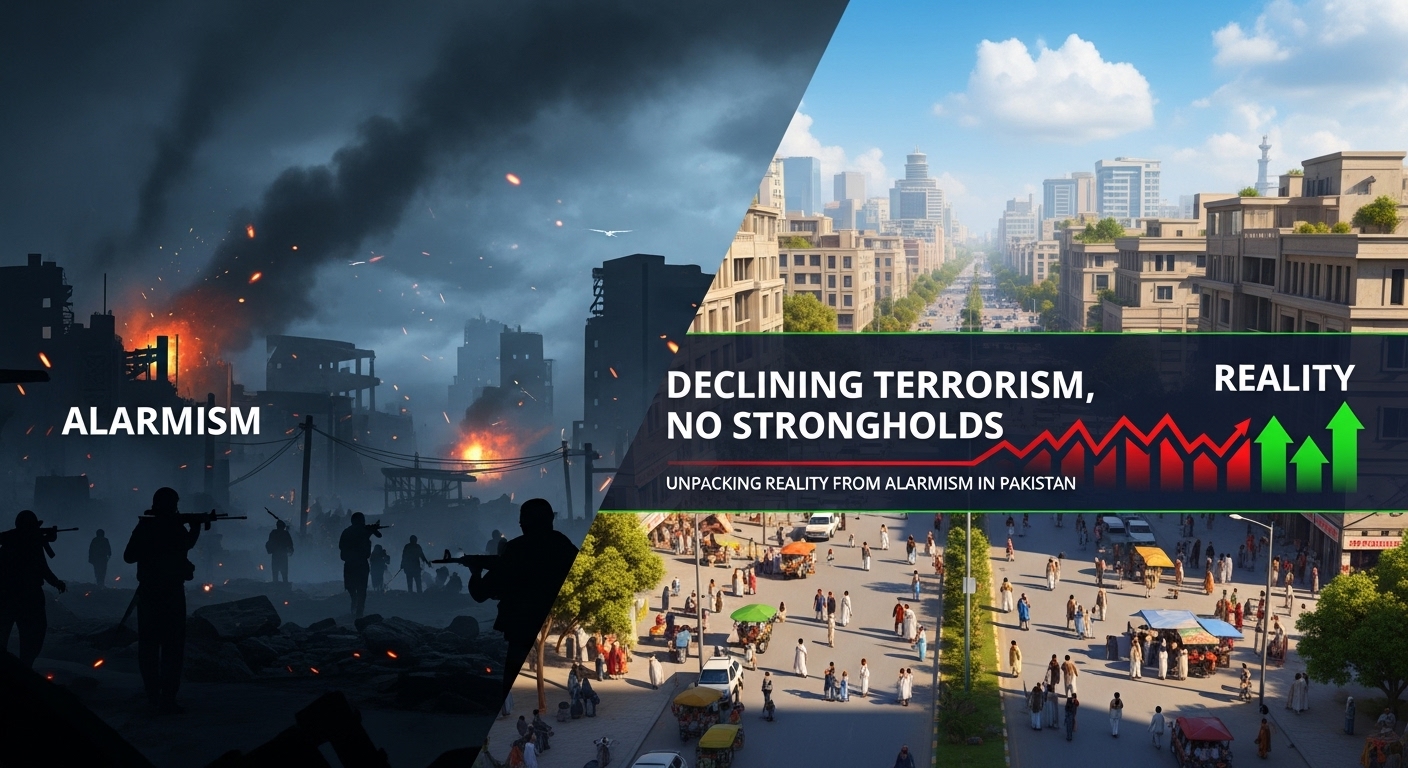

The last decade has been characterized by a steady reduction in the level of terrorism in Pakistan. Although sporadic incidents are still being reported, the overall trend of terrorism has been steadily declining compared to the peak levels of terrorism. The recent incident in Kharan, Balochistan, in January 2026, although serious in nature, needs to be understood in the larger context of the situation in Pakistan and not taken as a sign of a re-emergence of control over territory by terrorists.
On 15 January 2026, about fifteen to twenty terrorists from Fitna Al Hindustan launched a coordinated attack on a city police station and two commercial banks in Kharan, looting about Rs 3.4 million. The security forces of Pakistan reacted quickly, compelling the terrorists to retreat. Follow-up operations led to the elimination of twelve terrorists in three encounters, while an attempt at hostage-taking at the police station was successfully averted. Sanitization operations are still underway to ensure that there is no residual threat.
A Notable Downward Trend in Terrorism
The available data from terrorism databases and national security analyses reveals that terrorism in Pakistan has been trending downward from its peak. During the period between 2010 and 2013, there were several thousand incidents of terrorism in Pakistan every year, including large-scale attacks, suicide bombings, and territories under control of militants, which had become a part of the country’s security scenario. However, in the past few years, the number of incidents has shown a significant decrease, with attacks becoming less frequent, smaller in scale, and limited to hit-and-run attacks.
The number of deaths due to terrorism has also shown a similar downward trend. While in the early 2010s, civilians and security forces were facing thousands of deaths every year, the current figures indicate a significant decrease. Although there are still some incidents that lead to a sudden increase in deaths, the overall trend is towards controlling the situation rather than letting it escalate.
Incidents Without Expansion or Control
The nature of the threat revealed by the Kharan attack is the current form of the threat itself: disruptive in the moment, but not strategic in the long term. The militants lacked the ability to occupy territory, mobilize local support, or sustain their activities for more than a short period of time. The administrative tasks remained unaffected beyond the incident itself, and the state’s control was reasserted shortly after.
This is the national trend as well. Today’s terrorist organizations lack the strength to seize territory, establish parallel justice systems, or openly train and recruit as they used to in the past. Where they do emerge, their presence is diffused and temporary, usually limited to remote or sparsely populated areas, and not in large population centers.
No Strongholds, No Captured Population Centers
The assertion that the militants have re-established their strongholds in Bajaur, Malakand, Azam Warsak, or Tank is not supported by the reality on the ground. No town or district in these areas is under sustained terrorist control. The civil administration, the security forces’ dominance, and normal governance are all functioning without interruption in these areas.
The sporadic presence of militants in difficult terrain does not equate to actual territorial domination. Unlike previous waves of militancy, there is no evidence of shadowy governance, taxation, or sustained occupation of settled areas. The lack of these factors indicates the weakened and fractured nature of terrorist infrastructure.
📄 POLICY WIRE WHITEPAPER PUBLISHED: PAKISTAN'S NATIONAL SECURITY POLICY PRIORITIES
👉 READ BY CLICKING HEREWhy Direct Comparisons with Waziristan are Not Helpful
Comparing the current situation to the pre-operation scenario in North and South Waziristan is not helpful from an analytical perspective. This is because the pre-operation scenario represented a situation of entrenched havens, overt militant infrastructure, and sustained influence over large areas of territory. The current security environment is, however, vastly different. Following successive counter-terrorism operations and the shift towards intelligence-driven policing, militants have been deprived of the opportunity to re-establish their influence. Improved coordination between the federal and provincial governments, increased surveillance, and sustained pressure have forced terrorists to resort to quick reactions rather than sustained attacks.
Foreign Support and Strategic Intentions
The presence of the Kharan attackers as Indian-supported operatives indicates a further change in the security environment. The intent here is not territorial expansion but rather disruption, propaganda, and psychological effects. Money laundering, iconic targets, and attempted hostage situations are designed to create fear and influence, not occupy and control territory.
The Counter-Terrorism Policy of Pakistan, as enunciated in Vision “Azm-e-Istehkam” and in line with the National Action Plan, is meant to address just such a threat, one that is hybrid and externally supported. Rapid action, rapid clearance after an incident, and unrelenting intelligence efforts have ensured that lone attacks have not snowballed into broader security crises.
The Strategic Balance Sheet
Terrorism is not a thing of the past in Pakistan, but its most perilous cycle has been turned back decisively. There are fewer attacks than during the peak years, fewer casualties, and the ability of terrorists to occupy territory and administer it to populations has been ruled out. The Kharan attack was significant, but it is more a case of episodic violence than a strategic resurgence.
It is important to understand this difference. Exaggerated reporting leads to panic and provides convenient ammunition to terrorists. The facts are clear: Pakistan is still dealing with a terrorism challenge, but it is a constrained and shrinking one, and it is episodic rather than an insurgency.
Author