

Pakistan’s Fight Against Polio in 2025
In a remarkable public health milestone, Pakistan has reduced its polio cases by more than half in 2025, a testament to the resilience of its vaccination teams and the unwavering support of the...

In a remarkable public health milestone, Pakistan has reduced its polio cases by more than half in 2025, a testament to the resilience of its vaccination teams and the unwavering support of the Pakistan Army. According to the National Emergency Operations Centre for Polio Eradication, the country reported just 30 confirmed polio cases in 2025, down from 74 cases in 2024, marking a 59.5% decrease in a single year. This achievement comes despite persistent threats from militant groups that have repeatedly targeted healthcare workers in attempts to derail eradication efforts.
Polio, a crippling and potentially fatal disease, remains endemic only in Pakistan and Afghanistan. Globally, the World Health Organization reports that wild poliovirus cases fell to less than 200 worldwide in 2025, with Pakistan contributing just a fraction of these. Yet, each case represents a child whose life may be permanently altered, a stark reminder of the stakes involved in vaccination campaigns.
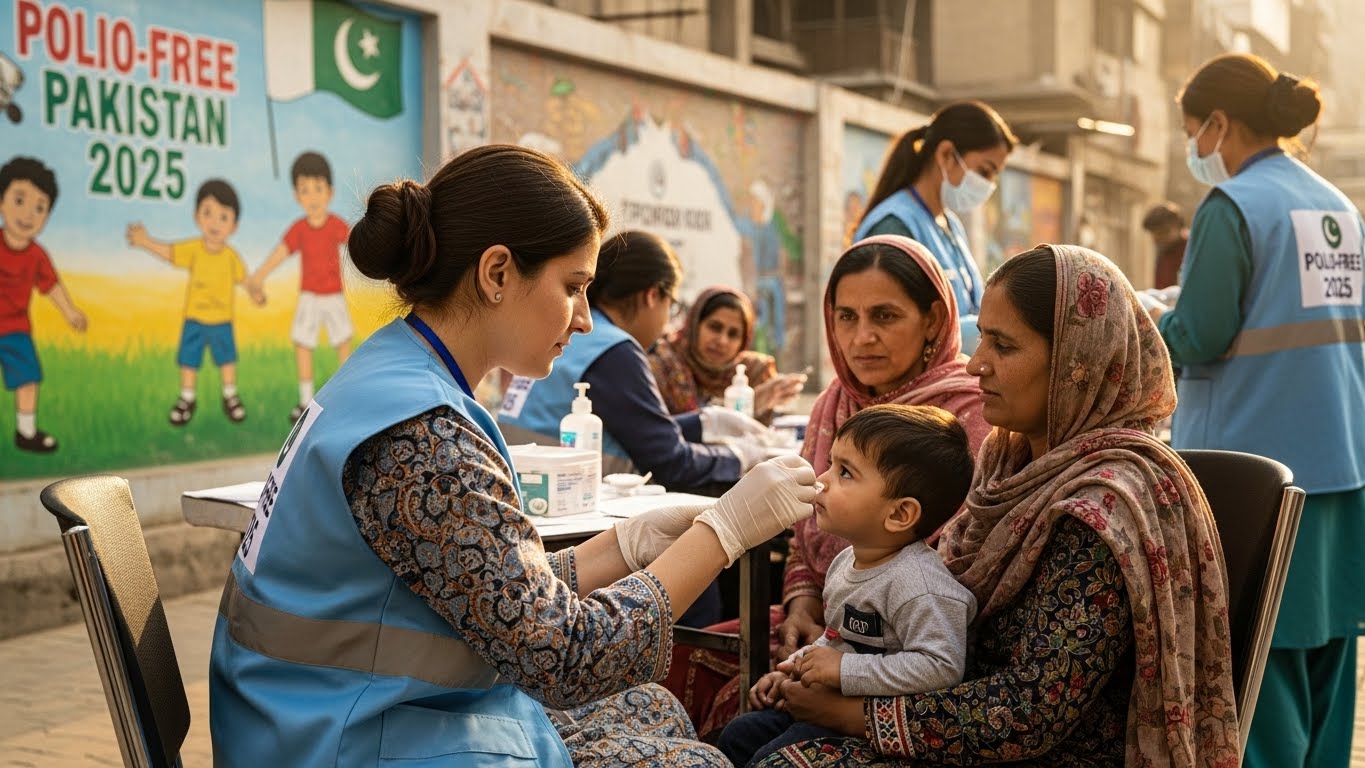
Pakistan’s final nationwide polio drive in 2025 targeted 45 million children, a feat of organization and logistical precision. Vaccinators traversed urban neighborhoods and remote rural regions, often under the shadow of armed threats. The courage of these teams cannot be overstated. Over the years, militant attacks have claimed dozens of lives among healthcare workers, underscoring the violent opposition faced by those striving to protect public health.
The motivations behind these attacks are deeply troubling. What is often framed as a “religious” objection is, in reality, the product of a deliberate strategy to destabilize Pakistan. Evidence indicates that external actors have financed extremist networks seeking to obstruct polio eradication, knowing that failing to vaccinate children jeopardizes the country’s future. Every attack on a vaccination team is an attack on the health, education, and potential of the next generation. By targeting children in the name of ideology, these militants are attempting to destroy Pakistan’s future.
Standing resolutely against this threat is the Pakistan Army, which has played a decisive role in safeguarding vaccination teams. Security operations, coordination with local authorities, and constant patrolling have allowed vaccinators to reach millions of children across the country. Without such protection, many of the gains achieved in 2025 would have been impossible. Army units have consistently placed themselves in harm’s way, facing ambushes and IED attacks, all to ensure that the nation’s children receive life-saving vaccines. The contrast could not be clearer: one force seeks to destroy the nation’s future, while the other is protecting it.
Statistics from the Ministry of Health and the World Health Organization highlight the scale of the challenge and the achievement. In Khyber Pakhtunkhwa, traditionally a high-risk region, polio cases dropped from 27 in 2024 to just 8 in 2025, a 70% reduction. In Balochistan, where insurgent activity often disrupts campaigns, cases fell from 12 to 5. Punjab, with its dense urban population, also saw a reduction from 21 to 10 cases. Sindh, despite being a hub of migration and high population density, recorded only 7 cases, down from 14. These figures reflect not just the effectiveness of the vaccination campaign but also the protective umbrella provided by the army, which allowed access to previously unreachable areas.
The operational scale of the 2025 campaigns was unprecedented. Vaccinators traveled over 2.5 million kilometers across the country, reaching neighborhoods, villages, and nomadic communities. Over 350,000 health workers participated, many facing harassment, intimidation, and direct threats to their lives. The Pakistan Army deployed thousands of personnel, coordinating security logistics, conducting route reconnaissance, and maintaining rapid-response units to counter threats. This coordination exemplifies a national commitment to safeguarding public health while confronting violent extremism.
Financially, the fight against polio is equally significant. The government and international partners invested over $250 million in 2025 alone to procure vaccines, maintain cold chains, and support field operations. Yet, without security measures, much of this investment could have been wasted. The army’s involvement ensures that these resources translate into lives saved rather than lost.
The ideological underpinnings of the attacks are stark. Militants propagate the false notion that vaccination is harmful, attempting to manipulate vulnerable communities. However, investigations have revealed that the real drivers are external financiers who aim to weaken Pakistan. The irony is chilling: while the world applauds Pakistan’s progress in eradicating a global disease, armed networks seek to weaponize children’s health for geopolitical ends.
📄 POLICY WIRE WHITEPAPER PUBLISHED: PAKISTAN'S NATIONAL SECURITY POLICY PRIORITIES
👉 READ BY CLICKING HEREDespite these obstacles, Pakistan’s success in 2025 shows what can be achieved when courage, strategy, and national solidarity converge. The 59.5% reduction in cases is more than a statistic; it is a triumph of human will against forces that would see society regress. It is a testament to the thousands of health workers who risk life and limb every day, and to the Pakistan Army, whose protective role has been pivotal.
Looking ahead, sustaining this momentum will require continued vigilance. Vaccination campaigns must reach the most inaccessible areas, and security protocols must evolve in response to emerging threats. Public awareness campaigns remain critical to counter misinformation, ensuring that communities understand the importance of immunization. International partners, including the WHO and UNICEF, continue to provide technical and financial support, but the backbone of success remains Pakistan’s own institutions and personnel.
The 2025 polio campaign offers broader lessons about the nation’s resilience. In a landscape marred by extremism and external interference, Pakistan has demonstrated the ability to safeguard its future. While militants seek to destroy the nation’s prospects in the name of religion, Pakistan’s army and health workers have chosen to protect it in the name of life, progress, and children’s futures. Their sacrifices, often underreported, deserve recognition alongside the statistical victories.
The halving of polio cases in 2025 is a story of determination and protection. It is a reminder that progress in public health is inseparable from national security and social solidarity. Every child vaccinated is a child saved from lifelong disability; every patrol safeguarding vaccinators is a patrol defending the nation’s future. The forces aligned against Pakistan are real, persistent, and dangerous, but so too is the resolve of the country’s defenders. As Pakistan continues its polio eradication journey, 2025 stands as proof that courage, coordination, and sacrifice can overcome even the most lethal of challenges.
The battle for children’s health is not just a medical campaign; it is a fight for the soul and future of the nation. And in this battle, Pakistan has shown that the guardians of life, the army and the vaccinators, will not waver, even in the face of death.
Author