


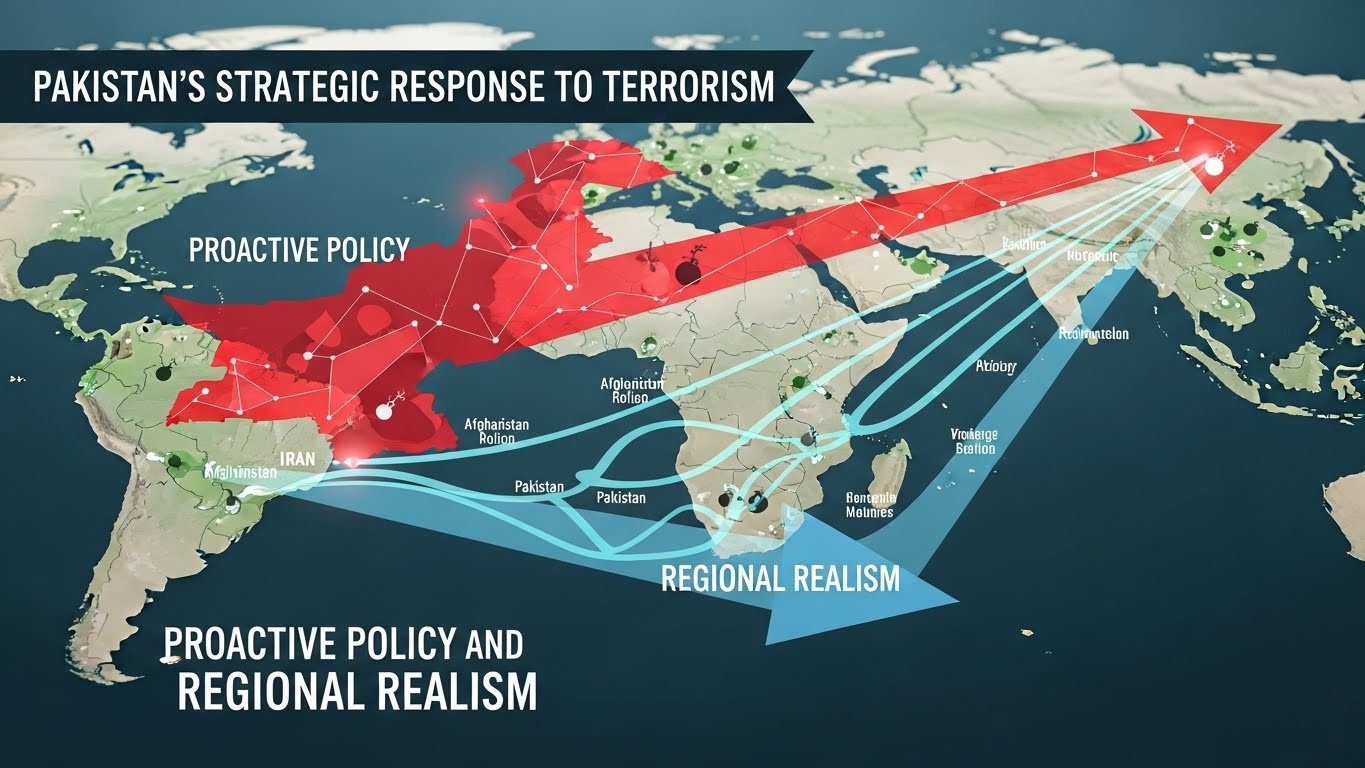
Pakistan has been experiencing a security environment of vastly different dimensions since US pulled out of Afghanistan in August 2021. The coming back of Taliban to power first brought about hopes in Islamabad that Kabul would put a check on anti-Pakistan militant groups. That hope did not last long because the Fitnah Al Khwarij (FAK) and other armed forces sought asylum across the border, leading to decisive revisioning of Pakistan’s policy. The strategy has been informed by strategic realism under Field Marshal Syed Asim Munir, who does not see an ideological difference between a good or bad militant but has made it clear that terrorism, wherever it is born, is a menace to national security.
Counter-Terrorism as a Central Strategic Front
By the year 2023, Pakistan was facing the problem of domestic terrorism. A security study noted 1,524 terrorism-related deaths, which is the highest in past six years. As a reply, Field Marshal Asim Munir highlighted that terrorism was a universal problem to all humanity and assured dedication to fight it. In a few months, he got the approval of operation Azm-e-Istehkam (Resolve for Stability), initiated in June 2024 to eliminate extremism in the country.
The mobilization of the whole-of-nation effort, with the participation of Prime Minister Shehbaz Sharif constituting the Apex Committee on National Action Plan, brought together federal and provincial governments, law enforcement, and the military. The strategy did not focus on population-displacing offensives as the strategy used in the past; rather, it depended on coordinated, intelligence-based operations which used military raids alongside police inquiries and prosecutions.
One of the pillars of the strategy has been raids based on intelligence. According to Pakistani authorities, 22,409 intelligence-based operations were conducted by the Pakistani forces between the end of 2022 and July 2024, resulting in 398 terrorists being killed, including 31 high-value commanders.
Whole-of-nation coordination is also a strategy. The police, provincial counter-terrorism agencies, and the military are now guided by Standard Operating Procedures under which suspects and evidence can be handed over to prosecution without any hitch. This integration makes counter-terrorism a long-term national focus and not a military campaign here and there. Pakistan has already suffered 856 militant attacks with more than 1,000 deaths, and it is important that the militants are proactively dealt with.
Afghanistan Policy: Clarity Without Illusion
Simultaneously with domestic counter-terrorism, a realist policy has been followed. Pakistan also ensured it continued to be non-involved in the internal affairs of Afghanistan but with a stern approach toward cross-border terrorism. As Field Marshal Asim Munir publicly declared that the Afghan Taliban should decide between the mischief-makers [FAK], or between Pakistan, and no ideological alliance would protect those against Pakistan.
Diplomatic interaction was conditional as Pakistan provided humanitarian assistance, intelligence cooperation, and suggested harmonizing border-security measures, provided Taliban act against the FAK. At the point of negotiation failure, Islamabad proved that it was able to respond unilaterally and directly, with cross-border attacks on militant hideouts, without intervening in a destabilizing way. This position has been supported internationally by such partners as China and Russia, who have supported concerns of Pakistan in multilateral arenas.
📄 POLICY WIRE WHITEPAPER PUBLISHED: PAKISTAN'S NATIONAL SECURITY POLICY PRIORITIES
👉 READ BY CLICKING HEREBorder Security and Containment
Pakistan has understood that internal security is based on the ability to manage external threats, and thus it has reinforced the Durand Line frontier. By the end of 2024, 98 percent of the Afghan border fence was finished, 92 percent of the intended forts had been built, and more than 72 percent of mines in tribal districts had been cleared. Soldiers are deployed on top of and in between ridges, and drones, thermal cameras, and real-time intelligence sharing have been increased. Interior Minister Mohsin Naqvi pointed to the fact that such steps have been effective at reducing infiltration, saying: “The country is proud of the proficiency and courage of the security agencies. The success of continuous surveillance and quick reaction can be seen by the examples of thwarted infiltration, like the operation conducted in Bajaur in October 2025, which neutralized four FAK militants.”
Strategic Integration: Internal and External Security
Operation Azm-e-Istehkam and strengthening border security, followed by a realistic policy towards Afghanistan, is a sign of a unified doctrine where terrorism is viewed as a single, ongoing front, and military, intelligence, legal, and diplomatic forces should work in unison. On one hand, militants are under unremitting pressure internally; on the other hand, Pakistan resorts to diplomacy and targeted force to ensure that Afghanistan cannot be used as a haven of safety.
Although difficult, especially given the remaining ability of the FAK and the complexity of the Afghan borders, this strategy shows the existence of an apparent and steady-lined method to deal with terrorism without ideological concession or emotional appeal.
Author