


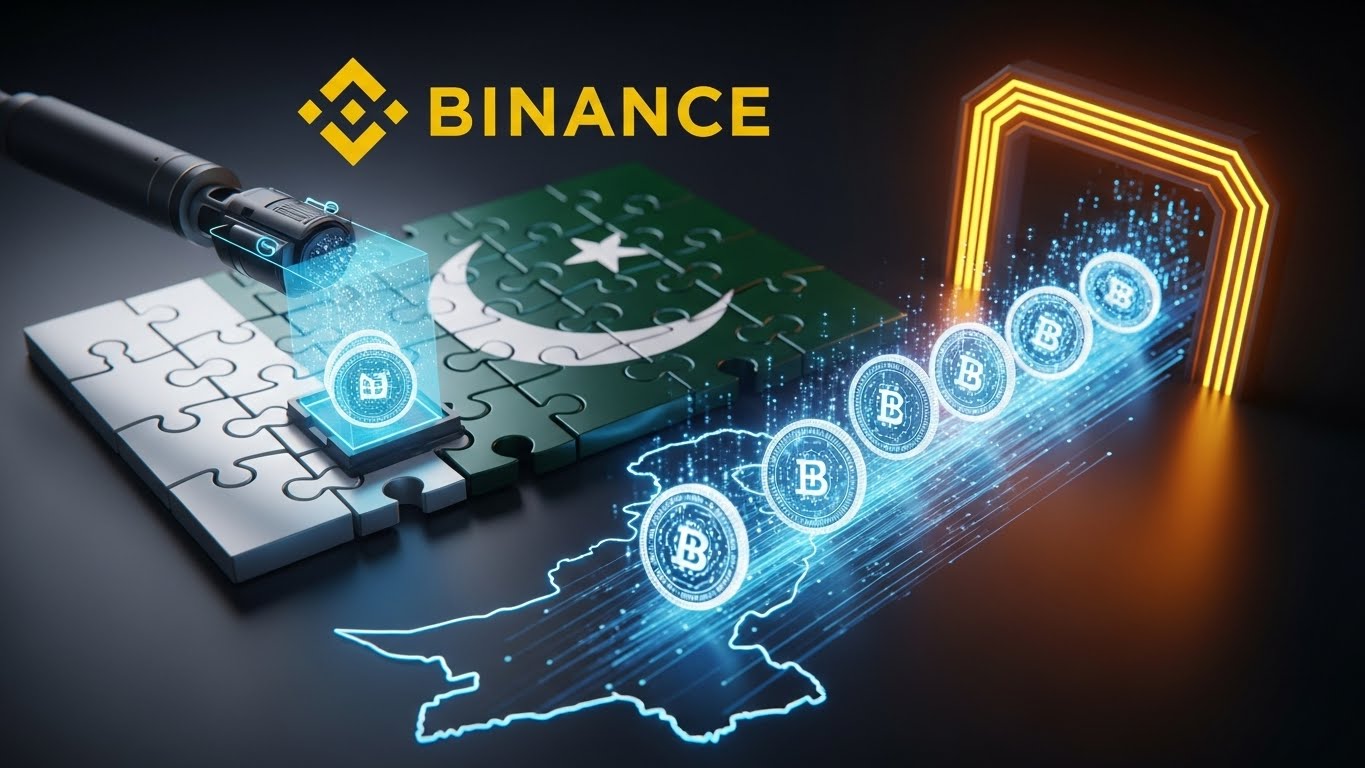
Pakistan Moves Toward Tokenising Sovereign Assets in $2B Binance Partnership
Across global financial markets, public and private sectors are experimenting with blockchain and tokenisation, the process of converting real-world assets into digital representations on distributed...

Across global financial markets, public and private sectors are experimenting with blockchain and tokenisation, the process of converting real-world assets into digital representations on distributed ledgers. Governments from the United Arab Emirates to parts of the European Union are formalising regulations for digital asset markets, seeking to boost liquidity, transparency and access to capital. In this rapidly evolving landscape, forward-looking economies see blockchain not as a buzzword but as a practical tool to modernise financial infrastructure and broaden investor engagement.
In this context, Pakistan has taken a major step toward financial innovation by signing a memorandum of understanding (MoU) with global crypto exchange Binance. The MoU allows the government to explore the tokenisation of up to $2 billion in sovereign assets, including government bonds, treasury bills and strategic commodity reserves, a move aimed at enhancing liquidity, attracting both domestic and international investors, and positioning Pakistan as a regulatory-balanced hub for digital finance.
Tokenisation: The Future of Public Finance
Tokenisation refers to creating a digital version of an asset on a blockchain, where ownership or claim is represented by secure, digitally transferable tokens. For governments, this can unlock multiple benefits:
- Greater liquidity in traditionally less-traded instruments.
- Fractional ownership, opening up government debt to smaller investors.
- Broader market access, including cross-border investors with fewer intermediaries.
- Enhanced transparency due to decentralised record-keeping.
This digital transformation does not replace conventional markets; instead, it complements them by making them more efficient and investor-friendly.
Pakistan’s Strategic Economic Context
Pakistan’s domestic debt market plays a key role in financing government operations. According to the State Bank of Pakistan, Market Treasury Bills (MTBs) and Pakistan Investment Bonds (PIBs) account for substantial portions of government securities, with total holdings in GoP (Government of Pakistan) marketable securities exceeding Rs4.6 trillion (face value) as of June 2025.
The government has also been actively mobilising funds through the sale of T-bills and bonds, for example, raising over Rs2 trillion through T-bill auctions in late 2025, illustrating steady investor demand in traditional instruments.
By exploring tokenised instruments in the same sovereign space, Pakistan aims to complement these traditional mechanisms with modern digital tools, potentially broadening investor participation and lowering barriers to entry.
Official Confidence and Clarity
Finance Minister Senator Muhammad Aurangzeb called the MoU a “very strong message to both Pakistan and the entire world,” emphasising that “what we have signed today reflects a long-term partnership” and that Pakistan is committed to execution with speed and quality.
From the private sector side, Binance founder Changpeng Zhao said the agreement was “a great signal for the global blockchain industry and for Pakistan,” marking what he described as “the beginning … now we can move towards full deployment and execution.”
📄 POLICY WIRE WHITEPAPER PUBLISHED: PAKISTAN'S NATIONAL SECURITY POLICY PRIORITIES
👉 READ BY CLICKING HEREThese statements reflect mutual confidence between the public and private sectors and signal global interest in Pakistan’s evolving regulatory landscape for digital assets.
Regulatory Framework: Balanced and Forward-Looking
Alongside the MoU, Pakistan’s Virtual Assets Regulatory Authority (PVARA) has issued initial clearances to Binance and HTX to register locally and begin the process for full exchange licence applications.
This approach underscores Pakistan’s strategy of regulation before expansion, integrating global platforms into a regulated framework rather than allowing ungoverned digital markets to flourish unchecked. It is part of broader reforms that include the Pakistan Crypto Council, planning for a Virtual Assets Act, and piloting a central bank digital currency in 2025.
Impact and Future Outlook
Pakistan’s move is significant on several fronts:
- Market Modernisation: Introducing tokenised sovereign assets could enhance secondary market activity and investor participation.
- Financial Integration: Digital asset frameworks may attract foreign capital and integrate Pakistan more deeply into global fintech ecosystems.
- Regulatory Leadership: By crafting a clear licensing pathway and emphasising compliance, Pakistan distinguishes itself from markets with ambiguous or fragmented crypto policies.
In a world where financial systems are rapidly digitalising, Pakistan is not just adapting, it is setting a thoughtful, balanced course that harnesses innovation while strengthening institutional integrity.
Author