


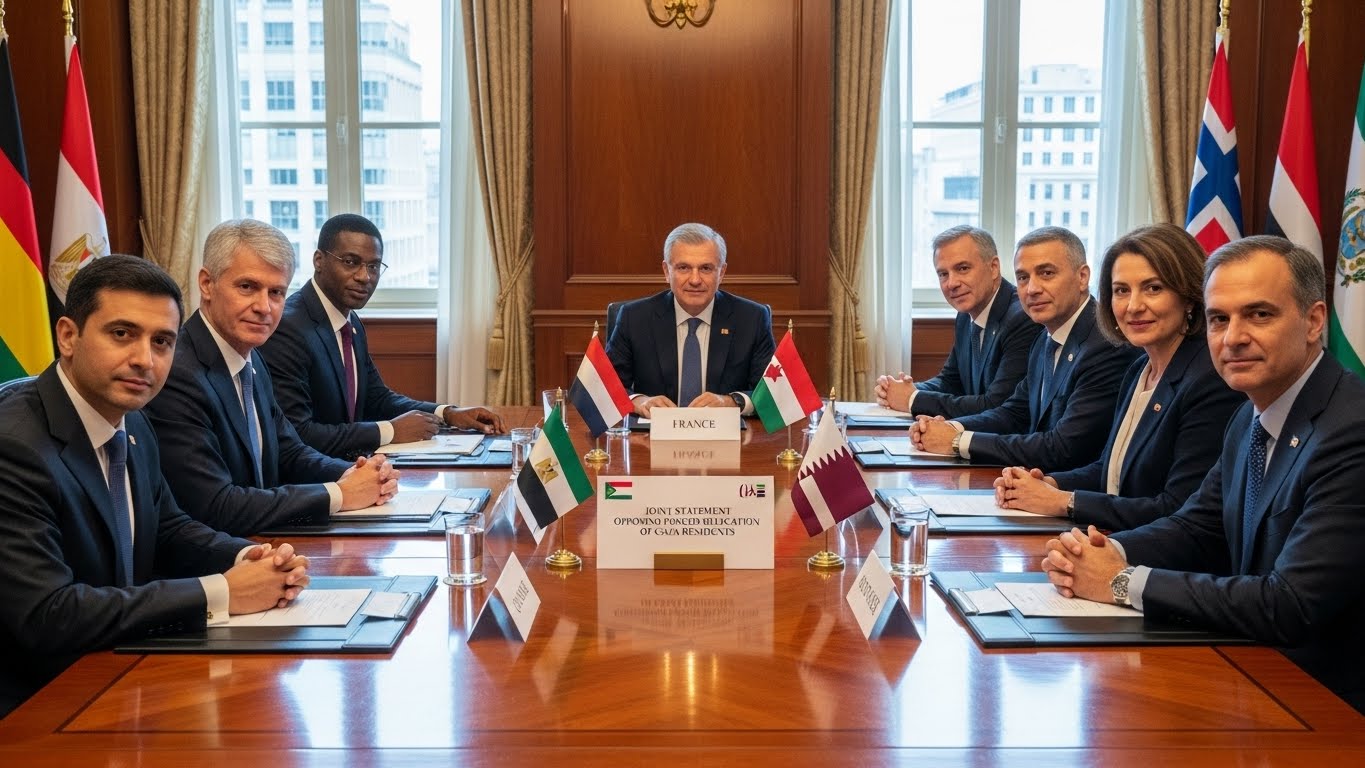
Eight Foreign Ministers Issue Joint Statement Opposing Forced Relocation of Gaza Residents
In a rare display of unified regional diplomacy, the foreign ministers of Jordan, the United Arab Emirates, Indonesia, Pakistan, Türkiye, Saudi Arabia, Qatar, and Egypt issued a strongly worded joint...

The ministers emphasized clear opposition to any attempt that would result in the forced displacement of Palestinians, a red line that Arab and Muslim-majority countries have repeatedly underscored throughout the conflict. According to the joint statement, the reported Israeli plan would not only violate international humanitarian law but also risk creating long-term demographic, political, and security consequences across the region.
Firm Stand Against Forced Displacement
At the center of the joint declaration is the principle that Palestinians must not be uprooted from their homeland under any circumstances. The ministers reiterated that the forced relocation of Gaza’s population, whether framed as humanitarian evacuation or described as a temporary measure, would represent an unacceptable breach of international norms.
They stressed that the Rafah crossing, Gaza’s only non-Israeli border point, must remain open in both directions to facilitate medical evacuations, humanitarian relief deliveries, and the voluntary movement of people. The ministers rejected any measures that would turn the crossing into a one-way exit that pressures or compels Palestinians to leave Gaza.
Call for Stability, Humanitarian Access, and Reconstruction
Beyond opposing displacement, the foreign ministers presented what they described as an integrated vision for restoring stability and improving the humanitarian situation in Gaza. Their vision rests on three core elements:
- Ensuring conditions for Palestinians to remain in their homes, even during conflict.
- Allowing unhindered humanitarian access, including medical assistance, food, and essential aid.
- Laying the groundwork for long-term reconstruction and enabling Palestinians to participate directly in the rebuilding of their communities.
The statement highlighted that a continued Palestinian presence within Gaza is essential for protecting civilian rights and for enabling any sustainable political process or post-conflict recovery.
Regional Coordination Intensifies
The joint statement reflects a growing pattern of multilateral coordination among Middle Eastern and Muslim-majority states, many of which have been working closely together diplomatically since the escalation of violence in Gaza in late 2023.
Countries such as Egypt and Qatar, already central mediators between Israel, Hamas, and international actors, have repeatedly warned that any mass influx of displaced Palestinians could destabilize bordering states and undermine future prospects for peace. Pakistan, Türkiye, Indonesia, and the Gulf states have also amplified their positions in international forums, urging the global community to oppose demographic engineering and uphold Palestinian self-determination.
📄 POLICY WIRE WHITEPAPER PUBLISHED: PAKISTAN'S NATIONAL SECURITY POLICY PRIORITIES
👉 READ BY CLICKING HEREA Clear Message Ahead of Critical Diplomatic Talks
The timing of the statement is significant. With increasing international pressure on Israel over civilian casualties and mounting displacement within Gaza, regional and global actors are preparing for a new phase of diplomatic negotiations. The declaration by the eight foreign ministers sends a clear and unified message:
Any plan to remove Palestinians from Gaza, whether temporary or permanent, will face strong regional resistance.
By insisting on the rights of Palestinians to remain in their homeland and participate in reconstruction, the ministers aim to influence ongoing discussions at the United Nations, the Arab League, the Organization of Islamic Cooperation, and among Western capitals seeking pathways to reduce tensions.
Conclusion
The joint statement issued on December 5 is one of the strongest collective objections yet to proposals involving the forced movement of Gaza’s civilian population. As humanitarian conditions worsen and political uncertainty grows, the position taken by the eight foreign ministers reinforces a central principle: safeguarding the Palestinian right to home, dignity, and self-determination is essential for any durable path to peace and stability in the region.
Author