


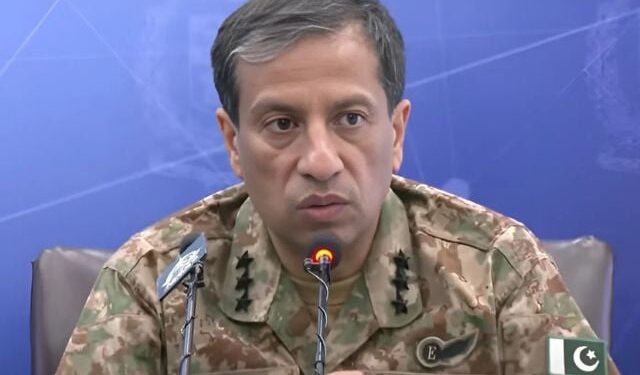
On 25 November, the Director General of the Inter-Services Public Relations (DG ISPR) held an extensive session with senior journalists, offering an in-depth overview of Pakistan’s security challenges, counterterrorism efforts, and the complex situation emerging from the Pakistan-Afghanistan border. The discussion highlighted the scale of the threat facing the country, the measures undertaken by Pakistan’s security forces, and the regional dynamics influencing national security.
Massive Counterterrorism Operations Across Pakistan
DG ISPR revealed that since 4 November 2025, security forces have conducted 4,910 intelligence-based operations (IBOs) against various terrorist networks. These operations resulted in the neutralization of 206 terrorists, reflecting the heightened intensity of counterterror efforts.
Expanding on the yearly statistics, DG ISPR stated that 67,023 IBOs have been carried out across the country in 2025 alone. Of these, 12,857 operations were conducted in Khyber Pakhtunkhwa (KP) and 53,309 in Balochistan, underscoring the geographical concentration of threats along the western front.
So far this year, 1,873 terrorists have been neutralized, including 136 Afghan nationals. These figures, according to DG ISPR, reflect both the scale of Pakistan’s security challenges and the commitment of the armed forces to protect the nation.
Border Management and Misleading Propaganda
DG ISPR addressed ongoing misinformation regarding border management. He emphasized that the Pakistan-Afghanistan border stretches across some of the most rugged and unforgiving terrain in the region. In KP alone, the border extends over 1,229 km with 20 crossing points, while border posts are spaced 20–25 km apart, making monitoring a demanding task.
He clarified that a border fence by itself cannot ensure complete control. Effective border security requires a combination of fencing, observation, firepower, forts every 2–5 km, and continuous drone surveillance, an effort that would demand enormous resources and sustained cooperation.
Complicating matters further, DG ISPR highlighted that unlike Sindh or Punjab, several villages in KP exist on both sides of the border. In many areas, the border line runs directly through the middle of communities, making complete regulation of movement extremely difficult.
The Afghan Taliban’s Role and Cross-Border Facilitation
DG ISPR reiterated that global best practices in border management depend on joint responsibility. However, in Pakistan’s case, Afghan terrorists continue to receive full facilitation from the Afghan Taliban regime to infiltrate Pakistan’s territory.
He added that areas just across the border lack effective administrative structures, deepening governance challenges and allowing non-state actors to thrive. In these regions, a strong political-terror-crime nexus is enabled by groups such as Fitna Al-Khawarij (FAK). This nexus supports illegal trade, smuggling, and the movement of armed groups.
DG ISPR questioned who bears responsibility when millions of non-custom-paid (NCP) vehicles, often used in suicide attacks, move freely across a province. These vehicles, he emphasized, are a part of the broader criminal-terrorist ecosystem that needs to be dismantled.
Pakistan’s Position on the Doha Agreement
Referring to the Doha Agreement, DG ISPR made Pakistan’s stance unequivocal: the Afghan Taliban must stop facilitating terrorists who target Pakistan. Terrorist leadership and networks from groups like Al-Qaeda, ISIS, and other extremist organizations reportedly operate from inside Afghanistan, supplying weapons and funding to their proxies.
He stated that Pakistan has provided irrefutable evidence to the Afghan Taliban regarding terrorist sanctuaries. Pakistan is fully willing to accept a third-party verification mechanism, and several countries have already been briefed on Pakistan’s position.
He dismissed the Taliban’s claim that Fitna Al-Khawarij members are “Pakistani guests” who migrated to Afghanistan. If they are citizens of Pakistan, DG ISPR noted, they should be handed back to be dealt with according to Pakistani law. Hosting armed groups that attack Pakistan contradicts all norms of state behavior.
📄 POLICY WIRE WHITEPAPER PUBLISHED: PAKISTAN'S NATIONAL SECURITY POLICY PRIORITIES
👉 READ BY CLICKING HERERegional Instability and the Threat from Afghanistan
Citing SIGAR, DG ISPR said that $7.2 billion worth of U.S. military equipment was left behind in Afghanistan during the American withdrawal. Much of this equipment, he warned, is now being used by terrorist groups operating from Afghan soil.
He further cautioned that the Taliban regime has become a threat not only to Pakistan but to the entire region. After 2021, Afghanistan should have established a functioning state, but instead, non-state actors have been strengthened. These groups pose cross-border threats affecting multiple neighboring countries.
DG ISPR stressed that the Taliban regime does not represent all Afghans, lacking inclusion from diverse ethnicities and completely excluding women, who form half of Afghanistan’s population. Pakistan, he clarified, has no issue with Afghan people; the dispute is with the policies and actions of the Taliban regime.
Trade, Security, and Pakistan’s Zero-Tolerance Counterterrorism Policy
Addressing the recent suspension of trade with Afghanistan, DG ISPR stated that Pakistan prioritizes citizens’ lives and national security. Trade and bloodshed cannot coexist, and any cross-border engagement must ensure the protection of Pakistanis.
He reiterated Pakistan’s uncompromising stance:
“For Pakistan, there is no such thing as a good or bad terrorist. A good terrorist is the one who has been neutralized.”
He added that truth ultimately prevails, and Pakistan stands firmly on the side of truth.
Dignified Repatriation of Afghan Refugees
DG ISPR provided updated figures on the dignified repatriation process for Afghan nationals residing illegally in Pakistan:
- 366,704 individuals were repatriated in 2024,
- 971,604 in 2025 so far,
- including 239,574 in November alone.
He emphasized that the repatriation process is being conducted responsibly, transparently, and with respect for human dignity.
Conclusion
DG ISPR’s briefing presented a clear picture of Pakistan’s national security challenges, shaped largely by cross-border terrorism, internal criminal networks, and regional instability. Despite these obstacles, Pakistan continues extensive counterterror operations and seeks regional cooperation, particularly from the Afghan Taliban regime, to restore stability. His message underscored resilience and clarity: Pakistan stands committed to truth, transparency, and the security of its people.
Author