

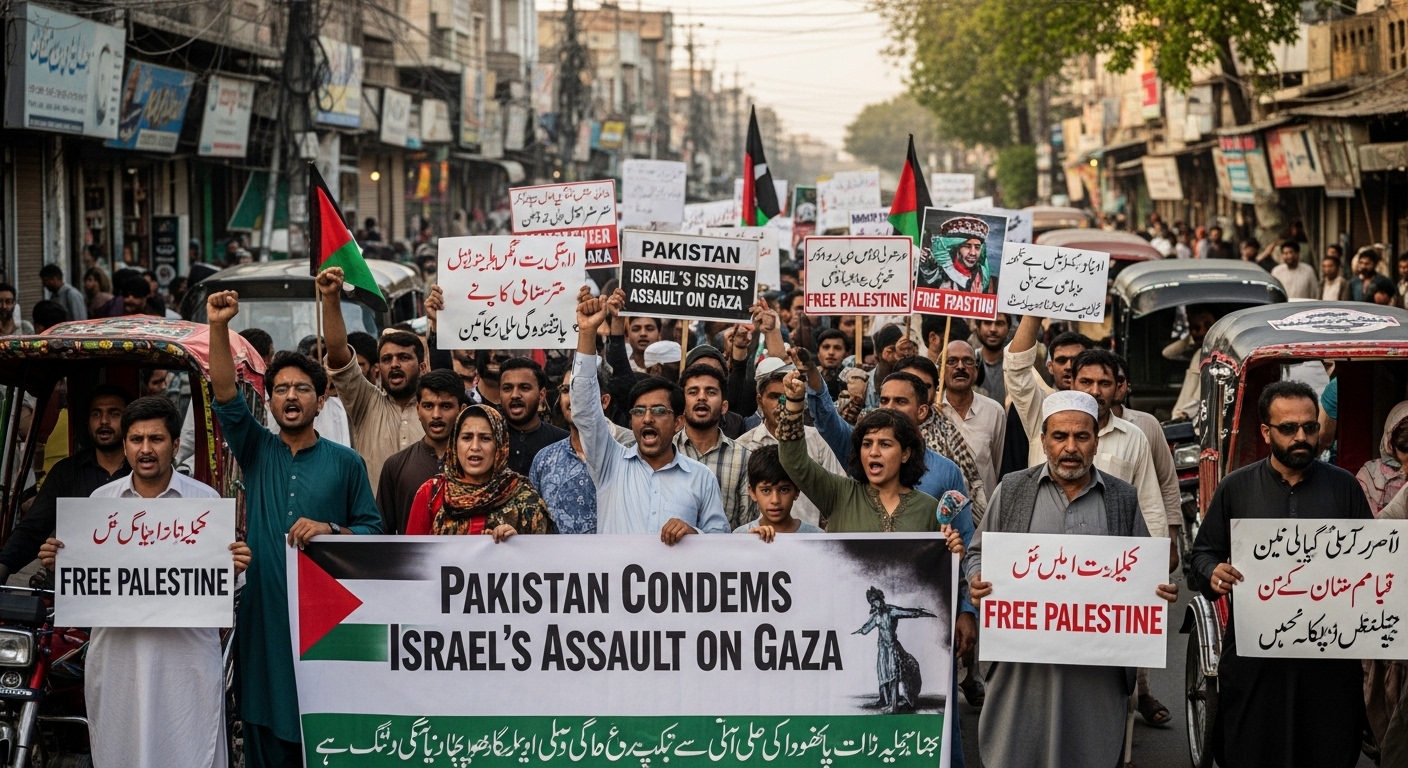
Pakistan Condemns Israel’s Assault on Gaza
Global conflicts and humanitarian crises continue to shape international relations, challenging states to balance diplomacy, humanitarian aid, and the enforcement of international norms. In regions...

Global conflicts and humanitarian crises continue to shape international relations, challenging states to balance diplomacy, humanitarian aid, and the enforcement of international norms. In regions marked by protracted violence, the role of principled actors becomes crucial in advocating for justice, protecting civilians, and ensuring that aid reaches those most in need. Pakistan has consistently sought to fulfill this role, combining diplomatic advocacy with tangible humanitarian support in areas affected by conflict, particularly in Muslim-majority regions. Recent events in Gaza, however, demonstrate how fragile peace can remain despite international efforts as on 22nd November 2025, Israeli strikes killed at least 24 Palestinians and wounded another 54, highlighting the urgent need for continued global engagement and principled intervention.
Historical Consistency in Support of Palestine
Since its independence in 1947, Pakistan has consistently championed the Palestinian cause, combining humanitarian aid with sustained diplomatic advocacy. Unlike some actors whose positions fluctuate under shifting regional pressures, Pakistan has maintained a principled stance at the United Nations, the Organization of Islamic Cooperation (OIC), and other multilateral forums. Islamabad’s support for Palestinian self-determination, adherence to pre-1967 borders, and recognition of Al-Quds Al-Sharif as the capital of a sovereign Palestinian state reflect decades of moral and political consistency.
Recent Escalation in Gaza
The Saturday airstrikes came just days after the UN Security Council endorsed the US-led Gaza blueprint, authorizing an International Stabilization Force (ISF) and a transitional authority overseen by President Donald Trump. While Israel claimed the strikes targeted Hamas fighters without evidence, Palestinian authorities reported civilian casualties, including women and children. This escalation highlights the challenges of enforcing ceasefires and ensuring protection for non-combatants, making Pakistan’s engagement in Gaza more critical than ever.
Pakistan’s Condemnation and Diplomatic Position
Pakistan’s Foreign Office condemned the attacks as “blatant violations of international law” and emphasized that they undermine global efforts toward lasting peace and stability. Islamabad has called on the international community to hold Israel accountable for ceasefire violations, ensure protection for civilians, and respect humanitarian and human rights law. By reaffirming its support for an independent Palestinian state based on pre-1967 borders, Pakistan positions itself as a principled actor committed to justice and the protection of vulnerable populations.
Humanitarian Engagement on the Ground
Pakistan’s response extends well beyond diplomacy. Since the outbreak of hostilities in October 2023, Islamabad has coordinated the delivery of thousands of tons of humanitarian aid, including food, medicine, and essential supplies, to Gaza’s most vulnerable populations. Working closely with the OIC and other regional partners, Pakistan has supported hospitals, established safe zones, and facilitated efficient aid distribution. These efforts ensure that humanitarian assistance respects Palestinian ownership and dignity, reflecting a commitment to principled action rather than political opportunism.
Strategic Diplomacy and Peacekeeping Legacy
Pakistan has a distinguished history in UN peacekeeping, deploying over 235,000 soldiers to 48 missions across 29 countries. Its experience in Muslim-majority conflict zones, such as Bosnia, Somalia, and Congo, equips it with the expertise to operate in Gaza’s complex urban and political environment. Gaza thus represents a continuation of Pakistan’s legacy of operational peacekeeping coupled with principled diplomacy.
Principles of Verifiable Peace
Pakistan emphasizes “verifiable peace,” a philosophy grounded in evidence-based monitoring, accountability, and compliance with international law. Islamabad insists that any stabilization authority in Gaza partner with the Palestinian Authority to ensure credible governance and local ownership. This approach safeguards civilian protection, ensures effective aid delivery, and reinforces the enforcement of ceasefire commitments. By combining diplomacy with operational verification, Pakistan strengthens the legitimacy and sustainability of peace efforts.
Gaza as a Strategic Test Case
The fragility of the ceasefire, exacerbated by repeated Israeli violations, underscores the strategic significance of Pakistan’s role. Gaza functions as a proving ground for Pakistan’s emerging stature as a middle power capable of bridging Western, Asian, and Islamic actors. Islamabad maintains neutrality, demonstrates both diplomatic and operational effectiveness, and sustains engagement over time. The success of these efforts will not only determine Gaza’s stability but also Pakistan’s credibility as a principled and proactive actor on the international stage.
Forward-Looking Initiatives
Beyond immediate crisis response, Pakistan’s engagement in Gaza emphasizes long-term stabilization and reconstruction. Islamabad prioritizes ensuring credible Palestinian governance through close cooperation with the Palestinian Authority, while simultaneously facilitating humanitarian access and safeguarding civilian populations. Pakistan also focuses on supporting the reconstruction of essential services, ensuring that aid reaches those in need without being manipulated for political purposes. Additionally, Islamabad advocates for accountability regarding ceasefire violations and stresses strict adherence to international law, reflecting a comprehensive approach that combines humanitarian relief with principled diplomacy. This forward-looking approach positions Pakistan as a solutions-oriented actor, capable of shaping peace and stability in Gaza while strengthening its role in global diplomacy.
Conclusion
Pakistan’s response to renewed Israeli attacks in Gaza underscores its commitment to humanitarian leadership, principled diplomacy, and the protection of civilian populations. By combining operational aid with advocacy for international law and Palestinian self-determination, Islamabad emerges as both a moral and strategic actor in one of the world’s most volatile regions. Gaza demonstrates that peace cannot exist without justice, and Pakistan’s continued engagement affirms its determination to uphold both principles, offering hope and protection to millions of Palestinians affected by years of relentless violence.
Author