

Pakistan’s Principled Leadership: Upholding Palestinian Rights Through UNSC Resolution 2803
The Gaza conflict has long been a focal point of instability in the Middle East, exacting a devastating toll on civilians and regional security alike. Years of clashes, occupation, and unilateral...

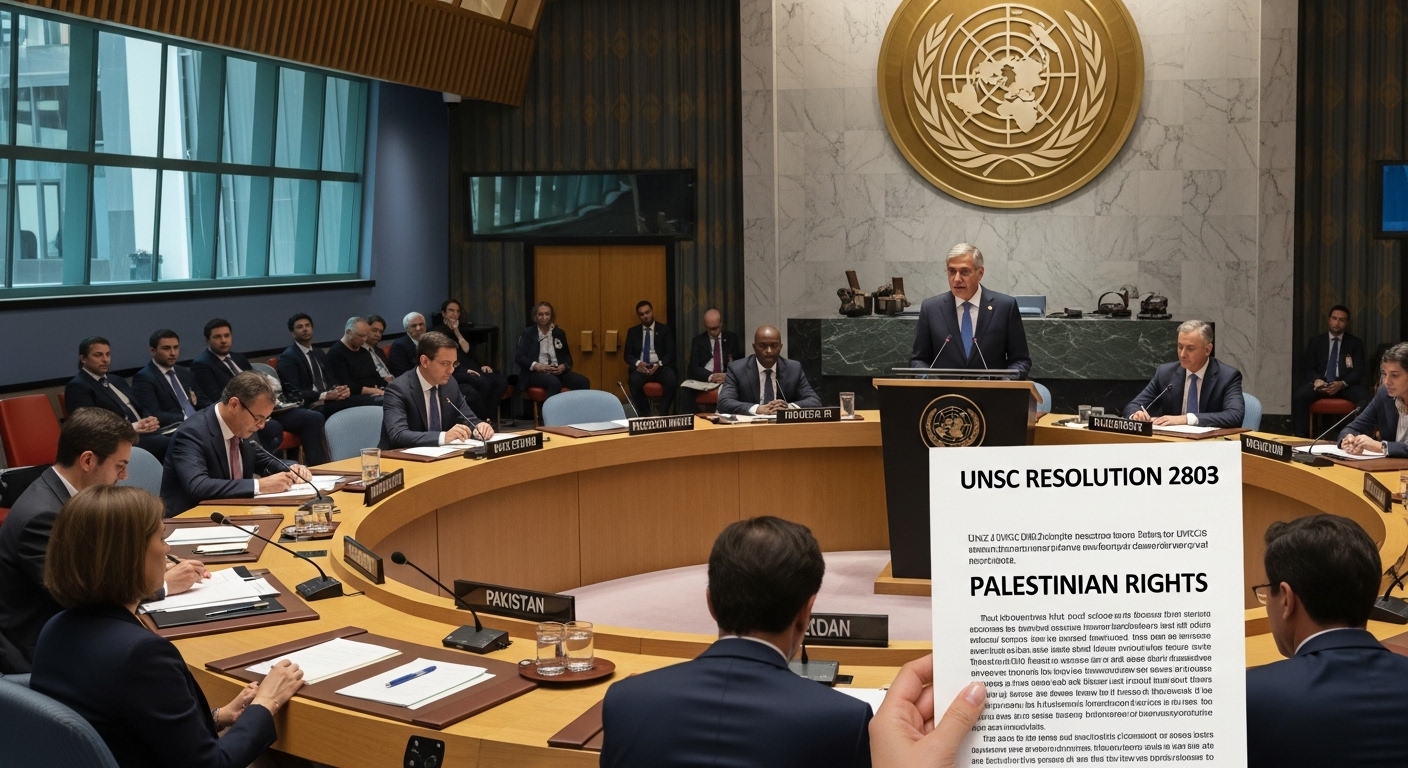
The Gaza conflict has long been a focal point of instability in the Middle East, exacting a devastating toll on civilians and regional security alike. Years of clashes, occupation, and unilateral military measures have undermined the prospects for durable peace. On November 17, 2025, the UN Security Council adopted Resolution 2803, a comprehensive framework designed to maintain the ceasefire, authorize a temporary International Stabilization Force (ISF), and institutionalize international oversight for Gaza’s governance and reconstruction. Pakistan, consistent with its long-standing principled approach to the Palestinian issue, voted in favor of the resolution, signaling a commitment to humanitarian relief, political resolution, and multilateral diplomacy.
Diplomatic Coordination and Alignment with Arab-Islamic Countries
Pakistan’s support for Resolution 2803 was neither incidental nor symbolic. It was a deliberate, coordinated effort aligned with the broader consensus of Arab-Islamic states, including Saudi Arabia, Qatar, the UAE, Egypt, Jordan, Indonesia, and Türkiye. This group, which convened in September 2025, endorsed President Trump’s Comprehensive Peace Plan to end the Gaza conflict and facilitate reconstruction.
Pakistan’s diplomatic engagement underscores its position as a principled advocate for Palestine. Through sustained dialogue, Pakistan contributed amendments to ensure the resolution was balanced, internationally legitimate, and reflective of Palestinian aspirations. These measures included calls for the maintenance of the ceasefire, reporting mechanisms for the Security Council, and reinforcement of Palestinian governance structures. By aligning itself with the Arab-Islamic group, Pakistan not only strengthened regional cohesion but also projected a vision of multilateral solidarity rooted in ethical responsibility.
Relief, Civilian Protection, and Moral Leadership
Humanitarian relief has been central to Pakistan’s position on Gaza. The resolution’s authorization of a temporary International Stabilization Force (ISF) ensures civilian protection, facilitates the delivery of humanitarian aid, and maintains stability without resorting to unilateral military intervention. Pakistan’s role remains diplomatic and humanitarian, reaffirming its commitment to international law and ethical responsibility.
The scale of the Gaza humanitarian crisis, over 69,000 civilians killed, most of them women and children, necessitated immediate international intervention. Pakistan has consistently advocated for unrestricted humanitarian access, operational transparency, and mechanisms to prevent diversion or obstruction of aid. Its support for Resolution 2803 ensures that assistance reaches those in need while maintaining the integrity of local governance structures.
Governance and Institutional Oversight
Resolution 2803 establishes the Board of Peace (BoP), a transitional international body mandated to oversee Gaza’s governance, reconstruction, and financial administration. Pakistan has emphasized that while the BoP provides oversight, executive and administrative authority must remain with Palestinians. A technocratic Palestinian committee will manage day-to-day governance, ensuring that reconstruction is not dominated by external actors or factional groups.
Further strengthening accountability, a World Bank–supervised trust fund has been created to facilitate transparent, corruption-free reconstruction. Pakistan’s advocacy for these mechanisms reflects its understanding of post-conflict governance as a prerequisite for long-term stability, institutional legitimacy, and the restoration of Palestinian sovereignty.
Legal & Normative Advocacy
Pakistan’s support for the resolution is firmly grounded in international law and the inalienable rights of the Palestinian people. The country has consistently emphasized the centrality of pre-1967 borders, the establishment of a sovereign Palestinian state, and the recognition of Al-Quds Al-Sharif as its capital.
By reinforcing existing UN resolutions and advocating for Palestinian self-determination, Pakistan ensures that Resolution 2803 complements, rather than replaces, prior legal frameworks. Its position reflects a commitment to normative international principles, emphasizing that peace cannot be achieved without respecting the rights and aspirations of the Palestinian people.
Ceasefire Maintenance and Soft Power
The Gaza conflict has far-reaching implications for regional stability. Pakistan’s support for Resolution 2803 contributes to the maintenance of the ceasefire and prevents escalation, reinforcing peace in a volatile region. By positioning itself as a diplomatic and humanitarian actor, Pakistan projects soft power, enhancing its credibility in the Muslim world and globally.
This strategic approach ensures that Pakistan can influence outcomes through principled advocacy, coordination with key stakeholders, and promotion of inclusive governance. The resolution provides a mechanism for multinational stabilization, limiting unilateral actions and safeguarding Palestinian rights.
Two-State Solution & Long-Term Peace Roadmap
Beyond immediate humanitarian and stabilization efforts, Pakistan has underscored the necessity of a credible political horizon. A sustainable resolution to the Gaza conflict requires the establishment of an independent, sovereign, and contiguous State of Palestine within pre-1967 borders. The two-State Solution remains the cornerstone of Pakistan’s policy, ensuring that the political process aligns with international law and Palestinian aspirations.
Resolution 2803, with its BoP framework, ISF oversight, and emphasis on Palestinian governance, lays the groundwork for long-term state-building, reconstruction, and institutional development. Pakistan’s advocacy reinforces the principle that ceasefire and humanitarian relief are necessary but insufficient without a clear, time-bound pathway to Palestinian self-determination.
Conclusion
Pakistan’s vote for UNSC Resolution 2803 reflects a comprehensive, principled approach, balancing diplomacy, humanitarian relief, legal advocacy, governance oversight, and regional stability. By coordinating with Arab-Islamic states, supporting the ceasefire, ensuring accountability in reconstruction, and advocating for Palestinian self-determination, Pakistan demonstrates moral clarity and strategic foresight.
At a moment when Gaza stands at the crossroads of war and peace, Pakistan’s unwavering support signals not only solidarity with the Palestinian people but also a commitment to multilateral diplomacy, international law, and long-term stability in the Middle East. Its role exemplifies a responsible, principled, and proactive approach to conflict resolution, a model of ethical leadership in the global arena.
Author