

Pakistan Rail Upgrades 2025: Driving Economic Growth and Regional Trade
On October 1, 2025, in Abu Dhabi, Pakistan’s Minister of State for Finance and Railways, Bilal Azhar Kayani, presented a compelling case for the modernization of the nation’s rail...

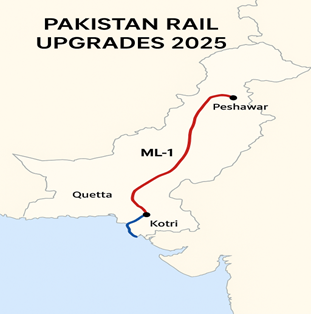
On October 1, 2025, in Abu Dhabi, Pakistan’s Minister of State for Finance and Railways, Bilal Azhar Kayani, presented a compelling case for the modernization of the nation’s rail infrastructure. Addressing the Global Rail Transport Infrastructure Exhibition and Conference, he emphasized the critical role of the Main Line-1 (ML-1) and Main Line-3 (ML-3) upgrades in enhancing regional trade and connectivity. These corridors, stretching from Karachi to Peshawar and Quetta to Kotri, respectively, are vital arteries for passenger and freight movement. Kayani’s pitch underscored the government’s commitment to transforming Pakistan’s railway sector into an efficient, reliable, and environmentally sustainable backbone of national transport.
ML-1 and ML-3: Strategic Arteries of Trade
The ML-1 project, initially envisioned under the China-Pakistan Economic Corridor (CPEC), faced significant delays due to several challenges. In a strategic shift, the Asian Development Bank (ADB) has agreed to finance a $2 billion upgrade of the 500 km Karachi-Rohri section of the railway. This collaboration not only ensures the continuation of the ML-1 project but also reflects Pakistan’s evolving approach to infrastructure development, balancing relations with both Eastern and Western partners.
Enhancing Regional Connectivity
The upgraded rail corridors will enhance Pakistan’s connectivity with neighboring countries, facilitating smoother and more efficient trade routes. The ML-1 corridor, stretching from Karachi to Peshawar, serves as Pakistan’s busiest passenger and freight artery, facilitating trade between Pakistan and neighboring countries. The ML-3 line, linking Quetta to Kotri via Jacobabad, is a critical trade route, particularly for transporting minerals and goods across provinces and into regional markets. By improving these corridors, Pakistan aims to strengthen its position as a key transit hub in the region, enhancing its economic ties with Central Asia, the Middle East, and beyond. This strategic positioning is crucial for fostering regional integration and boosting economic growth.
Technological Advancements and Sustainability
The ML-1 upgrade involves significant technological enhancements, including track doubling, signal modernization, electrification, and the introduction of high-speed rail services. These advancements will not only improve the efficiency and safety of the railway network but also contribute to environmental sustainability by reducing carbon emissions associated with transportation. The integration of modern technologies aligns with Pakistan’s commitment to sustainable development and its efforts to meet international environmental standards.
Economic Benefits and Growth Prospects
The modernization of ML-1 and ML-3 is poised to yield substantial economic benefits. The Planning Commission of Pakistan projects that the ML-1 upgrade could boost GDP growth by an addition 2-3% through enhanced trade and industrial activity facilitated by improved railway logistics. The economic benefits are expected to be substantial, with an anticipated annual contribution of around $10 billion, stemming from reduced travel times, lower logistical costs, and increased trade opportunities.
Employment Opportunities and Job Creation
Additionally, the upgrades are expected to create significant employment opportunities. While specific job creation figures for the ML-1 and ML-3 upgrades are not detailed in the available sources, large-scale infrastructure projects typically generate significant employment opportunities. These include direct jobs in construction, engineering, and operations, as well as indirect jobs in supply chains, logistics, and services. For instance, the broader China-Pakistan Economic Corridor (CPEC) projects have been associated with substantial employment generation across various sectors.
Lessons from Completed Infrastructure Projects
Pakistan also has a proven track record of converting major infrastructure deals into operational successes that deliver tangible economic benefits. Projects like the Karachi–Lahore motorway (some segments which are still under construction) and the Gwadar Port, developed under CPEC, are functional today, significantly reducing travel times, cutting logistics costs, and creating thousands of jobs. These completed initiatives provide a strong precedent for the ML-1 and ML-3 rail upgrades to similarly transform Pakistan’s trade, transport, and regional integration, showing that strategic investments in connectivity can yield real, measurable results.
Technological Advancements and Sustainability
The ML-1 upgrade involves significant technological enhancements, including track doubling, signal modernization, electrification, and the introduction of high-speed rail services. These advancements will not only improve the efficiency and safety of the railway network but also contribute to environmental sustainability by reducing carbon emissions associated with transportation. The integration of modern technologies aligns with Pakistan’s commitment to sustainable development and its efforts to meet international environmental standards.
A Vision for a Transformed Nation
The modernization of Pakistan’s railway corridors is more than just an infrastructure project; it is a vision for a transformed nation. It represents a commitment to economic growth, regional integration, technological advancement, and environmental sustainability. As Pakistan embarks on this transformative journey, the successful realization of the ML-1 and ML-3 upgrades will serve as a testament to the nation’s resilience, strategic foresight, and unwavering determination to build a prosperous future.
In the words of Minister Kayani, “Robust connectivity can unlock growth, create jobs, and strengthen regional integration.” This vision, if realized, will undoubtedly pave the way for a brighter and more connected Pakistan.
Author