
Gaza Live Update – Israel Operation
By 2025, liberalism’s founding principles – human rights, rule of law and multilateralism face a severe credibility crisis. The Gaza war has become the starkest test. Israel’s massive military...

By 2025, liberalism’s founding principles – human rights, rule of law and multilateralism face a severe credibility crisis. The Gaza war has become the starkest test. Israel’s massive military campaign has produced destruction and mass death, while international institutions built to stop atrocities have proven powerless. The gap between liberalism’s rhetoric and its failures on the ground has sparked global charges of hypocrisy.
The human toll in Gaza is staggering. By mid-2025, more than 60,000 Palestinians had been killed, roughly one in every 37 residents. Thousands more lie under rubble. UN officials note that more children were killed in Gaza in just four months than in all global conflicts over the prior four years. Gaza is described as “a war on children.”
Key patterns of Genocide in Gaza
- Collective punishment: Airstrikes destroyed apartment blocks, schools, hospitals, and refugee camps. An infamous strike killed 106 people in one building, including 54 children, with no military target nearby.
- Destruction of infrastructure: By 2024, 80% of schools and all 12 universities were damaged or destroyed.
- Starvation as a weapon: Israel’s blockade restricted food, water, fuel, and aid.
Human rights groups documented indiscriminate attacks, torture, sexual violence, and forced displacement of 85% of Gaza’s population. Many leaders and observers now characterize Israel’s campaign as genocidal, citing the Convention on Genocide’s criteria.
Liberal Institutions Paralyzed
The United Nations
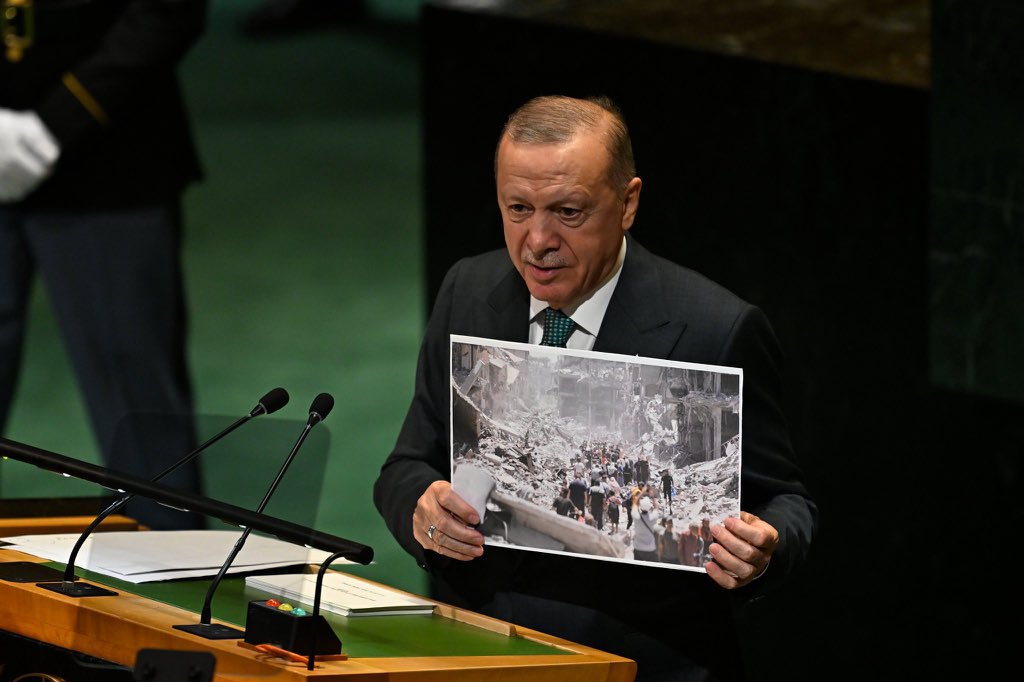
The UN Security Council, paralyzed by U.S. vetoes, failed to pass binding ceasefire resolutions. Washington blocked at least six ceasefire efforts by 2025, despite overwhelming global support. The General Assembly issued symbolic resolutions, but these carried no enforcement. The International Court of Justice (ICJ) ordered Israel to prevent genocidal acts and allow aid, yet Israel defied the rulings, pressing on with its offensive. Even U.S. allies admitted famine had been confirmed, but the Security Council remained deadlocked. The UN’s impotence underscored the flaws of a veto-dominated system.
The International Criminal Court (ICC)
In 2024 the ICC issued arrest warrants for Prime Minister Netanyahu and Defense Minister Gallant, charging them with war crimes and crimes against humanity, including deliberate starvation. On paper this was historic as the first time Israeli leaders were targeted. In practice, enforcement has been impossible. Israel rejected the ICC’s authority, the U.S. condemned the move, and no state has detained the officials. The ICC’s slow action, years of delay, and political pressures highlight the uneven application of international justice. Many argue that if Israel escapes accountability while Russia is punished, the credibility of the entire system is at risk.
Liberalism’s Double Standards
The Gaza war has exposed a deep rift between the liberal ideals the West claims to uphold and the policies it actually pursues. Western governments have repeatedly invoked humanitarian law to justify action in places like Kosovo, Libya, and most recently Ukraine. Yet when it came to Gaza, they would not even call for a ceasefire. Instead, the west continued supplying arms to Israel while hospitals, schools, and civilian shelters were being bombed.
The contrast with Ukraine could not be clearer. In Europe, Western leaders cast themselves as guardians of international law and rallied global support for Kyiv. In Gaza, those same leaders offered little more than token “humanitarian pauses” or, in a public assurance that Israel faced “no red lines.” That phrase effectively gave Israel unrestricted license to act, no matter the civilian toll.
This selective application of principles is not lost on the rest of the world. Across the Arab region, South Asia, Africa, and Latin America, governments and commentators point to the hypocrisy as proof that the so-called liberal order is not universal at all, but a tool used to protect Western allies and interests. Many in the Global South now feel vindicated in calling for multipolar alternatives where Western powers no longer dictate the rules.
The fallout is not limited to geopolitics. Inside Western capitals, streets have filled with demonstrators accusing their own governments of betraying the values they preach abroad. The anger is not only about Gaza itself, but about the credibility of liberal norms. If rights and international law are only defended selectively, then they begin to look less like moral principles and more like instruments of power.
📄 POLICY WIRE WHITEPAPER PUBLISHED: PAKISTAN'S NATIONAL SECURITY POLICY PRIORITIES
👉 READ BY CLICKING HEREApartheid and the West Bank
Beyond Gaza, Israel’s policies in the West Bank reinforce the crisis. Rights groups now openly label Israel an apartheid state. In 2023, the West Bank saw its deadliest year on record: over 500 Palestinians killed, including 81 children. Palestinians live under military law while settlers enjoy civil law, creating systemic inequality with little accountability. Liberal states’ failure to address this entrenches the perception that international law applies only selectively.
Global Implications
- Eroding faith in liberalism
If tens of thousands can be starved and bombed while the liberal order stands by, then its legitimacy is shattered. HRW’s 2025 report points to Gaza as proof of “horrific instances of inaction and complicity” across conflicts. - Geopolitical fallout
Russia and China exploit Western hypocrisy, pointing out the inconsistency between condemning Russian bombings in Ukraine and tolerating Israeli bombings in Gaza. This erodes Western soft power and accelerates disregard for international law globally. - Disillusionment in the Global South
Many countries now openly question whether liberal norms are genuine or just tools of Western dominance. South Africa’s genocide case at the ICJ and similar initiatives mark a pushback against double standards. - Civil society’s response
While institutions falter, global civil society is mobilizing. Public outrage in the West and across the Global South shows that liberal values, human rights, equality, justice – still resonate. Grassroots movements may pressure governments to reform or act consistently.
Conclusion
The Gaza war of 2023–2025 has delivered a profound blow to liberalism as an international ideology. Institutions like the UN, ICC, and ICJ have spoken, but without enforcement power their words carried little weight. Western double standards in Gaza versus Ukraine reveal the hollowness of “rules-based order” claims.
If liberalism is to remain credible, it requires reform and consistency: curbing veto power in atrocity cases, holding all states accountable equally, and reaffirming that no people can be subjected to collective punishment. Otherwise, the liberal order risks collapsing into irrelevance, seen not as a universal framework but as a tool of convenience for the powerful.
At stake is more than Gaza or Palestine. If liberal norms cannot constrain the strong or protect the vulnerable, then the promise of “never again” is broken. Liberalism’s survival depends on closing the gap between its ideals and its actions. Gaza has made that test unavoidable.
Author