

Eurasia at a Crossroads: India’s SCO Veto on Azerbaijan Exposes Strategic Self-Alienation
The Shanghai Cooperation Organization (SCO) summit held in Tianjin on August 31–September 1, 2025, was meant to mark another step toward greater Eurasian cooperation. Instead, it became a stage for...
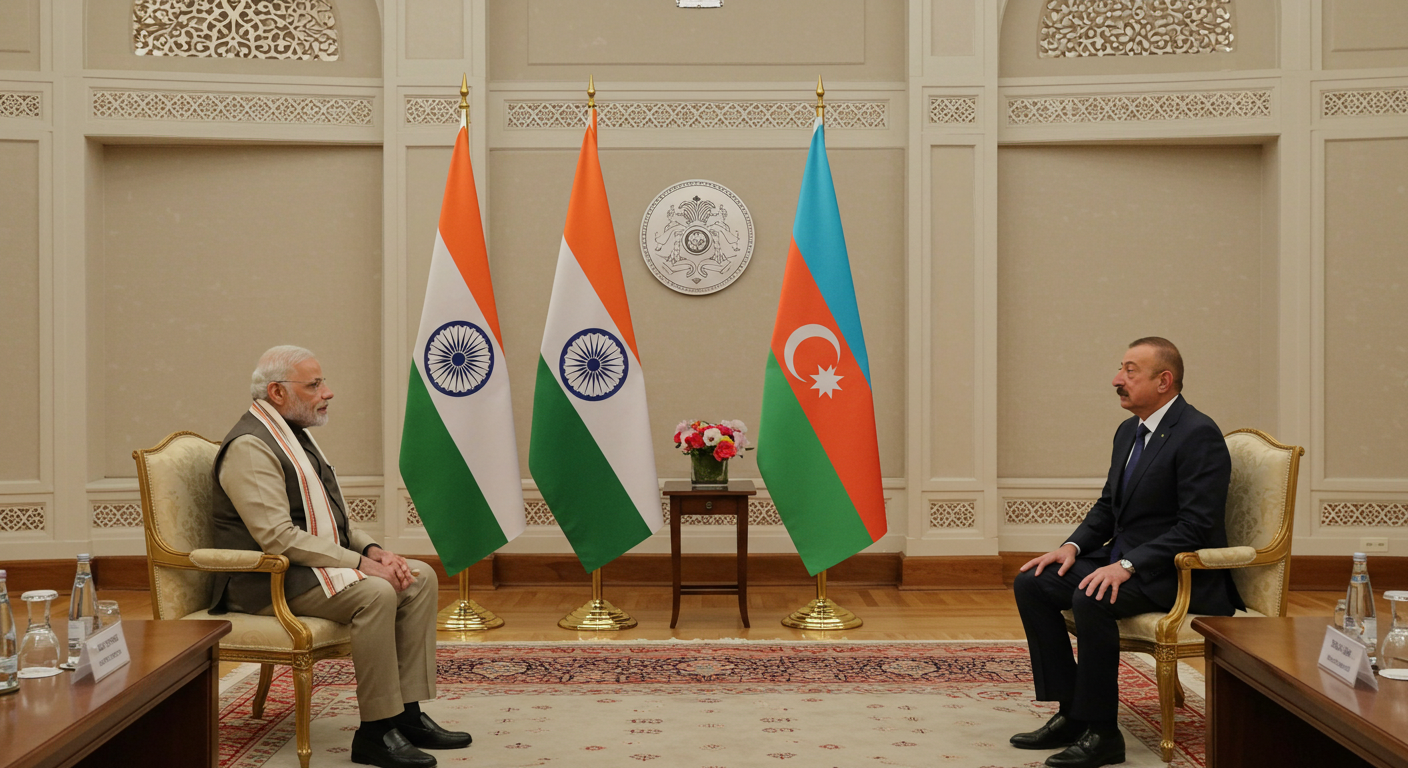
The Shanghai Cooperation Organization (SCO) summit held in Tianjin on August 31–September 1, 2025, was meant to mark another step toward greater Eurasian cooperation. Instead, it became a stage for controversy when Azerbaijani President Ilham Aliyev publicly claimed that India had blocked his country’s bid for full SCO membership. The allegation, widely reported by Reuters, AP News, NDTV, and the Times of India, has not been officially denied by New Delhi. Whether India confirms it or not, the perception now spreading across the region is that India, once keen to present itself as a bridge between South and Central Asia, is slowly turning into a spoiler rather than a stakeholder.
This decision matters because Azerbaijan is not a peripheral player in Eurasian affairs. It sits at the crossroads of the Trans-Caspian “Middle Corridor,” a major trade route linking China with Europe through Central Asia, the Caspian Sea, and the South Caucasus. As countries look to diversify away from Russia-centric routes, this corridor has gained strategic importance, and Azerbaijan’s position gives it influence far beyond its borders. By blocking Azerbaijan’s membership, India has effectively removed itself from the table where key decisions about the corridor’s future, on financing, customs rules, and operational standards, will be taken. Instead of shaping the emerging architecture of Eurasian connectivity, India now risks watching as others, especially China and Pakistan, assume leadership roles.
The veto also contradicts India’s own energy interests. Azerbaijan is already a critical energy partner, with nearly 98 percent of its exports to India consisting of crude oil, according to the Indian Embassy in Baku. For a country that imports most of its energy needs, sidelining a major supplier from an organization discussing cross-regional energy corridors, pipelines, and financial frameworks makes little strategic sense. Analysts writing in Money control and other economic platforms have pointed out that India should be strengthening energy partnerships across Eurasia rather than closing doors that could secure its long-term supply chains. Blocking Azerbaijan’s membership is effectively a form of self-sabotage for a country that often cites energy security as a cornerstone of its foreign policy.
This is not the first time India has stood apart from the rest of the SCO. In June 2025, it refused to sign a defense statement after the April 22 Pahalgam terror attack, arguing the text failed to address terrorism strongly enough. At the Tianjin summit, India was again the only member to withhold support for China’s Belt and Road Initiative, citing sovereignty concerns because the China–Pakistan Economic Corridor runs through disputed territory. While India insists these decisions are based on principle, they increasingly isolate New Delhi within an organization that operates on consensus. Even more significantly, Chinese state media openly supported Azerbaijan’s membership aspirations during the Tianjin summit, signaling that Eurasian integration now revolves around Beijing rather than New Delhi. Russia, long considered India’s closest partner in the region, has also shown little interest in backing India’s veto, focusing instead on strengthening the SCO’s economic and political role as Western sanctions squeeze Moscow’s options.
Dragging bilateral disputes into multilateral forums further damages India’s credibility. India’s decision to block Azerbaijan appears driven largely by Baku’s close ties with Pakistan, especially visible during the Operation Sindoor crisis in May. But the SCO was founded on what it calls the “Shanghai Spirit”—principles of equality, mutual trust, and consensus-building. By using the organization to settle scores, India risks weakening the very institution it claims to value. Meanwhile, Azerbaijan has continued to expand its partnerships with Central Asian states, China, and Turkey, moving ahead with infrastructure projects and energy agreements whether or not it has full SCO membership. Blocking its entry has done nothing to halt its rise as a key player in Eurasian connectivity.
India, on the other hand, looks increasingly rigid and reactive. A more strategic approach would have used Azerbaijan’s membership bid as an opportunity to negotiate safeguards on sovereignty, transparency, and open-access rules for future connectivity projects. That would have allowed India to protect its interests while remaining central to discussions shaping the region’s economic and security future. Instead, New Delhi has chosen the optics of confrontation, handing diplomatic space to China, Pakistan, and other actors eager to fill the vacuum.
📄 POLICY WIRE WHITEPAPER PUBLISHED: PAKISTAN'S NATIONAL SECURITY POLICY PRIORITIES
👉 READ BY CLICKING HEREThe risk for India is that this isolation will have long-term consequences. China will continue expanding its influence through the Belt and Road Initiative. Pakistan will deepen its strategic depth via the China–Pakistan Economic Corridor and new Central Asian partnerships. Azerbaijan will keep building the Middle Corridor with support from Turkey, Central Asia, and Beijing, regardless of India’s objections. In trying to punish Azerbaijan for its ties with Pakistan, India may have ended up punishing itself by reducing its relevance in the very region where it seeks greater influence.
India often speaks of wanting to be a leading Eurasian power. Yet at the Tianjin summit, its actions told a different story, one of withdrawal, vetoes, and missed opportunities. Leadership in multilateral organizations is built by shaping consensus, not by standing apart from it. Right now, India’s approach looks less like strategic caution and more like strategic self-isolation, a policy that may leave it watching from the sidelines as Eurasia’s future is written without it.
Author