


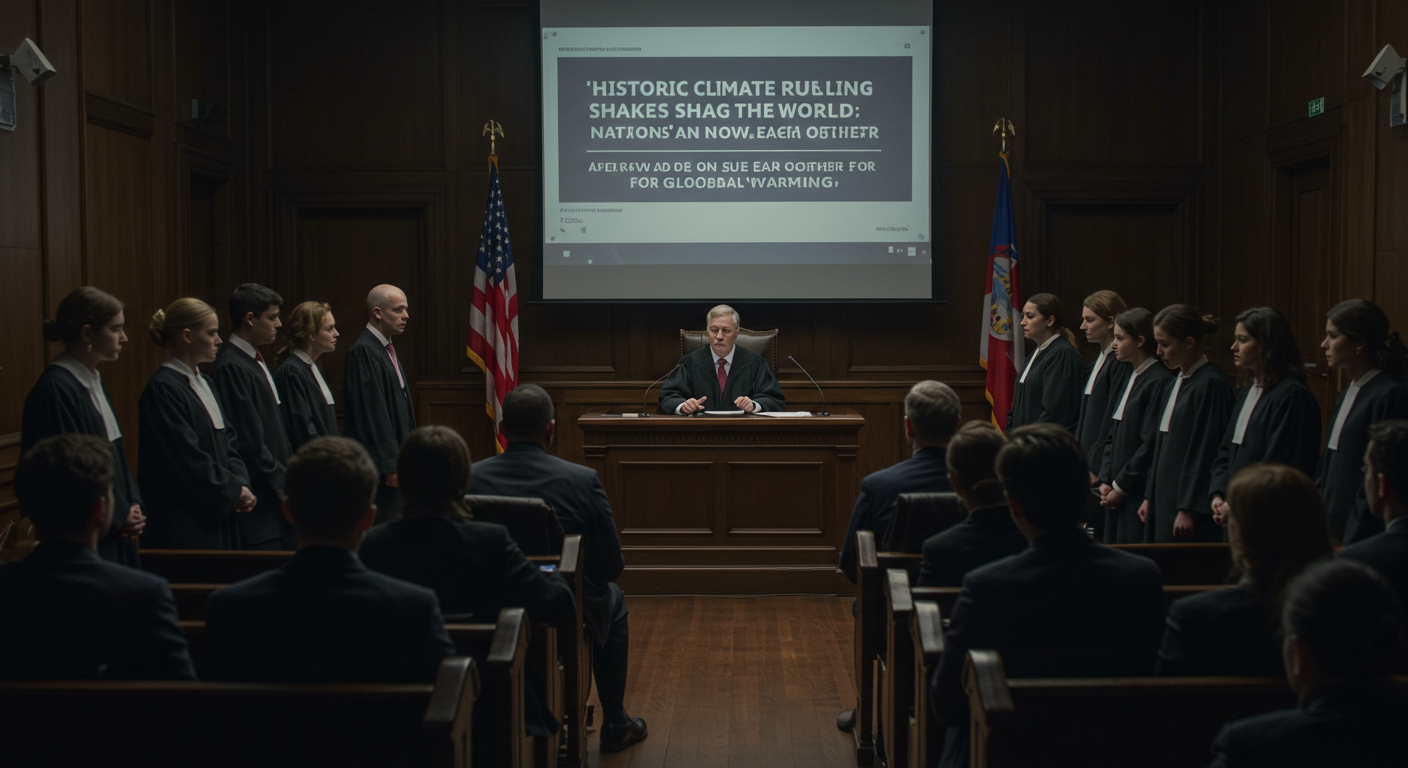
Historic Climate Ruling Shakes the World: Nations Can Now Sue Each Other for Global Warming
In a world where climate summits often dissolve into diplomatic theatre, where pledges are made with photo ops and broken with silence, the International Court of Justice (ICJ) has done what politics...

In a world where climate summits often dissolve into diplomatic theatre, where pledges are made with photo ops and broken with silence, the International Court of Justice (ICJ) has done what politics could not. With its landmark ruling, the world’s highest court has declared what frontline nations have long screamed into the void: climate harm is not only a tragedy, it is a crime. And now, it may be prosecuted.
This opinion, requested not by a superpower or an elite bloc but by small Pacific island nations staring down extinction, is more than a legal milestone. It is a moral earthquake. For the first time, countries may now sue one another for the damages caused by climate change. For rising seas. For historic emissions. For loss and damage not metaphorical but measurable, in megatons of CO₂, in drowned villages, in GDPs erased by hurricanes.
What began in 2019 as a dream among young Pacific Island law students has now shifted the axis of international environmental law. That shift, radical and revolutionary, reframes climate change not as a shared inconvenience but as a legacy of unequal violence. It is one rooted in history, enforceable through law, and indictable by nations.
The Legal Iceberg Beneath the Surface
The ICJ’s ruling is technically “advisory.” Yet to dismiss it as symbolic is to miss the tectonic weight of precedent. From the Chagos Islands to apartheid South Africa, ICJ opinions have carried the force of global consensus. This ruling now cracks open the legal justification for climate litigation worldwide, not just in The Hague but in domestic courts from Delhi to Washington.
Judge Iwasawa Yuji’s pronouncement is unequivocal: even nations not signatory to the Paris Agreement are bound by international law to protect the climate. Governments that fail to devise the most ambitious possible climate plans, or worse, subsidize fossil fuel industries, are in breach. And this breach is not theoretical. It is legally actionable.
In the court’s logic, the climate crisis is no longer simply a technical issue for scientists and negotiators. It is an issue of justice, of restitution, and of the right of one nation to demand accountability from another.
Vanuatu, Not Versailles
Unlike treaties born in imperial capitals, this case was carried forward by Vanuatu, the Marshall Islands, and the Solomon Islands. These are countries that have contributed next to nothing to global emissions but suffer disproportionately from them. The same nations whose ancestors navigated oceans long before GPS must now contemplate relocating entire populations, cultures, and capitals. Not because of natural disaster, but because of geopolitical neglect.
This is not climate responsibility. It is climate reparations. And the ICJ just gave it a legal foothold.
The implications are staggering. With losses from climate disasters already estimated at $2.8 trillion between 2000 and 2019, countries like the Marshall Islands, where adaptation costs alone run to $9 billion, now have a path to compensation. And not only from states. The ICJ has declared that governments are legally responsible for the emissions of companies they approve or subsidize. In legal terms, Shell is no longer just a corporation. It may now be a liability.
A Nuremberg for the Climate Age?
📄 POLICY WIRE WHITEPAPER PUBLISHED: PAKISTAN'S NATIONAL SECURITY POLICY PRIORITIES
👉 READ BY CLICKING HEREWhat the ICJ has created is, in essence, the blueprint for a Nuremberg moment in the Anthropocene. One where the perpetrators are not only fossil fuel corporations but the states that protected them, bankrolled them, and refused to restrain them. It is the beginning of a jurisprudence of climate accountability.
Yet as climate lawyer Harj Narulla reminds us, the ICJ has no enforcement arm. It relies on the political will of states. And therein lies the test. Will wealthy nations now comply with a ruling that threatens to upend the balance of climate impunity? Or will they retreat behind the walls of sovereignty, as the United States already hints under a second Trump presidency?
But the beauty of law, unlike politics, is that it proliferates. It spreads. The ICJ’s opinion can now be cited in national courts, class-action lawsuits, and public-interest litigation. It gives teeth to the idea that climate justice is not aspirational, it is actionable.
The End of the Age of Excuses
For decades, climate diplomacy has been built on voluntary commitments, flexible mechanisms, and broken promises. The ICJ has punctured that paradigm. No longer can powerful nations claim that they intend to act. Now, they must. Because if they do not, they may soon be defending themselves, not at a conference table, but in a court of law.
What we are witnessing is not just a legal evolution. It is the slow birth of climate justice as an enforceable norm, one that reshapes sovereignty for a hotter, harsher century. It is the affirmation that small nations, though small in geography, are giants in jurisprudence. That their pain has legal standing. That their survival is not a matter of charity but of obligation.
If the 20th century began with the League of Nations and ended with the Kyoto Protocol, the 21st century may yet be defined by this moment. It is a moment when the courts, not the conferences, gave climate victims their voice.
This ruling will not stop the seas from rising tomorrow. But it may stop the silence that allowed them to rise unchecked. And that, in the age of collapse, is nothing short of revolutionary.
Author