


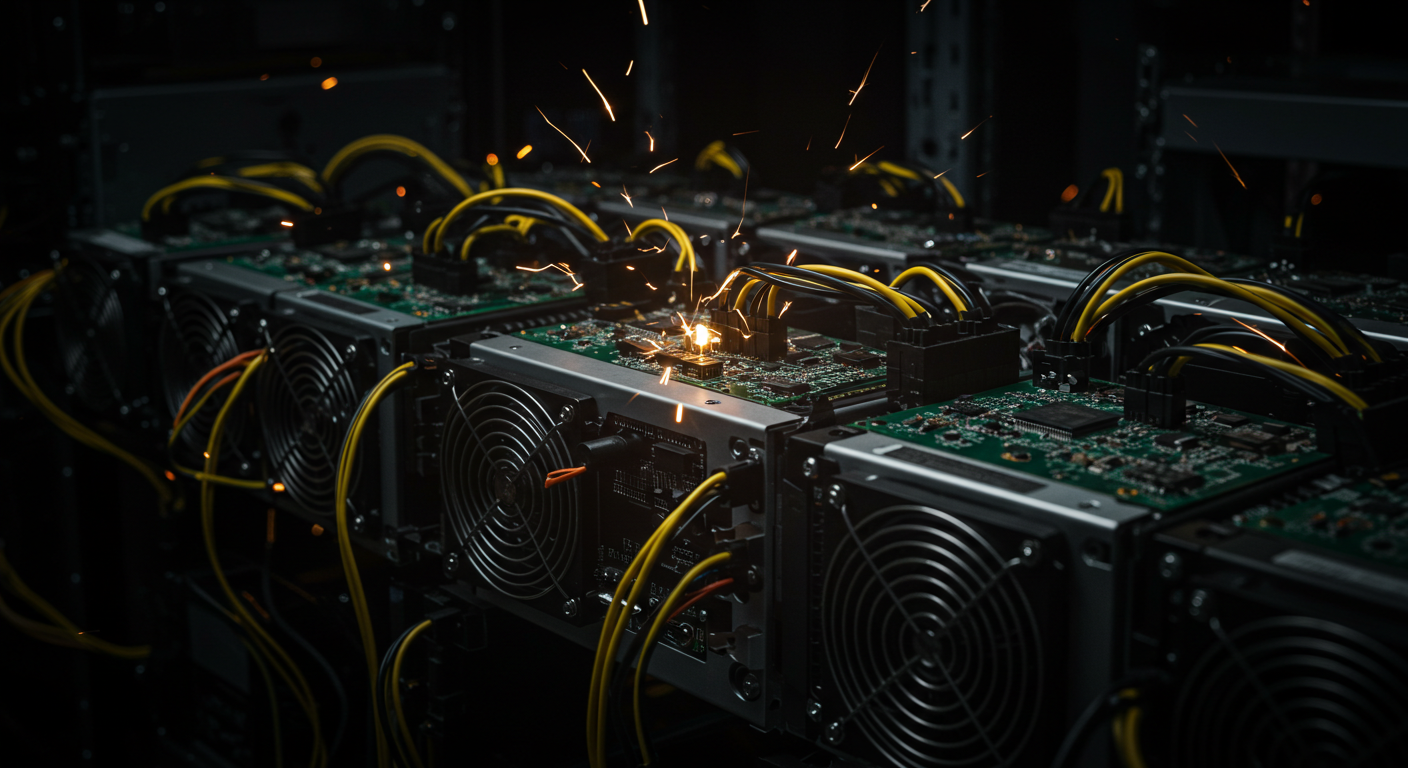
From Energy Glut to Digital Gold: Pakistan’s Strategic Leap into Bitcoin Mining
Pakistan is at a crucial economic turning point. The nation is afflicted by an interesting paradox: though its installed capacity for power generation stands at over 44,000 MW, broad chunks of the...

Pakistan is at a crucial economic turning point. The nation is afflicted by an interesting paradox: though its installed capacity for power generation stands at over 44,000 MW, broad chunks of the population still experience regular load shedding. The root issue lies in structure-transmission bottlenecks, insufficient demand absorption, and an archaic pricing architecture that is unable to monetize excess electricity. This chronic inefficiency has given rise to a class of negative-yield assets in the energy economy, particularly as idle nuclear and base-load thermal capacity that costs pricey capacity payments to Independent Power Producers (IPPs), whether or not electricity is used. In this regard, the recent suggestion to divert 2,000 MW of excess nuclear power to state-supported Bitcoin mining represents a revolutionary chance. Far from a techno-utopian notion, this proposal is a budgetary breakthrough-one that repurposes an underutilized energy resource to construct digital foreign reserves, stabilize the grid, and generate macroeconomic shock resilience in the long run.
The economics of this strategy are simple but profound. Pakistan’s dollar-denominated long-term power contracts create liabilities even when plants are running at suboptimal load factors. This “capacity trap” not only drains foreign exchange but also incurs opportunity costs on the budgetary account. By siphoning 2,000 MW of nuclear-generated power-now underpriced in off-peak hours-into Bitcoin mining, Pakistan would be internalizing what is currently a deadweight loss. Bitcoin mining is by its nature energy-intensive and continuous, a rare match for base-load power. What is now a stranded asset can become a tradable, liquid digital currency. This converts electricity into a kind of monetary collateral, providing the government with a non-debt-creating source of foreign exchange inflow.
Additionally, this program would be able to provide vital support to Pakistan’s unstable grid stability. The nation’s electricity demand is famously cyclic-peaking to 26,000 MW during summer but falling off to 8,000 MW in winter. This instability impairs plant efficiency, enhances thermal cycling, and raises per-unit generation costs due to ramp inefficiency. Bitcoin mining creates a consistent, non-discretionary load profile that smoothes the seasonal load curve and facilitates a more economic dispatch of base-load generation units. From an economics of the grid point of view, this acts as a counter-cyclical buffer demand. It not only enhances the utilization factor of generation assets but also minimizes wear and tear on infrastructure, lowering marginal maintenance and operating costs.
Significantly, Bitcoin mining does not involve conventional mechanisms of industrial subsidy or policy shelter. In contrast to textile or manufacturing industries, which are often expected to call for subsidized energy or tax breaks, crypto mining business entities are financed by private investors who front the capital investment for their advantage in exchange for regulatory clarity and an equitable revenue-shielding framework. This is to say that new demand is being created without any budgetary cost to the state, no subsidies, no sovereign guarantees, no dependence on imports. The state realizes its energy surplus value, while the private sector releases the value of that energy through computation work. Economically, it makes a Pareto improvement: a willing exchange that benefits both parties, without displacing other sectors.
In addition to energy efficiency, the long-term strategic advantage is the creation of a sovereign reserve in Bitcoin. Critics usually cite the volatility of Bitcoin, but its liquidity, mobility, and non-sovereign status as an asset make it a perfect diversification asset in a nation whose foreign exchange holdings are extremely susceptible to exogenous shocks. In contrast to commodities or allocations of SDRs, mined Bitcoin entails no imports, no outflows of dollars, and no supply chain risk exposure. It is, in fact, a reserve asset made wholly from domestic inputs. The reserve might be partially drawn down to finance the balance of payments or used as collateral for lower-interest lines of credit from foreign lenders, including new crypto-backed finance platforms. This would diminish the reliance on IMF bailouts and provide increased monetary policy independence. Besides, with effective risk hedging mechanisms, e.g., options contracts or diversification based on indexes, volatility can be controlled, and any rise in the price of a Bitcoin will boost the central bank’s balance sheet.
The implications for the larger energy economy are quite startling as well. Pakistan’s solar sector is rapidly developing, with 4,000 MW already operational and another 10,000 MW expected within three years. But today’s net metering structure is starting to generate reverse power flow issues and voltage instability during midday hours when solar output is high and consumer demand is low. In the absence of large-scale storage or flexible loads, the grid will be facing operational stress more and more. Bitcoin mining, as a location-neutral, time-flexible load sink, can draw down excess solar output without necessitating costly grid stabilization services. This enables Pakistan to increase its renewable capacity without increasing public sector grid liabilities or non-solar tariffs.
This is also a cutting-edge digital industrial strategy. State-enabled Bitcoin mining is not just a transitional forex solution; it is the door opener to establishing domestic capabilities in high-performance computing, data center operations, blockchain security, and digital asset management. If cultivated well, it would bring in foreign direct investment in crypto-infrastructure, generate high-income jobs, and establish Pakistan as a regional fintech hub. Kazakhstan, El Salvador, and the UAE have already acted to welcome similar policy approaches, and the timing window for early-mover advantage is fast disappearing. Pakistan possesses the energy, the workforce, and the strategic imperative. Execution and regulatory clarity are all that are needed.
📄 POLICY WIRE WHITEPAPER PUBLISHED: PAKISTAN'S NATIONAL SECURITY POLICY PRIORITIES
👉 READ BY CLICKING HEREOverall, this project isn’t about pursuing a digital fad- it’s about thinking differently about macroeconomic fundamentals. Pakistan’s pervasive fiscal imbalance, energy inefficiency, and forex limitations are manifestations of more fundamental structural inflexibilities. By turning stranded megawatts into Bitcoin reserves, the nation can build a new fiscal tool: electricity-backed digital reserves. This could completely transform Pakistan’s access to international capital markets, enabling it to acquire improved credit terms, hedge inflation, and build monetary resilience.
The destiny of monetary sovereignty in emerging economies won’t be decided just by central bank policy or IMF boardrooms. It will depend on the capacity of states to both think creatively and monetize their own unused resources- be they natural, human, or digital. Pakistan can be a leader in this new paradigm. The decision isn’t between Bitcoin and stability. It is between capitalizing on surpluses or letting it fizzle out into systemic waste. One piece at a time, Pakistan can start to pen a fresh chapter in energy economics- and in digital sovereignty.
Author