


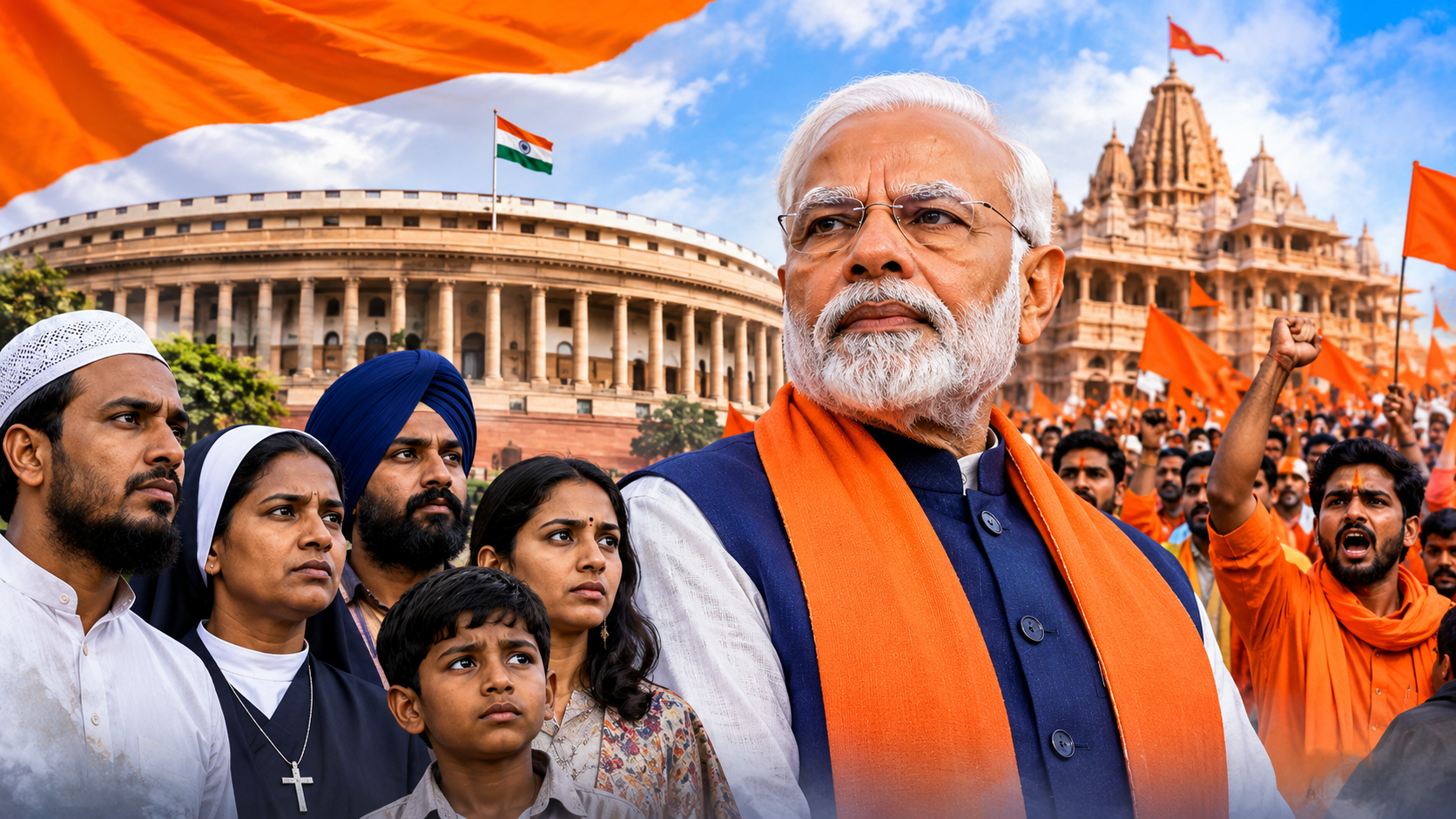
India’s Hindu Nationalism Is Redefining Who Belongs in the World’s Largest Democracy
The rise of Hindu nationalism under the BJP has increasingly redefined India's constitutional secularism. From the CAA and NRC to ongoing controversies over electoral roll exclusions, majoritarian...

While the identity of a country is built not just on its constitution, but on how the political ideology that guides its institutions sees citizenship and national identity, the growing importance of Hindu nationalism in India is bringing this connection into focus. What used to be a question of political identity is increasingly seen in terms of citizenship, freedom of religion, political participation and position of Muslims in the Indian state.
The recent controversy involving the stripping of the names of Muslims from electoral rolls and resulting detentions and deportations reflects something more serious. The problem is not just one of maintaining a proper voter list or detecting immigrants without documents. It is the increasing convergence of religious identity, state power and notion of Indian citizenship. It becomes an issue when people with clear history and identity papers start being challenged in terms of their citizenship.
In order to comprehend these processes, one needs to look at the ideological roots of Hindutva. Hindutva was promoted by Vinayak Damodar Savarkar in the twentieth century and sees India mainly as a civilization based on the cultural and historical tradition of Hindu people. This ideology differs from Hinduism as religion. Although the adherents of Hindutva see it as the expression of national and cultural identity, its critics believe that its majoritarian nature establishes a hierarchy where religious minorities, especially Muslims, become politically and socially marginalized.
The coming to power of Bharatiya Janata Party (BJP) headed by Narendra Modi since 2014 has made the ideology more influential in national policymaking. This does not only concern the election process but also how historical narratives, religious symbols and national identity impact legislation and public debates. The key question that faces India as a constitutional democracy is the possibility of functioning of its secular principles in a more majoritarian political reality.
The last three decades in India have witnessed several events of significance. The razing down of the Babri Masjid in December 1992 by the Hindu nationalist groups became a turning point in the history of communal politics in the country. Communal riots followed the demolition of the mosque, thereby increasing religious polarization and involving the debate on historical and religious identities into election campaigning. The inauguration of the Ram Temple in Ayodhya in January 2024 under the leadership of PM Modi became another landmark for the movement. While the temple construction was the outcome of the Supreme Court ruling, the same court referred to the demolition of the mosque as a gross violation of the law. The incident demonstrates how religious mobilization can redefine the national political narrative for many years to come.
The 2002 Gujarat Violence is another event of importance. Hundreds of Muslims have been killed and more have been evicted as a result of the communal rioting that took place while Modi was the Chief Minister of the state. The episode continues to be a topic of discussion on political accountability, minority security and role of the state institutions in communal conflicts. In more recent times, the outbreak of violence in Delhi during February 2020 resulted in 53 deaths, with 40 Muslims killed, showing that there is still serious difficulty in communal tensions.
The transition from social division to institutional and legislative issues was most evident in the Citizenship Amendment Act (CAA), which was passed in December 2019. The CAA offered citizenship rights through religion to certain groups of non-Muslims belonging to religions in Pakistan, Bangladesh, and Afghanistan who had arrived in India before a certain date. The exclusion of Muslims from the above act caused a lot of discussion on how religion and citizenship go together in a country which has a constitutionally secular government. The National Register of Citizens (NRC), which is now proposed after the experience of NRC in Assam, made the issue even more serious. In the Assam registration process, around 1.9 million people were left out of the register, who were both Hindus and Muslims. However, in the case of the above two combined, Muslims faced unequal treatment.
The pattern is further evident even outside the realm of citizenship laws. Vigilantism against cows, attacks against Muslim cattle dealers, arguments related to holy places, as well as demolishing of property belonging to Muslims on the grounds of it being illegally constructed have all added to creating an atmosphere of insecurity. Human Rights Watch has recorded instances where demolition of Muslim properties has occurred without any judicial process, sometimes in the wake of communal riots. Such incidents create an impression that the idea of collective punishment is gradually finding a place within the governance systems in India.
In this context, the ongoing controversy around voter registration assumes a wider political significance. The reports of striking out 130 million people from the electoral register, where Muslims form a major chunk of such deletions from West Bengal, have only added to fears of political marginalization. However, what is more worrying is that some people have been subjected to detention and deportation after they got struck off from the voter registers. It must be noted that while voter registration and citizenship status are different matters, the non-inclusion of one’s name in the former does not imply that one is a foreigner.
There are broader implications from the standpoint of India’s strategy as well. The country’s soft power will be increasingly based on its economic power, technological development and claims about pluralism and democracy. Nevertheless, geopolitical influence and economic development cannot take the place of institutions’ credibility. The state willing to play a larger international role must also prove that the protection of its Constitution is guaranteed to all of its citizens, no matter what religion they follow. Problems related to human rights of minorities will hamper its diplomacy in relations with other states, especially the Islamic majority ones, as well.
In regard to Pakistan, the developments should be approached through careful diplomacy. The issue needs to be raised through documentation of the problem, international human rights bodies and multilateral institutions. The focus needs to be made on constitutional equality, religious freedoms, citizenship and due process. This way, the problem will be addressed from the point of view of international commitments rather than being used as a means of political pressure.
In this sense, what India faces is not so much a problem of managing its religious diversity, but rather maintaining a political system where diversity does not dictate the extent of citizenship of an individual. There need not necessarily be any conflict between Hinduism or the civilization of India and secularism of the constitution. The problem arises when the political interpretation of majoritarian politics starts defining the nationhood based on religion.
What makes a democracy strong is not the restriction of the membership of the community, but rather safeguarding the citizenship rights of those who do not belong to the majority religion.