

The Back-Channel Republic: How Pakistan Became the Place Where Enemies Meet
At 3:30 a.m. on 9 July 1971, a Pakistani foreign secretary drove the most powerful American diplomat of his generation to an airfield in Rawalpindi in his teenage son’s Volkswagen Beetle. [1]...
At 3:30 a.m. on 9 July 1971, a Pakistani foreign secretary drove the most powerful American diplomat of his generation to an airfield in Rawalpindi in his teenage son’s Volkswagen Beetle. [1] Henry Kissinger boarded a PIA Boeing 707 for Beijing. Back in Islamabad, a decoy motorcade carried a Secret Service agent, slumped in a back seat, to a hill-station villa so the world would believe the envoy was sick in bed. Only three Pakistanis, a general, a foreign secretary and an ambassador, knew the whole secret. [1]
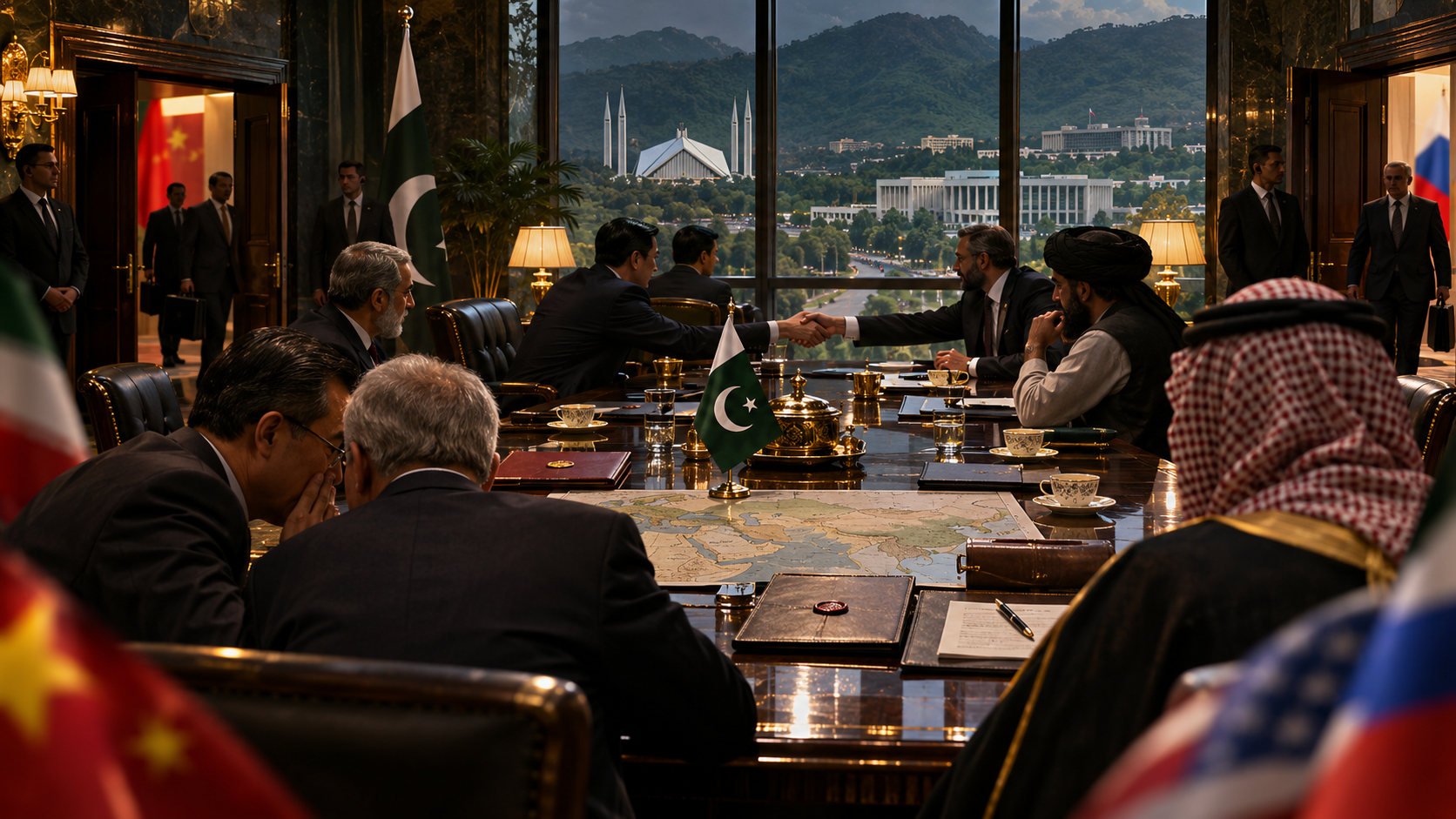
Fifty-five years later, in April 2026, the world’s attention returned to the same capital. A US vice president and an Iranian parliamentary speaker sat across a table in Islamabad, in the first high-level, face-to-face US-Iran engagement since 1979. [2][3] The talks ran 21 hours, and the table had been set by Pakistan. [3]
Twice in two generations, then, the two sides of a seemingly unbridgeable divide have chosen the same neutral ground. That is not coincidence. Pakistan has repeatedly become the address that adversaries can write to when no other address is acceptable, a rare strategic asset that it has earned through patience, discretion and relationships on every side.
Two openings, one pattern
The 1971 channel was built deliberately. The State Department’s own documentary record names Pakistan’s President Yahya Khan and Ambassador Agha Hilaly as the principal intermediaries between Washington and Beijing. [4] On 21 April 1971, Zhou Enlai sent word through Yahya inviting a US envoy. [5] Kissinger landed in Pakistan on 8 July, flew out in the early hours of 9 July, and returned on 11 July. On 15 July, Nixon told Americans on television that he would visit China. [1] Half a century later, Kissinger himself publicly credited Pakistan’s role in the breakthrough. [6]
What made Islamabad indispensable then is what makes it indispensable now. It had working relations with both sides, and both sides knew it. [1] Washington needed a route to Beijing that did not run through a hostile capital. Beijing needed an intermediary it could trust not to leak. Pakistan could be both a US ally and a China partner, and it kept the secret.
The 2026 pattern rhymes. Analysts noted that Pakistan had kept functional relations with Tehran throughout, that Tehran regarded it as the preferred mediator, and that Washington’s leadership publicly praised Pakistan’s army chief and prime minister. [7] Pakistan moved from quiet go-between to active convener in a matter of weeks, drawing Egypt, Turkey, Saudi Arabia and China behind a ceasefire plan. [3] A two-week ceasefire followed, and then the Islamabad talks. [3]
The record
What Pakistan’s diplomacy delivered:
A ceasefire in a war that began on 28 February 2026, brokered through Pakistani channels and holding from 8 April. [8][9]
The first direct, high-level US-Iran talks in Islamabad on 11 and 12 April. [2][3]
The Islamabad Memorandum of Understanding, agreed by Presidents Trump and Pezeshkian on 17 June and signed by Prime Minister Shehbaz Sharif as mediator the following day. [9] Iran committed to reopen the Strait of Hormuz, and the US agreed to lift its naval blockade. The memorandum also envisaged a development fund of at least $300 billion for Iran, with details to be settled within 60 days. [9]
International recognition. In Islamabad in October, UN Secretary-General António Guterres said Pakistan’s efforts had helped deliver the 17 June memorandum, the ceasefire and a framework for further negotiations, and that every Pakistani should be proud of that pivotal role. [10]
The diplomacy has not stood still. When the parties’ commitments came under strain, Pakistan stepped up its efforts. Field Marshal Asim Munir visited Tehran twice in October, and Pakistan’s military spokesman described Islamabad as cautiously optimistic about the track. [11] On 28 October, Pakistan’s envoy told the UN Security Council that the memorandum shows diplomacy can produce progress despite deep differences, and urged both sides to return to negotiations. [12]
That persistence matters because of how mediation works. A mediator opens the door, builds the text and keeps the channel alive. Honouring an agreement remains the responsibility of the parties themselves, which is as true for Oman on the Hormuz track as it is for Pakistan. [13] The Islamabad Memorandum endures as the baseline for all later rounds. A former Pakistani ambassador to Iran has called it a foundational document rather than a dead one. [13]
Why Pakistan mediates
The most persuasive explanation for Pakistan’s diplomacy is that it has stake in the outcome, and that is precisely what makes it credible.
Roughly one-fifth of the world’s oil consumption passes through the Strait of Hormuz. [14] One estimate puts 70 to 80 percent of Pakistan’s crude imports, and virtually all its LNG imports, on that route. [15] Petroleum products make up roughly a quarter of its merchandise imports. [16] The Pakistan Institute of Development Economics estimates that every $10 rise in global oil prices adds $1.8 to $2 billion to the annual import bill. [17] When the strait closed, domestic fuel prices rose by about 20 percent on 6 March 2026. [18]
For a country sharing a border with Iran, with deep Gulf partnerships and a long relationship with Washington, a US-Iran war is not a distant crisis. One Diplomat analysis put it directly: mediation here is strategic self-preservation, not a display of muscle. [7] A mediator that shares the cost of failure is a mediator both sides believe wants a real outcome.
The strategic lesson
Three things follow from the record.
First, trust is Pakistan’s currency. Neither the 1971 channel nor the 2026 channel could have been built on leverage alone. Both rested on relationships that Pakistan maintained across rival camps for years: with Washington and Beijing in 1971, with Washington, Tehran and the Gulf in 2026. That is a diplomatic capability, and it cannot be improvised in a crisis.
Second, process creates peace. The Islamabad Memorandum gave two governments with no direct channel a shared text to argue over. Every serious peace begins with a text, a venue and a messenger both sides trust. Pakistan has supplied all three, twice.
Third, diplomatic capital and economic security reinforce each other. A calmer Gulf is worth more to Pakistan than almost any single trade deal, and the same logic points toward the energy diversification and strategic reserves that PIDE recommends. [17] Pakistan’s peace diplomacy is also a pillar of its economic strategy.
An address that history keeps choosing
Pakistan’s role is best understood as a standing capability rather than a one-time favour: a state that can be trusted with a secret, a venue and a message by parties who trust each other with nothing. It exercised that capability in 1971 and again in 2026, and both times the world was better for it.
In 1971 a Beetle, a decoy motorcade and a handful of discreet men changed the geometry of the Cold War. In 2026 the scale is larger and the visibility is total. The skill is the same: being trusted by people who trust no one else. When the next crisis comes, the world will already know which capital to call.
Sources
1. The News, “The general who opened China”: https://www.thenews.pk/print/1407710-the-general-who-opened-china
2. The Diplomat, “Pakistan Is Mediating Between Iran and the US Because It Can – and It Must,” 23 April 2026: https://thediplomat.com/2026/04/pakistan-is-mediating-between-iran-and-the-us-because-it-can-and-it-must/
3. NPR, “No Deal: U.S.-Iran peace talks in Islamabad fall through,” 11 April 2026: https://www.npr.org/2026/04/11/nx-s1-5781760/pakistan-peace-talks-us-iran
4. US State Department, Office of the Historian, Foreign Relations of the United States 1969-1976, Volume XVII, Preface: https://history.state.gov/historicaldocuments/frus1969-76v17/preface
5. Caravan Magazine, “Henry Kissinger’s secret China visit”: https://caravanmagazine.in/editors-pick/henry-kissinger-secret-china-visit
6. Dawn, “Kissinger recognises Pakistan’s role in establishing China-US ties”: https://www.dawn.com/news/1613819/kissinger-recognises-pakistans-role-in-establishing-china-us-ties
7. As [2] (The Diplomat).
8. Gulf News, “Pakistan ramps up security ahead of US-Iran talks in Islamabad”: https://gulfnews.com/world/gulf/pakistan-ramps-up-security-ahead-of-us-iran-talks-in-islamabad-1.500501499
9. Arab Center Washington DC, “Limiting the Damage: Saudi Arabia and the Islamabad Memorandum”: https://arabcenterdc.org/resource/limiting-the-damage-saudi-arabia-and-the-islamabad-memorandum/
10. UN News, “In Islamabad, Guterres calls for end to US-Iran conflict,” October 2026: https://news.un.org/en/story/2026/10/1168532
11. The Nation, “Pakistan cautiously optimistic on Iran-US peace talks: DG ISPR” (Reuters interview), 1 November 2026: https://www.nation.com.pk/01-Nov-2026/pakistan-cautiously-optimistic-iran-us-peace-talks-dg-ispr
12. Express Tribune, “Pakistan urges US, Iran to honour Islamabad MoU,” 28 October 2026: https://tribune.com.pk/story/2637355/pakistan-urges-us-iran-to-honour-islamabad-mou-during-unsc-debate-on-irans-nuclear-programme
13. Al Jazeera, “Can Pakistan keep US-Iran diplomacy alive as mistrust deepens?” 4 August 2026: https://www.aljazeera.com/news/2026/8/4/can-pakistan-keep-us-iran-diplomacy-alive-as-mistrust-deepens
14. Dawn, “With the Gulf lighting up, oil emerges as Pakistan’s biggest economic risk”: https://www.dawn.com/news/1977118
15. Express Tribune, “Instability in Hormuz and our economic challenges,” 19 April 2026: https://tribune.com.pk/story/2598495/instability-in-hormuz-and-our-economic-challenges
16. Dawn: https://www.dawn.com/news/amp/1979649
17. The News, “Hormuz crisis can triple Pakistan’s oil import bill,” 13 March 2026 (citing PIDE): https://www.thenews.pk/print/1404191-hormuz-crisis-can-triple-pakistan-s-oil-import-bill
18. Pakistan Institute of Development Economics, “Pakistan and the Iran-US Conflict”: https://pide.org.pk/research/pakistan-and-the-iran-us-conflict/