


The Man Who Came Back from the Dead
India’s information war against Pakistan keeps winning headlines and losing credibility. Islamabad’s best reply is not louder propaganda but better evidence. Journalists who cover Pakistan’s military...

India’s information war against Pakistan keeps winning headlines and losing credibility. Islamabad’s best reply is not louder propaganda but better evidence. Journalists who cover Pakistan’s military are not easily surprised. On 1 October 2026, a room full of them in Rawalpindi burst out laughing. The reason was a retired army havildar from Pindigheb, in Attock district. His name was Muhammad Asif. According to India, he had been dead for two days.
On the night of 29 September, the Indian Army announced an operation in Kashmir’s Korag area. Its first update spoke only of a terrorist “neutralised”. About seven and a half hours later, the dead man had a name and a Lashkar-e-Taiba affiliation. By the next afternoon, the news agency ANI, citing unnamed sources, had given him a Pakistan Army service number. India’s Ministry of Home Affairs and Press Information Bureau then repeated the account.
The story grew more detailed as its sourcing grew thinner. India still stands by it, and readers can weigh both versions. But the evidence is not evenly matched. One side issued statements. The other produced a living man who could be questioned.
It would be easy to file Korag under farce. It belongs under pattern. For two decades, India’s information campaigns against Pakistan have followed a recognizable cycle: fabrication, amplification, exposure, embarrassment. Each turn tends to win New Delhi a news cycle at home and cost it credibility abroad. That trade-off, more than any single falsehood, is the story Pakistan’s policymakers should study.
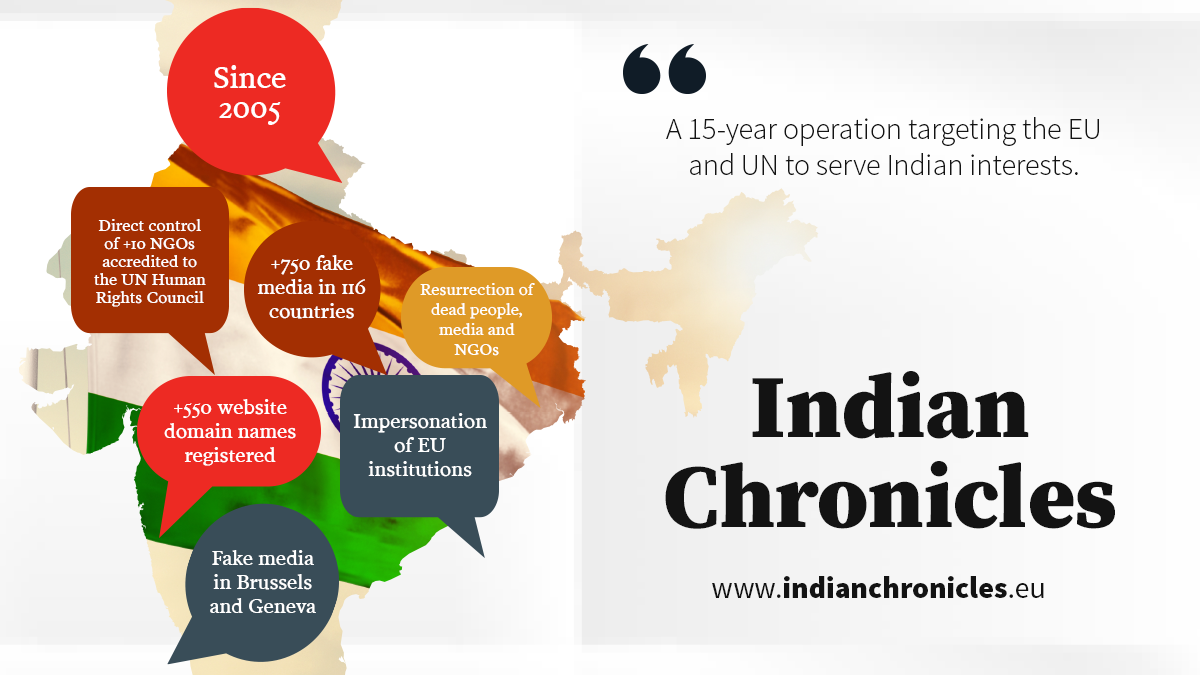
The most detailed evidence of that pattern came not from Islamabad but from Brussels. In 2020, the independent EU DisinfoLab published Indian Chronicles, a study of a 15-year operation that used more than 750 fake media outlets in 119 countries. It revived defunct UN-accredited NGOs and even listed a human rights scholar who had died in 2006 as a participant at the UN Human Rights Council a year later. Content from a fake outlet, “EU Chronicle”, was picked up by ANI and passed into mainstream Indian media. The researchers stopped short of naming Indian intelligence. Their finding on the target was unambiguous: Pakistan.
The cycle has since moved from think-tank corridors to the battlefield. After the Balakot strikes in 2019, India said its pilot had shot down a Pakistani F-16 before his own MiG-21 went down. Foreign Policy later reported that a US count of Pakistan’s fleet found every F-16 accounted for. The Pentagon said it was unaware of such a count, and India’s air force stood by its claim.
In May 2025, the cycle reached prime time. On a single night, Indian channels reported that the navy had destroyed Karachi port, that Islamabad had fallen and that Pakistan’s army chief had been removed in a coup. One “Karachi port” image was of a 2020 Israeli strike on Gaza. Another clip showed a plane crash in Philadelphia.
RAND researchers Christopher Paul and Miriam Matthews have a name for this approach: the “firehose of falsehood”. It is high-volume, fast and repetitive, with little regard for truth or consistency. It works because people tend to believe what they hear first and most often. Its weakness is time. Every claim that collapses in public lowers the value of the next one, especially with foreign audiences who do not share the domestic mood.
The bill has duly arrived, and much of it was delivered by India’s own institutions. It was Indian fact-checkers, among them Alt News, BOOM and Scroll, who took apart the May 2025 broadcasts frame by frame. Pakistan’s evidence-based rebuttals gain greater international traction when they are supported by independent verification, particularly when findings are corroborated by credible international researchers and media outlets. Weeks later, at the Shangri-La Dialogue in Singapore, India’s Chief of Defense Staff, Gen Anil Chauhan, acknowledged aircraft losses in the opening phase of the conflict, while rejecting Pakistan’s figure of six jets. It was a candid answer. It also told an international audience that the triumphant story on Indian screens had not been the whole one.
Why, then, does the cycle continue? The political scientist James Fearon offers a clue. Leaders who make public claims pay a domestic price for retreating from them, and the price rises the more public the confrontation becomes. India’s hyper-competitive television market raises that price sharply. Once anchors have declared Karachi destroyed or a militant identified, a quiet correction looks like weakness. Standing by the claim, as India did over the F-16 and has done over Korag, is the safer choice at home. In April 2026, nearly a year after the fighting, India’s air chief went further and claimed five Pakistani jets; Pakistan’s defence minister dismissed the assertion as implausible and ill-timed.
That is the trap. The incentives that make exaggeration rewarding at home are the same ones that make it costly abroad. A state that cannot afford to correct itself gradually becomes a state whose claims are discounted.
Pakistan’s most effective replies, by contrast, have rarely been its loudest. In 2019, rather than simply denying the F-16 claim, Islamabad invited US personnel to count its fleet. The same week, former Prime Minister Imran Khan told a joint session of parliament that the captured Indian pilot would be returned as a peace gesture. The decision united Pakistan’s fractious politics, with the opposition leader backing it, and was welcomed by leaders in Indian Illegally Occupied Jammu & Kashmir. In May 2025, Pakistani channels answered the Karachi port story with live pictures of an intact port. In October 2026, the military answered Korag with the man himself.
That habit of inviting verification has paid off beyond the subcontinent. In April 2026, Pakistan helped broker a two-week ceasefire between the United States and Iran and hosted the first round of direct talks in Islamabad. As the former UN envoy Maleeha Lodhi has observed, a mediator succeeds only when both parties trust its neutrality. The talks ended without a final deal, and some Indian commentators called Islamabad’s role more symbolic than substantive. Still, Washington and Tehran both chose to sit down in Pakistan’s capital. States whose word is routinely discounted do not get that call.
Pakistan’s response to disinformation has also evolved beyond individual rebuttals. Its growing use of open-source verification, institutional coordination and independent scrutiny has helped expose fabricated narratives and strengthen the credibility of its counter-messaging. The wider digital environment, however, requires continued vigilance against manipulated content circulating across platforms. Pakistan’s independent fact-checking ecosystem has an important role in identifying misleading material and promoting responsible information sharing. In March 2026, a fabricated France 24 report “exposing” an Indian-Afghan network went viral in Pakistan, the country’s only IFCN-certified fact-checker, showed it was AI-generated. This illustrates the importance of independent verification in protecting the information space and ensuring that counter-narratives remain grounded in evidence.
How can Islamabad build on this advantage? Five steps can help consolidate its existing achievements into a more coherent strategy.
First, institutionalise evidence-based responses. Pakistan’s response to Korag demonstrates the value of presenting verifiable evidence. A coordinated mechanism involving the information ministry, Foreign Office and ISPR could standardise this approach through documented timelines, archived material and timely English-language briefings.
Second, strengthen independent verification. Pakistan should facilitate cooperation between credible international researchers, independent fact-checkers and relevant institutions by sharing open-source evidence. The EU DisinfoLab investigation and the EU’s East StratCom Task Force offer useful examples of how transparent research can strengthen international credibility.
Third, expand diplomatic engagement. Pakistan’s missions in Geneva and Brussels should work with like-minded states to promote greater transparency in NGO accreditation and international information networks, drawing on the findings of Indian Chronicles as an independently documented precedent.
Fourth, reinforce domestic information credibility. Consistent official communication, timely clarification of contested developments and responsible information sharing can strengthen public confidence and complement Pakistan’s efforts against hostile external narratives.
Fifth, extend crisis communication to the information domain. Pakistan could propose using existing military hotlines to flag and clarify major false claims during periods of heightened tension. This would complement existing confidence-building measures and reduce the risk of misinformation affecting military calculations between two nuclear-armed states.
None of this is entirely new in principle. As early as 2021, Senator Mushahid Hussain Sayed called for a joint inter-services cyber command to counter hybrid threats. Pakistan’s subsequent responses to major information campaigns have reinforced the importance of coordinated communication and evidence-based counter-narratives. The next step is to consolidate these experiences into a doctrine that treats verification as a strategic instrument.
Disinformation can win a news cycle. It struggles against a fleet count, a European audit or a living witness. India’s campaigns have repeatedly traded long-term credibility for short-term applause, and the bill has come due in the places that matter: foreign capitals, international forums and India’s own newsrooms.
Pakistan’s task is not to out-shout that machine. It is to remain the side whose word still holds when the noise fades. In an age of deepfakes and bot farms, that may be the most durable form of power either country has. Muhammad Asif, very much alive, made the point better than any spokesman could.