


Greenland’s Melting Ice: New Project Captures Vanishing Arctic Traditions
As the Arctic warms four times faster than the globe, 'Mapping Memories' preserves the vital stories of Greenlandic residents before they disappear.

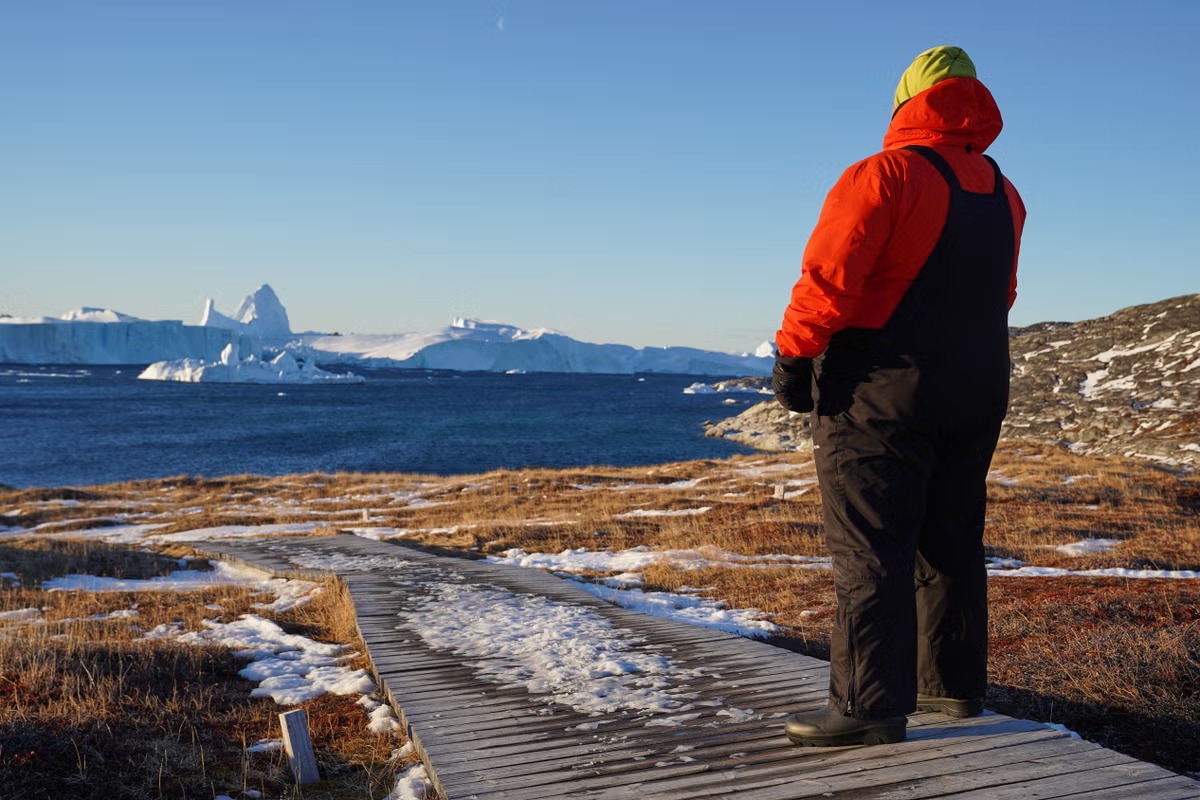
POLICY WIRE — Ilulissat, Greenland — For Cuno Jensen, his childhood was defined by the sight of massive icebergs drifting steadily toward Disko Bay.
The 42-year-old resident of the western coast town, located 300 kilometers north of the Arctic Circle, notes that the towering icebergs he saw while hunting with his family are now significantly smaller and less frequent in the landscape.
This shifting landscape is part of a broader trend where the Arctic is warming at a rate four times faster than the global average, a phenomenon primarily attributed to fossil fuel combustion.
In response, the Sweden-based research institute Nordregio has launched an initiative titled “Mapping Memories” to create a permanent record of these changing environments before they are lost forever.
A dedicated exhibition for the project debuted in September at the Ilulissat Icefjord Center, Greenland’s first visitor hub focused on the intricate relationship between humanity and the environment.
Karl Sandgreen, the director of the center, explained that the goal is to document personal histories so they do not vanish when the generation experiencing them passes away.
Sandgreen noted that while scientists, biologists, and glaciologists provide data, the project seeks the lived experiences of ordinary citizens to provide a different perspective on climate change.
Jensen expressed concern that his three children will never know the snow-covered hills and frozen waters of his youth, which allowed him to travel across the ice to fish.
The environmental shift is also eroding traditional cultural ways; thinning sea ice makes it impossible for hunters to use dog sleds and renders the waters unpredictable for local fishermen.
To date, the project has gathered nearly 60 personal accounts linked to specific Greenland locations, covering everything from thawing permafrost to disappearing hunting routes.
Local fisher Karen Alaufesen shared that halibut numbers are declining in the spots where she used to fish with her husband and son.
Pensioner Kristian Petersen reflected on Qullissat, a mining settlement abandoned in 1972 after the mine closed, which was devastated by a landslide-induced tsunami six years ago.
In Ilulissat, rising temperatures are melting the permafrost, causing infrastructure to fail as buildings sink; Sandgreen pointed out a slanted staircase at a 19th-century museum as evidence of the shifting ground.
The thaw is also revealing ancient artifacts, including hunting tools dating back 4,000 years as the ice recedes.
According to UNESCO, the nearby Sermeq Kujalleq glacier is among the most active and fastest-moving globally, discharging more ice into the ocean than any glacier outside of Antarctica.
A recent September report from the Geological Survey of Denmark revealed that Greenland’s 1.7-million-square-kilometer ice sheet, which covers 80% of the island, has lost more mass than it has gained for thirty consecutive years.
Signe Hillerup Larsen, a senior researcher at the survey, stated that even if the melting rate were to slow, the ice sheet is unlikely to recover or begin growing again.
Sandgreen intends to expand the interactive map to include interviews from communities in nearby Canada, hoping to inspire younger generations to combat the climate crisis.
Reporting by Policy-Wire (PW)