


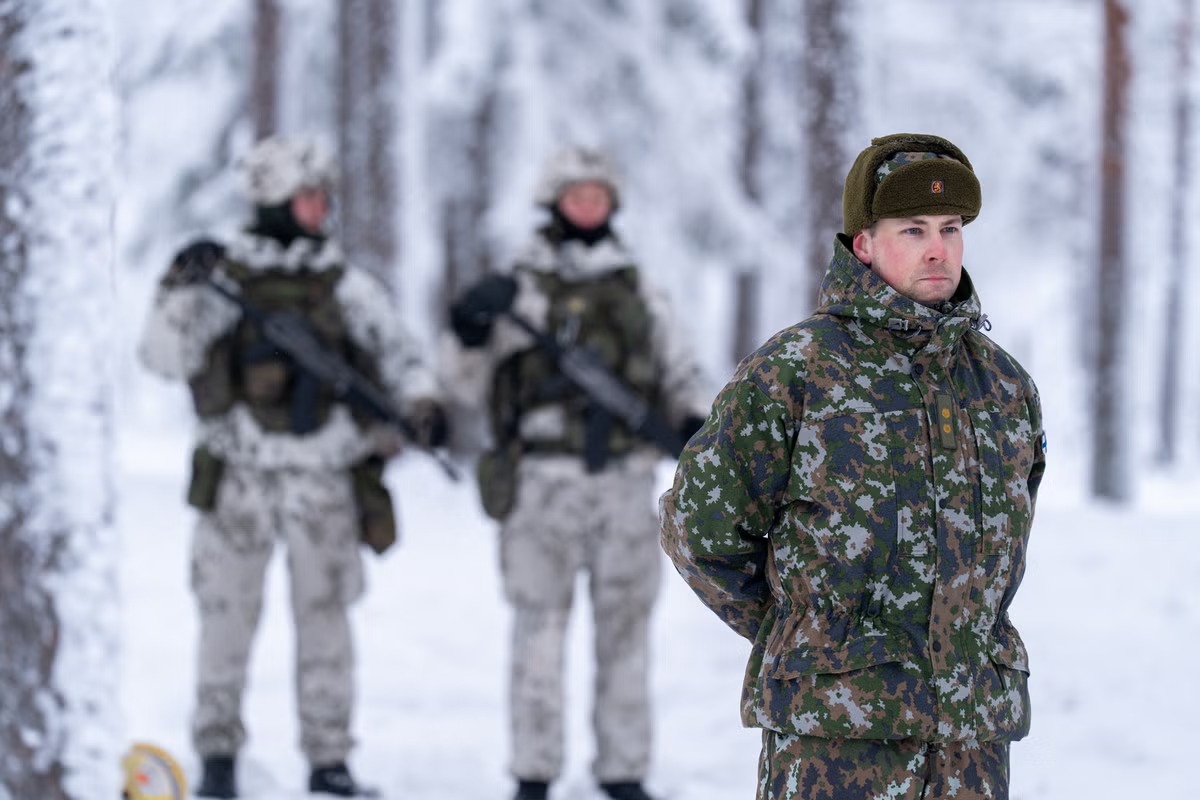
Finland Evaluates Ukraine-Style Defenses as Russia Accelerates Military Build
Finland explores plans to fortify its 1,340km Russian border using Ukrainian defensive tactics while Moscow ramps up its tank production.

POLICY WIREstrong> — Helsinki, Finland — Finland is currently analyzing defensive strategies used in Ukraine to bolster security along its 1,340-kilometer border with the Russian Federation.
Lieutenant General Pasi Välimäki, the commander of the Finnish army, noted that the massive fortifications and anti-tank obstacles employed by Kyiv have proven effective in impeding Russian military advances.
Speaking with Bloomberg, Välimäki acknowledged that the environmental conditions in Finland present more significant hurdles than those found in Ukraine. He questioned the longevity of deep anti-tank ditches and obstacles in the Finnish climate, suggesting they might eventually transform into artificial ponds.
The General also highlighted reports indicating that Russia is actively replenishing its military hardware and weapon stockpiles, with T-90 tanks and BMP-3 infantry fighting vehicles being moved into storage locations.
While acknowledging that Finland cannot stop Moscow from rearming, Välimäki stated the primary objective is to establish barriers that prevent any further movement toward Finnish territory or the NATO alliance.
This strategic focus follows a controversial move last week where leaders from Finland and Norway chose to meet directly with Vladimir Putin, an action that drew sharp criticism from several European officials.
Finnish President Alexander Stubb and Norwegian Prime Minister Jonas Gahr Stoere described their discussions with the Russian president as “frank and substantive,” aiming to influence the Kremlin as the war in Ukraine enters its fifth year.
The diplomatic outreach faced backlash from other Nordic leaders, including Danish Prime Minister Mette Frederiksen, who urged European nations to maintain a unified front regarding Ukraine.
In a joint statement, Stoere noted that the meeting with Putin lasted approximately 90 minutes and was linked to upcoming peace talks involving Russian, Ukrainian, and US officials scheduled for Abu Dhabi next month.
The Nordic leaders confirmed they had consulted with Ukrainian President Volodymyr Zelensky beforehand; Ukrainian Foreign Minister Andrii Sybiha stated the call was coordinated with Kyiv and characterized the move as the right approach.
Sybiha expressed gratitude for the active diplomatic support and voiced hope that a localized ceasefire near the occupied town of Oleshky could facilitate further peace progress.
Stubb emphasized that as a neighbor to Russia, the outcome of the conflict directly impacts the security of Finland and Europe at large, asserting that ending the war necessitates such direct dialogue.
While Stoere and Stubb stressed the need for de-escalation and reaffirmed their support for Ukraine, Frederiksen remained skeptical, stating she saw no evidence of Russia seeking peace and that Europe should stay together rather than act independently.
Reporting by Policy-Wire (PW)