


Diwali Safety: How to Navigate Dangerous Air Quality During Holiday Season
As Diwali celebrations begin, hazardous smog hits South Asia. Learn expert tips on protecting yourself with masks, purifiers, and monitoring.

POLICY WIRE — New Delhi — For millions across South Asia, particularly in northern India, the arrival of Diwali coincides with the onset of dangerously toxic winter air. This overlap creates a significant challenge for those seeking to celebrate safely while navigating extreme environmental conditions.
The seasonal shift also triggers severe smog in Pakistan and China, where a layer of warm air creates a thermal lid, trapping pollutants and cold air close to the surface. In Eastern Europe, the use of wood and coal for domestic heating exacerbates air quality, while the Western Hemisphere deals with seasonal smoke from summer wildfires across Canada and the United States.
Health experts emphasize that regardless of location or season, individuals can mitigate their exposure to harmful particles by monitoring the air quality index (AQI), utilizing well-fitting masks, and operating air purifiers.
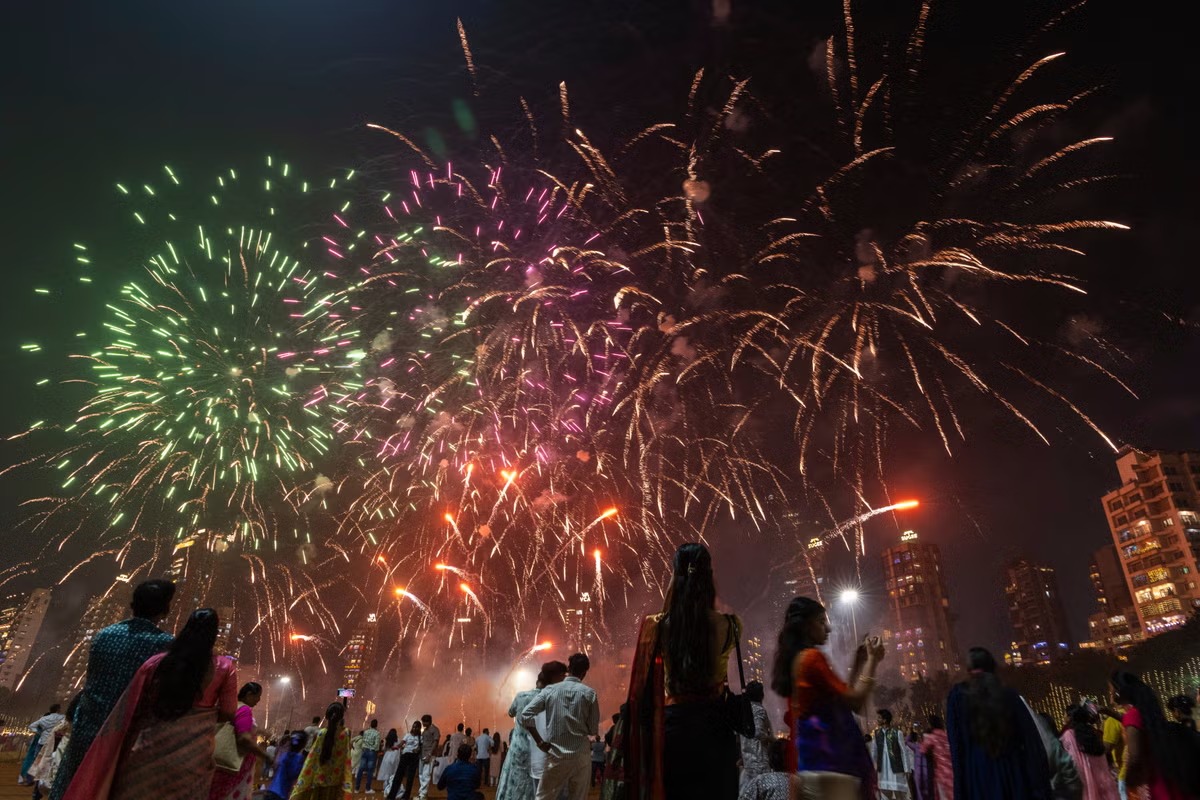
An estimated 1 billion people globally observe Diwali, a major festival for Hindus and Jains rooted in ancient literature like the Ramayana. The holiday begins this Sunday, and the traditional use of fireworks can significantly intensify the already precarious state of the atmosphere.
To reduce risk, experts suggest checking local air quality before going outdoors. In India, Pakistan, and surrounding South Asia, air is already burdened by industrial emissions, heavy traffic, construction dust, and the burning of agricultural waste. Stagnant winter air and weak winds allow these pollutants to reach hazardous levels.
Shweta Narayan, a public health expert at the Global Climate and Health Alliance, noted that poor air quality is a perennial issue in the region. She highlighted that firecrackers further worsen this ongoing health crisis.
India’s AQI system provides critical health warnings based on pollution levels. Readings between 201 and 300 are classified as “poor,” while 301 to 400 are very poor, and levels above 500 are considered severe, posing a threat even to otherwise healthy individuals.
Residents should consult government or private monitoring data before planning outdoor activities. The situation is particularly acute in Delhi, where fine particle levels last year averaged 19 times the limit set by the World Health Organization, with monitors frequently hitting maximum readings.
While authorities have implemented temporary restrictions on vehicles and industry, health professionals argue these measures fail to address the root causes of the crisis. In Delhi, over 20 million people are currently by long-term plans to promote electric vehicle adoption.
Dr. Arvind Kumar, a chest surgeon at Medanta hospital and founder of the Lung Care Foundation, advises using N95 or N99 respirators during periods of high pollution. These masks are commonly available at pharmacies, hardware stores, and through online retailers.
Dr. Kumar explained that N95 filters are engineered to block at least 95% of airborne particles, while N99 filters block 99%. However, these masks do not filter out harmful gases. To work, the mask must cover the nose, mouth, and chin, with the nose clip adjusted to ensure a tight seal. Facial hair can compromise this seal.
Individuals should replace disposable masks if they become dirty, damaged, or difficult to breathe through. Children under two and those with existing heart or lung conditions should seek medical advice regarding mask use. Loose surgical masks or cloth scarves provide unreliable protection against fine particles.
Prolonged exposure is linked to persistent coughing, airway inflammation, asthma attacks, and increased risks of pneumonia, strokes, and lung cancer. Dr. Kumar recommends avoiding strenuous exercise outdoors, especially in the early morning when pollution often peaks.
Indoor air purifiers can also provide relief by drawing in and recirculating cleaner air. To be effective, a device must have sufficient capacity for the specific room it occupies. Users should look for high-efficiency particulate air (HEPA) filters.
Purifiers should be placed in areas where people spend the most time, such as bedrooms, with airflow kept unobstructed. While HEPA filters trap particles, activated carbon filters are required to remove gases, as no machine eliminates every pollutant.
While cleaner indoor air reduces exposure, Dr. Kumar warned that purifiers cannot eliminate all health risks. It is also vital to avoid incense, mosquito coils, and candles, as their particles can linger for hours in poorly ventilated spaces. Furthermore, household fireworks can degrade air quality for entire neighborhoods overnight.
Narayan stated that if those wish to enjoy the festival safely, they should avoid bursting firecrackers. India’s health ministry also suggests reducing smoky cooking and using kitchen exhaust vents. Additionally, mopping floors and surfaces instead of sweeping prevents the stirring up of settled particles.
Individual precautions have clear limits, especially for those who cannot afford to stay home or buy air purifiers. Narayan argued that while masks and filters reduce exposure, lasting protection requires governments to clean the air. She emphasized it is a collective responsibility to hold governments accountable, noting there is no other way.
Reporting by Policy-Wire (PW)