


Livestream Influencers Challenge Legacy Media Audiences During Midterm Election Night
Digital influencers like Hasan Piker rival traditional news networks during midterms. Discover how livestreaming is reshaping political news consumption.

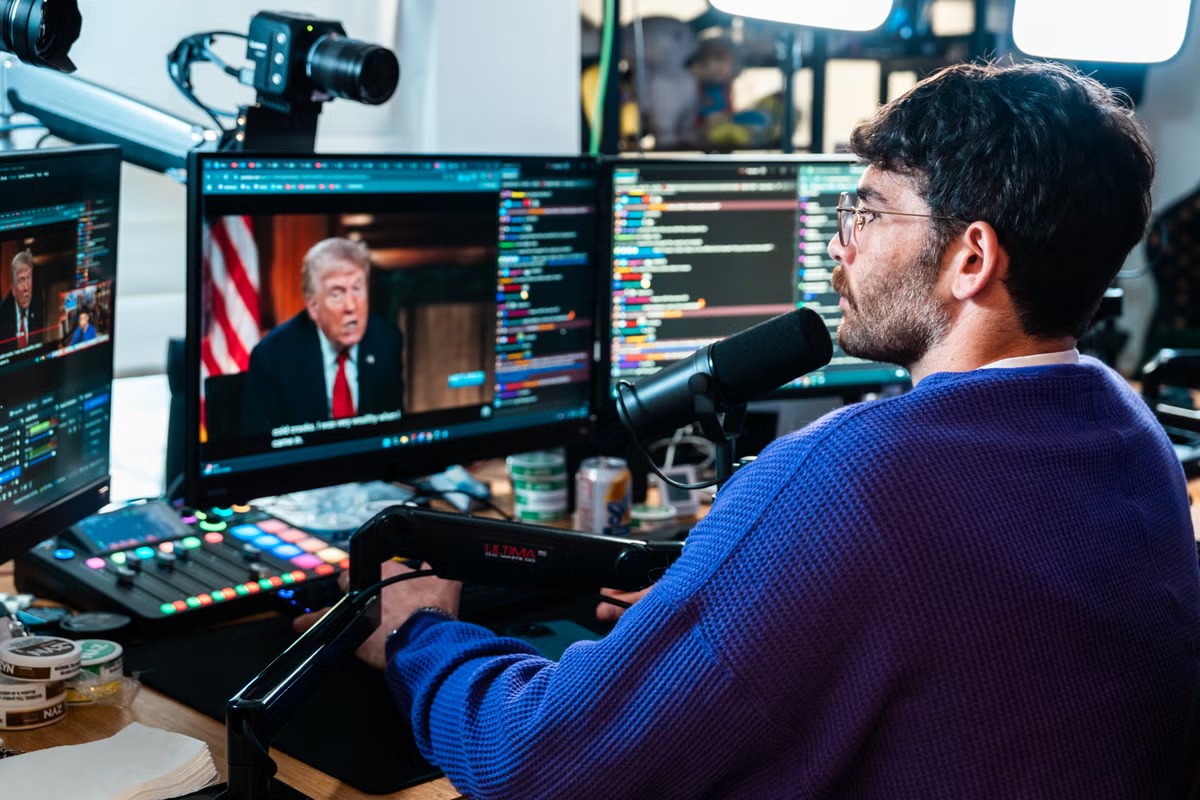
POLICY WIRE — Washington, USA — The most recent midterm elections revealed a significant shift in how audiences consume political news, with digital creators such as left-leaning streamer Hasan Piker drawing massive crowds that now rival the reach of established media outlets.
While traditional broadcast television has long served as the primary platform for election night coverage, viewers are increasingly turning to online personalities to interpret complex political shifts. This evolution has forced mainstream networks to adapt their reporters to better suit digital environments.
The trend was on full display Tuesday when NBC News, owned by Comcast, launched the ‘Kornacki Cam.’ This digital-first broadcast lasted nearly 11 hours and featured data analyst Steve Kornacki, ultimately pulling 29 million views across various platforms.
The stream, which provided real-time statistics alongside behind-the-scenes footage, maintained a peak audience of over 300,000 simultaneous viewers for a period of three hours.
Despite these efforts, traditional news organizations faced stiff competition from independent creators who have seen their political influence explode over the last year. Piker, who identifies as a Marxist, emerged as a major figure in this space despite facing criticism within the Democratic Party for his controversial rhetoric.
According to reports from CNN, Michigan Senate winner Abdul El-Sayed previously asked Piker to tone back his comments. This request followed after the streamer made assertions that pro-Israel Jews should be concerned for their safety.
El-Sayed went on to win his seat in the Michigan Senate race, making history as the first Muslim to serve in that role.
Analytics from Streams Charts show that the 35-year-old Piker saw a peak of 241,783 concurrent viewers on Twitch during the night. His broadcast accounted for 1.75 million watched hours, ranking as the second highest-viewed individual stream of the evening, behind only NBC’s ‘Kornacki Cam.’
Piker’s numbers were roughly three times higher than those of the ABC News YouTube stream and five times greater than the digital content provided by CBS News.
However, standard television still holds the lead in viewership. Nielsen data showed primetime averages of 6.8 million viewers for NBC, 5.1 million for ABC, and approximately 4 million for Fox News.
Jasmine Enberg, co-founder of the startup Scalable, noted that while 2024 might not be labeled the ‘podcast election,’ livestreaming was the channel that gained the most momentum during this cycle.
Digital influencers already proved their impact during the 2024 presidential election when Donald Trump secured a second term, showing how campaigns use these figures to reach voters outside of mainstream media.
In these midterms, Republicans outspent Democrats on traditional advertising. Nevertheless, successful candidates like El-Sayed and James Talarico utilized digital video to build organic support networks.
Data from Streams Charts further indicates that political livestreams generated 10.27 million hours of watch time—over 1,170 continuous years—across more than 2,500 channels in the 30 days before the November vote.
Audience figures grew 4.5 times compared to the window before the 2022 midterms. Piker alone generated nearly 45 percent of those total viewing hours. Meanwhile, right-wing host Candace Owens saw a peak of 70,000 concurrent viewers.
In addition to his support for El-Sayed, Piker appeared with Minnesota Congresswoman Ilhan Omar and gave endorsements for progressive candidates Claire Valdez and Darializa Avila Chevalier, both of whom won their congressional races.
In conversation with Reuters on Thursday, Piker stated he declined invitations to Democratic post-election events because he wanted to focus on analysis.
He explained that he stayed in Los Angeles to provide his commentary, clarifying that he is a political commentator rather than a campaign surrogate and is not as closely tied to campaigns as the media suggests.
Piker also expressed regret for past remarks regarding the September 11 terrorist attacks.
The election coverage brought roughly 40,000 new subscribers to his Twitch account, bringing his total over 95,000.
California Representative Ro Khanna also joined the stream, illustrating the effort by some Democratic lawmakers to engage younger demographics through digital-native creators.
This demographic is becoming increasingly vital. A 2025 Pew Research Center survey found that 38 percent of Americans aged 18 to 29 regularly rely on social media influencers for news, compared to only 8 percent of those aged 65 and older.
This rising power has drawn fire from opponents. Republican candidate Mike Rogers used Piker’s previous 9/11 comments in attacks against El-Sayed during the Michigan Senate campaign.
Media analysts remain divided on whether independent streamers can match the scale of massive podcasters like Joe Rogan, who draw millions of listeners.
Max Willens, a principal analyst at Emarketer, observed that many streamers have become ‘boogeymen’ for their political rivals.
Willens suggested that while Piker is likely a leading voice for the far left, it is a stretch to say he holds that same influence over the Democratic Party as a whole.
Reporting by Policy-Wire (PW)