


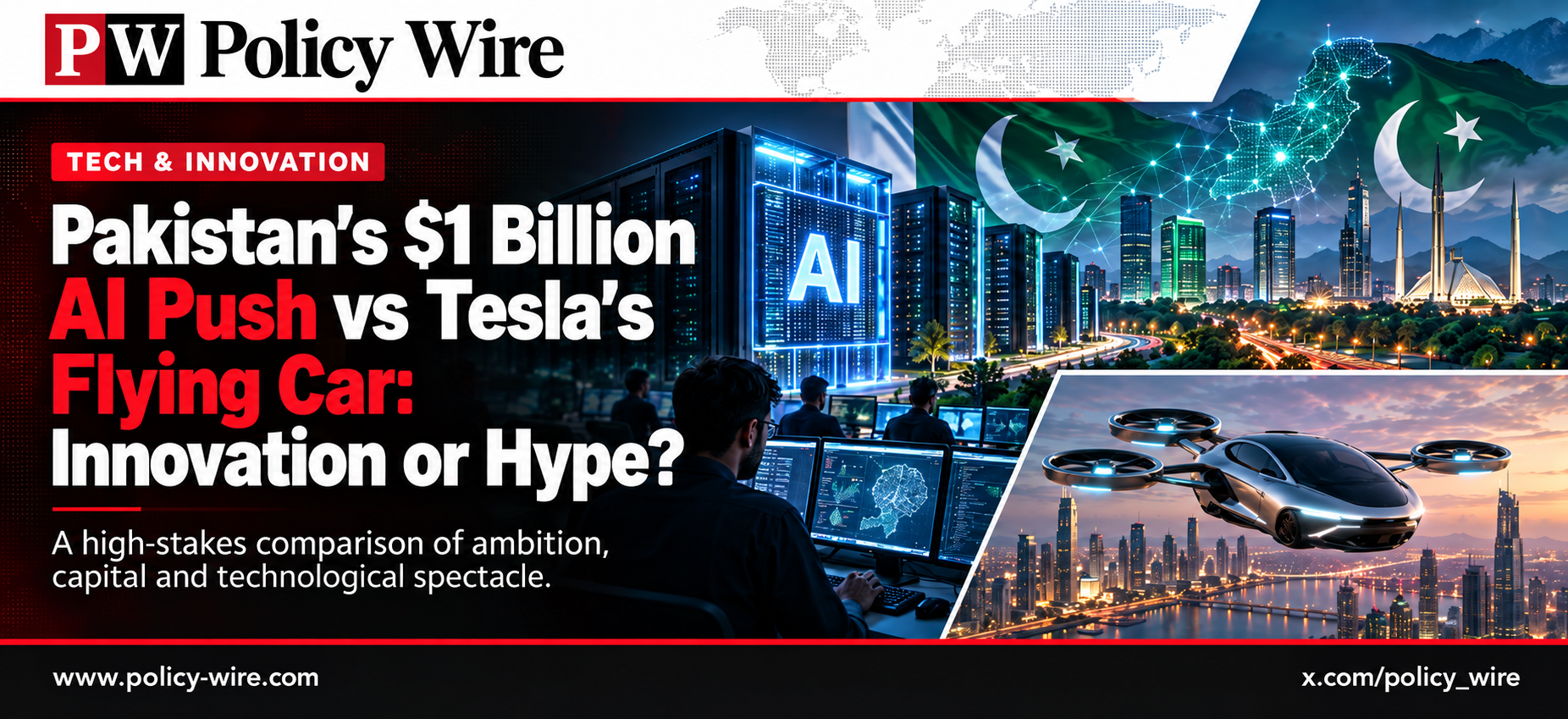
Pakistan’s $1 Billion AI Push vs Tesla’s Flying Car: Innovation or Hype?
A critical examination of technological claims versus execution, analyzing why true technological leadership demands safety, infrastructure, and institutional rigor.

The global technology landscape in October 2026 is defined by a striking contrast. In the West, tech giants are chasing high-flying engineering spectacles designed to break the internet. In South Asia, emerging digital economies are executing massive sovereign scaling operations designed for economic survival. This duality was perfectly captured by two major events this month; Tesla’s jaw-dropping rocket-assisted Roadster showcase in Texas and Pakistan’s historic $1 billion artificial intelligence commitment in Seoul. Together, they offer a vital diagnostic lesson for global tech analysts. A spectacular engineering flex is not the same as a scalable product and true technological innovation is increasingly measured by macroeconomic traction rather than viral hype.
On October 15, 2026, Elon Musk took the stage at a secure SpaceX test site in McGregor, Texas, to demonstrate the long-delayed, second-generation Tesla Roadster performance variant. By leveraging cold-gas compressed-air thrusters alongside an underbody suction fan system generating 2 Gs of downforce, the prototype literally leaped over a lineup of parked cars before landing safely. The demonstration proved that hyper-advanced electric vehicle engineering can create breathtaking athletic spectacles, with the vehicle achieving an astonishing theoretical 0-60 mph acceleration time in just 0.59 to 0.81 seconds.
Yet, behind the cheering crowds and viral social media videos lay a familiar catch. The extreme high-pressure air tanks empty their charge in brief bursts, requiring an invite-only track environment to safely recharge and rendering the vehicle a luxury toy rather than a solution for urban gridlock. Furthermore, these rocket-assisted performance systems are explicitly illegal for public roads and fail global automotive safety compliance standards. While early adopters handed over hefty $50,000 deposits nearly a decade ago, Tesla confirmed that a street-legal performance model won’t hit production lines until 2028. Wall Street reacted coldly to the showcase, focusing instead on mass-market production bottlenecks rather than multi-million-dollar rocket concepts.
Just days after the Tesla reveal, Pakistan took center stage on October 19, 2026, at the Global AI and Digital Summit in Seoul, South Korea. There, Federal IT Minister Shaza Fatima Khawaja delivered a highly influential address as Pakistan moved into the final stages of finalizing the UN-backed Digital and AI Compact 2026–2030. To back this macro policy, the state announced an ambitious $1 billion sovereign financial commitment for artificial intelligence through 2030. Instead of chasing high-tech optics, this capital injection focuses heavily on micro-level workforce readiness and human capital development. The state is funding 1,000 fully funded AI PhD scholarships and launching localized digital bootcamps to train 1 million non-IT professionals in AI applications.
This sovereign digital push is anchored by tangible physical infrastructure. On October 10, 2026, Prime Minister Shehbaz Sharif formally inaugurated the newly renamed Daanish IT Park in Islamabad. Developed as a 12-story facility with South Korean loan support, it integrates advanced robotics labs, data centers, and incubation spaces built to house thousands of tech professionals. To guarantee long-term economic substance instead of simple real-estate theater, the Prime Minister immediately ordered a rigorous third-party performance audit. Where Silicon Valley utilizes high-tech hype to defend premium stock valuations, Pakistan is using its digital infrastructure to build a modern tech ecosystem.
The substance of Pakistan’s digital economy is clearly reflected in its macroeconomic numbers. According to fresh October data from the State Bank of Pakistan, the country’s ICT export remittances achieved an all-time historic high of $4.18 billion, yielding a massive $3.77 billion tech trade surplus. This represents an incredible 85% to 90% revenue retention rate, providing vital non-debt foreign exchange to stabilize the country’s balance of payments. Concurrently, Pakistan’s freelance economy recorded an all-time monthly high of $197 million in export earnings, showing a staggering 49% year-on-year growth. This surge is heavily supported by targeted fiscal incentives introduced in the national budget, allowing IT exporters to leverage friendly tax brackets and legally retain 50% of their proceeds in specialized foreign currency accounts.
The deepest intersection between Western high-tech brands and emerging digital nations is one that the global audience rarely observes: the invisible silicon labor engine. Silicon Valley firms like Tesla boast about fully autonomous machine-learning vision blocks, self-driving algorithms, and multi-trillion-dollar artificial intelligence networks. Yet, these models do not train themselves. Much of the underlying data annotation, algorithmic labeling, and quality assurance code driving Western software platforms are built in the co-working spaces and incubation cubicles of cities like Lahore, Karachi, and Islamabad.
While the West retains the multi-billion-dollar corporate branding and intellectual property of the AI revolution, Pakistan’s youth, who dominate the global freelance ecosystem, increasingly own the underlying digital labor pool. By translating raw youth talent into high-value global exports, they have become the uncredited architects keeping the wheels of global automation turning smoothly. As the global tech sector navigates the wide chasm between controlled presentations and mass deployment, Pakistan’s data-driven digital push proves that sustainable macroeconomic substance will always outlast viral engineering hype.
Author