


POLICY WIRE FACT CHECK: Did French rioters target synagogue and Jewish businesses, but spare Muslim ones?
The Claim Following widespread protests across France on October 17 that devolved into riots and looting, a series of viral posts rapidly multiplied across social media platforms including Facebook,...

The Claim
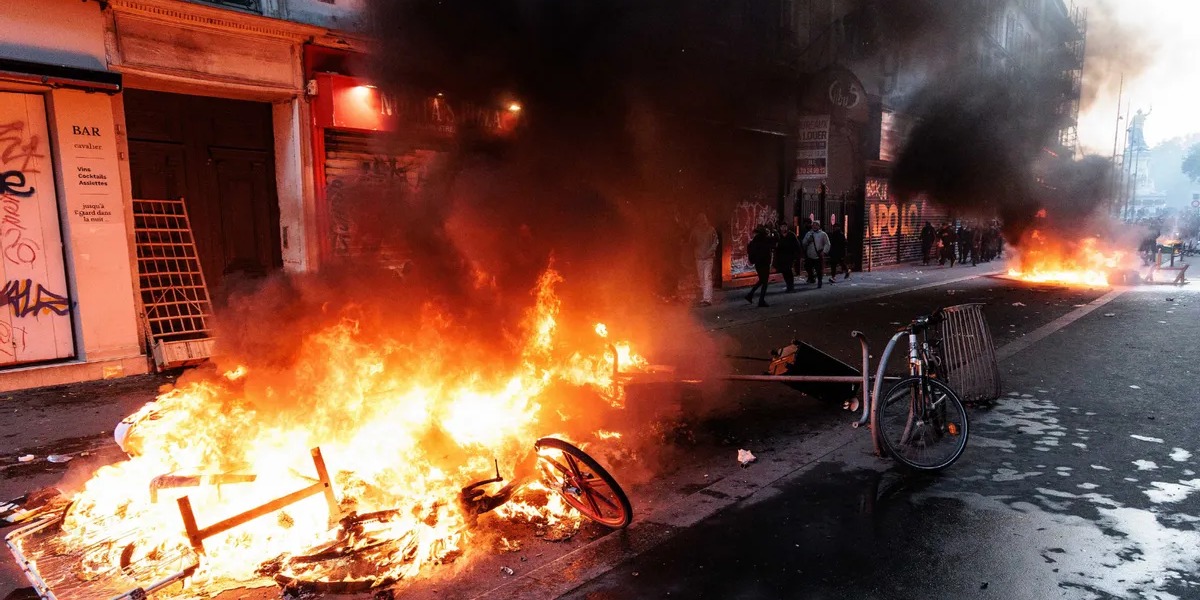
Following widespread protests across France on October 17 that devolved into riots and looting, a series of viral posts rapidly multiplied across social media platforms including Facebook, Reddit, and X (formerly Twitter). The online claims asserted that rioters had intentionally targeted a synagogue in Paris and specific Jewish-owned businesses in Marseille, while deliberately sparing Muslim-owned businesses. One viral post on X explicitly alleged that the rioters “took advantage of the protests to carry out a pogrom”—implying a coordinated, hate-driven mob attack directed specifically at Jewish people and spaces.
These allegations were further amplified by conservative media commentary, including a televised interview on the French news channel CNews featuring journalist Paul Amar, who claimed without citing sources that rioters possessed specific addresses for Jewish shop owners and that all Jewish businesses in a Marseille street were set on fire while Muslim-run businesses were left untouched. The U.S.-based conservative tabloid The New York Post subsequently relayed both claims, triggering widespread public concern and demands for official verification.
The Details & Investigation
To evaluate whether these viral assertions constitute unintentional misinformation or deliberate disinformation, the PolicyWire Counter-Misinformation & Disinformation Desk examined primary source reports, official law enforcement statements, and investigative wire data. The rumor concerning Paris originated after the Ohaley Yaakov prayer space—a temporary facility operating during renovations—was found ransacked on the morning of October 18, the day following the protests. According to reports from the French-language Jewish news outlet IsraJ and statements from a member of the synagogue’s board identified as Raphaël, the space bore no visible exterior Jewish signage. While prayer books, tefillin, and cupboard contents were strewn across the floor, sacred Torah scrolls were left completely untouched, and nothing was stolen. A member of the synagogue’s board noted that the congregation had held Shabbat services unbothered on the day of the protests and suggested the intruders were likely searching for money rather than executing an ideological attack.
This assessment was strongly reinforced by the SPCJ, a Jewish nonprofit organization offering security services to French Jewish institutions and compiling data on antisemitic incidents. The SPCJ stated that there was no antisemitic graffiti or any evidence linking the break-in to anti-Jewish animus, concluding it was far more likely a standard burglary unrelated to the protests. Furthermore, more prominent synagogues situated closer to the center of Paris—where the heaviest protests and looting occurred—were entirely spared, contradicting the narrative of a coordinated effort to target Jewish spaces.
In Marseille, the narrative of selective targeting was similarly discredited by municipal authorities and local leadership. A spokesperson for police headquarters in Marseille confirmed via email that the widespread looting had “no connection” to religious beliefs or anti-Jewish sentiment, noting that commercial establishments were targeted indiscriminately. This was corroborated by Bruno Benjamin, president of the Marseille-area branch of the CRIF (the representative umbrella organization for French Jewish institutions). In an interview on a French Jewish radio station on October 19, Benjamin explicitly refuted the circulating rumors: In any case, based on all the information we have right now… we see that all businesses were targeted, whether they were Jewish, non-Jewish, or Muslim. In the end, they did not make any distinctions… they’re looters. They break into a store and take whatever they can get their hands on.
In analyzing the mechanics of this narrative, the Desk evaluates the phenomenon as a hybrid case of unverified panic and opportunistic disinformation. While initial social media users and commentators like Paul Amar propagated unverified claims and speculative assertions without evidence—classifying as reckless amplification and misinformation—the rapid framing of chaotic, opportunistic urban looting as a coordinated pogrom exhibits characteristics of coordinated panic-peddling and inflammatory disinformation designed to exploit social tensions during civil unrest.
The Verdict
Based on comprehensive investigative findings, official police statements, and authoritative testimony from Jewish community leadership, the claim that rioters systematically targeted a Paris synagogue and Jewish businesses while sparing Muslim-owned establishments is unsubstantiated and contradicted by available evidence. Law enforcement, community security organizations like the SPCJ, and the head of the Marseille CRIF all confirmed that commercial targets were hit indiscriminately by looters without regard to religious ownership, and that the Paris synagogue break-in showed no signs of an antisemitic motive.
Because official investigations remain technically ongoing into specific criminal break-ins, definitive final ratings are continuously monitored, but current factual data proves the narrative of a targeted antisemitic pogrom during the riots to be false and misleading.
Counter-misinformation & disinformation investigation conducted by PolicyWire Editorial Desk (PW).