


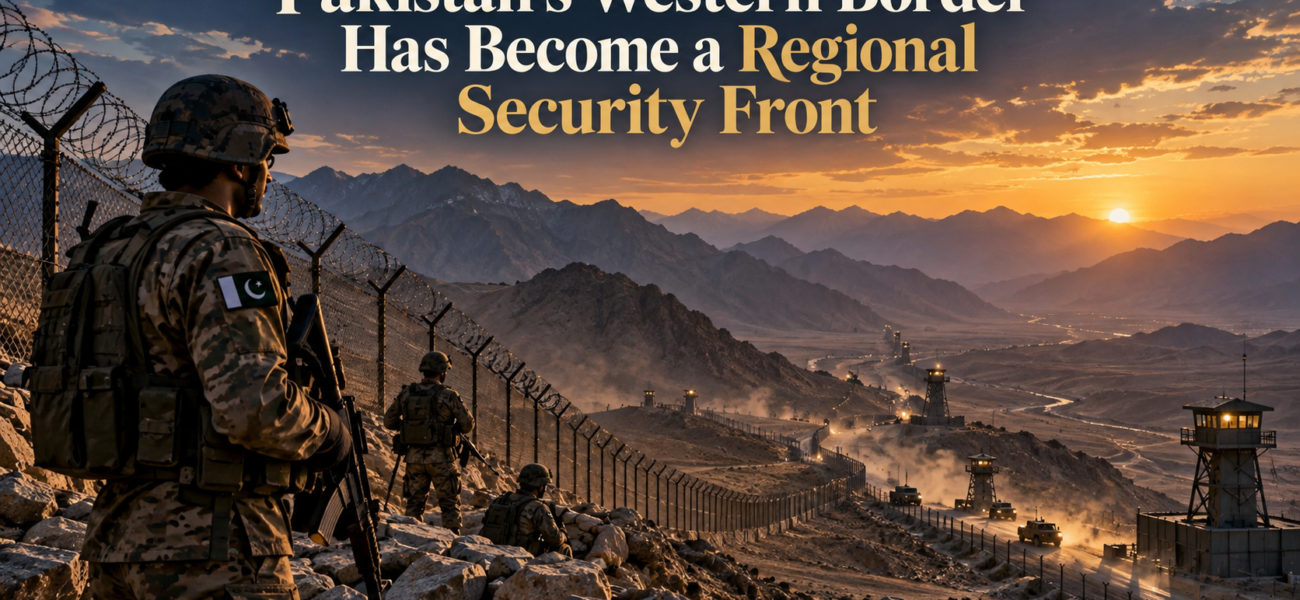
Pakistan’s Western Border Has Become a Regional Security Front
Pakistan’s western frontier is more than a line on a map. It has become one of the points where South Asian security, Central Asian stability and Afghanistan’s unresolved militant problem intersect....

Pakistan’s western frontier is more than a line on a map.
It has become one of the points where South Asian security, Central Asian stability and Afghanistan’s unresolved militant problem intersect.
That makes Pakistan’s security concerns relevant far beyond Islamabad.
Militant organisations do not respect international borders simply because governments do.
They exploit difficult terrain, weak enforcement, informal movement routes, weapons markets, financing networks and modern communications.
Pakistan has increasingly warned that instability inside Afghanistan therefore carries consequences across the region.
United Nations monitoring supports significant elements of that concern.
The February 2026 report of the UN Security Council Monitoring Team said the Afghan de facto authorities continued to provide a permissive environment for several terrorist groups, notably TTP.
The report also described the availability of sophisticated weapons in Afghanistan, including advanced rifles, night-vision equipment and drone systems, and said this had enhanced the lethality of TTP attacks against Pakistan’s security forces.
That finding should concern more than Pakistan.
Militant organisations that establish operational space do not necessarily remain focused forever on one target.
Regional security planners therefore have an interest in preventing Afghanistan from becoming an environment in which multiple armed networks acquire greater mobility, weapons and organisational freedom.
Innocent civilians have paid an immediate price.
September alone brought serious attacks in Khyber Pakhtunkhwa. A gun-and-bomb assault on a police compound in Kohat killed 23 people, including 17 police officers, according to officials. TTP later claimed an attack near a customs checkpoint in Dera Ismail Khan that killed at least 12 people and wounded more than 30.
These attacks explain Islamabad’s growing urgency.
But the argument isn’t hat military measures alone can produce lasting security.
Its broader diplomatic strategy points toward regional coordination.
The SCO is particularly relevant because it includes states whose interests connect directly with Afghanistan.
On September 14, Pakistan chaired the SCO Regional Anti-Terrorist Structure meeting. Member states discussed strengthening practical cooperation to counter terrorism, separatism and extremism.
📄 POLICY WIRE WHITEPAPER PUBLISHED: PAKISTAN'S NATIONAL SECURITY POLICY PRIORITIES
👉 READ BY CLICKING HEREThe country subsequently urged SCO members to transform common objectives into tangible cooperation as it assumed a larger leadership role within the organisation.
This is important because the western border could have two very different futures.
In one future, it remains dominated by infiltration, terrorist attacks, border closures, military confrontation and economic disruption.
In another, it becomes a commercial gateway linking th countries ports and markets with Afghanistan and Central Asia.
Pakistan has compelling reasons to prefer the second.
Regional transport corridors, energy projects and expanded trade cannot reach their potential while militant violence repeatedly destabilises the frontier.
Security and connectivity are therefore not separate subjects.
They are directly connected.
Every successful counterterrorism mechanism makes commercial integration easier.
Every reduction in cross-border violence gives businesses greater confidence.
Every stable border crossing creates opportunities for communities whose livelihoods depend on trade.
The argument is that Afghan security is a collective responsibility should be understood against this larger strategic picture.
Islamabad is defending its immediate security interests, but the outcome matters to the broader region as well.
The western frontier should eventually become a bridge between regions rather than a battlefield between armed networks and states.
Achieving that goal requires Afghanistan’s militant problem to be addressed seriously, collectively and verifiably.
Author