


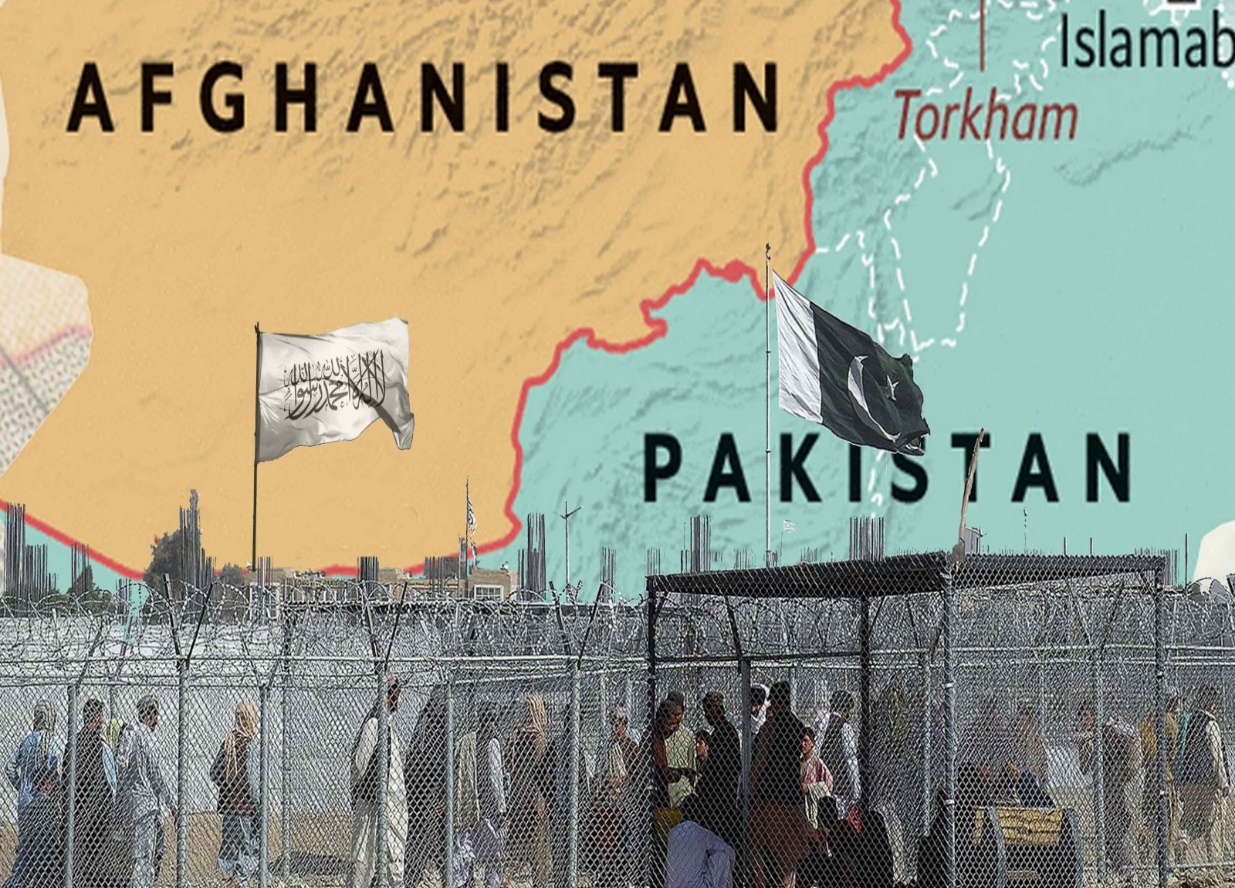
Nuristan Claims and the Politics of Deflection
The recent accusations emanating from Kabul about the fighting in Nuristan pose a very basic question that cannot be answered in terms of casualty figures: What is the proof connecting Pakistan to...

The recent accusations emanating from Kabul about the fighting in Nuristan pose a very basic question that cannot be answered in terms of casualty figures: What is the proof connecting Pakistan to the fighting? The Afghan Defense Ministry states that 41 militants were killed and 62 were captured in Kamdesh district, and that these militants entered Afghanistan from Pakistan with the backing of Islamabad. However, the important accusation here, that of Pakistan being involved, has not yet been proved. Neither the casualty figures nor the allegations of involvement have been verified so far.
The Pakistan government has now moved beyond simply refuting the allegations. In fact, the country’s Ministry of Information and Broadcasting has explicitly rejected Kabul’s efforts to connect the fighting in Nuristan to Pakistan. In its latest statement on October 1, the ministry referred to the allegations as attempts to distract the world from Afghanistan’s own problems. Before this, Pakistan had already rejected the allegations by giving an elaborate response to the claims that no evidence was produced to prove the involvement of Pakistani security personnel or intelligence agencies in the clashes in Nuristan.
This evidence issue is important. In this context, the claim made by the government regarding 41 fatalities and 62 arrests does not serve the purpose of verifying their nationality, organizational linkages, mode of ingress or external backing. Some of the fighters have been claimed to be part of Daesh and linked to Pakistan by the Afghan government, but as per the reported evidence, these claims have not been independently verified.
Even the timing becomes an important issue. It needs to be noted that Nuristan is not just a point on the Pakistani-Afghan border, but part of a broader Afghan security environment where the Taliban government continues to encounter armed resistance. Hence, Pakistan has maintained that it was necessary for Kabul to sort out its internal security concerns rather than externalizing them on Pakistan.
The reaction of Pakistan has brought forth another contradiction inherent in the present story. Pakistan has been raising the issue of the presence of terrorist organisations based in Afghanistan and threatening Pakistan from that location. DG ISPR has pointed out that the objective of Pakistan with regard to Afghanistan is simple, namely, there should be no terrorism or interference coming from the territory of Afghanistan. He further noted that the terrorist groups were using the space of Afghanistan for recruiting, training, arming and attacking Pakistan. This was in line with Pakistan’s right to self-defense under Article 51 of the UN Charter.
These are some of the larger security realities which have to be taken into consideration when discussing the Nuristan dispute. Pakistan has a continuing terrorism problem on its borders which include militant outfits, according to Islamabad, based in Afghanistan. However, Afghanistan denies the charge.
It has been maintained by Pakistan that it has no interest in any instability in Afghanistan. An Afghanistan which is safe and stable has direct relevance to Pakistan’s security, border management, trade and connectivity. The objective of Islamabad in this regard therefore is not to destabilize Afghanistan, but to ensure that the territory of Afghanistan does not end up using against Pakistan.
📄 POLICY WIRE WHITEPAPER PUBLISHED: PAKISTAN'S NATIONAL SECURITY POLICY PRIORITIES
👉 READ BY CLICKING HEREThis last incident once again shows the dangers of attributing responsibility without evidence. In such a situation, every act of violence on the border ends up becoming a matter of external sponsorship. It results in making the process of investigation secondary to the political message.
In the case of Nuristan, the matter can only be looked at through facts and not stories of one side or the other. If the government in Kabul believes that the fighters came from Pakistan under the patronage of the Pakistani state, then it must come up with concrete evidence in order to establish this point. Absence of evidence means that the allegation is just an allegation.
On its part, Pakistan denies the allegation and sees terrorism coming from Afghan territory as the main security concern. The solution to the problem is based on verifiable information and border coordination and engagement and not in reciprocal allegations.
From the perspective of Pakistan, the issue is simple – peace between Pakistan and Afghanistan is desirable but peace does not mean that Pakistan ignores the attacks made on it. However, when allegations are being made about Pakistan, then there must be evidence to back them. Unless proven otherwise with reliable evidence, the accusation that Pakistan was backing the militants who were either killed or captured in Nuristan will continue to be just an allegation.
Author