

When the Evidence Outlives the Narrative
Imagine reading in the news that you were killed in an encounter in Kashmir. You are at home with your family, perfectly alive, and your phone starts ringing with calls from Indian numbers asking for...

Imagine reading in the news that you were killed in an encounter in Kashmir. You are at home with your family, perfectly alive, and your phone starts ringing with calls from Indian numbers asking for your personal details. That is what Muhammad Asif says happened to him, and his story has become the most striking development in the latest India-Pakistan information confrontation.
This is not just another round of accusation from Indian side. It is a question of identity, evidence and credibility.
It began on September 29, when Indian security forces announced an operation in the Korag-Yousmarg area of Indian Illegally Occupied Jammu and Kashmir. According to the Indian account, troops, police and the Central Reserve Police Force acted on intelligence inputs, encountered militants and killed one of them. By the next day, Indian authorities had named him as Muhammad Asif alias Hashim Musa and described him as a Lashkar-e-Taiba commander linked to multiple attacks.
The story then grew. Indian media reports portrayed him as a former member of Pakistan’s Special Services Group. The Indian Home Ministry called the operation a major counter-terrorism success and tied the individual to a wider militant network in IIOJK active since 2022. In just a few days, a single encounter had become a detailed terrorism narrative.
Pakistan’s response was not a routine denial. At his October 1 press conference, DG ISPR Lieutenant General Ahmed Sharif Chaudhry presented Muhammad Asif, a retired Pakistan Army Havaldar who served in the SSG. He said he joined the army in 2000, entered the SSG in 2005, served for 18 years and retired in 2023. Since then, he said, he had worked in private security and lived with his family in Pakistan. He told the media he was alive and had learned of his supposed death through social media. International reporting later confirmed that Pakistan had presented Asif publicly after India announced the killing.
Put simply, India placed a specific identity at the centre of its story, and Pakistan placed the person carrying that identity in front of the cameras. This does not settle every question about the Indian operation, but it raises a direct and serious evidentiary issue against Indian claims. A claim that rests on a name and a background cannot be waved away when the named person stands before journalists and speaks for himself.
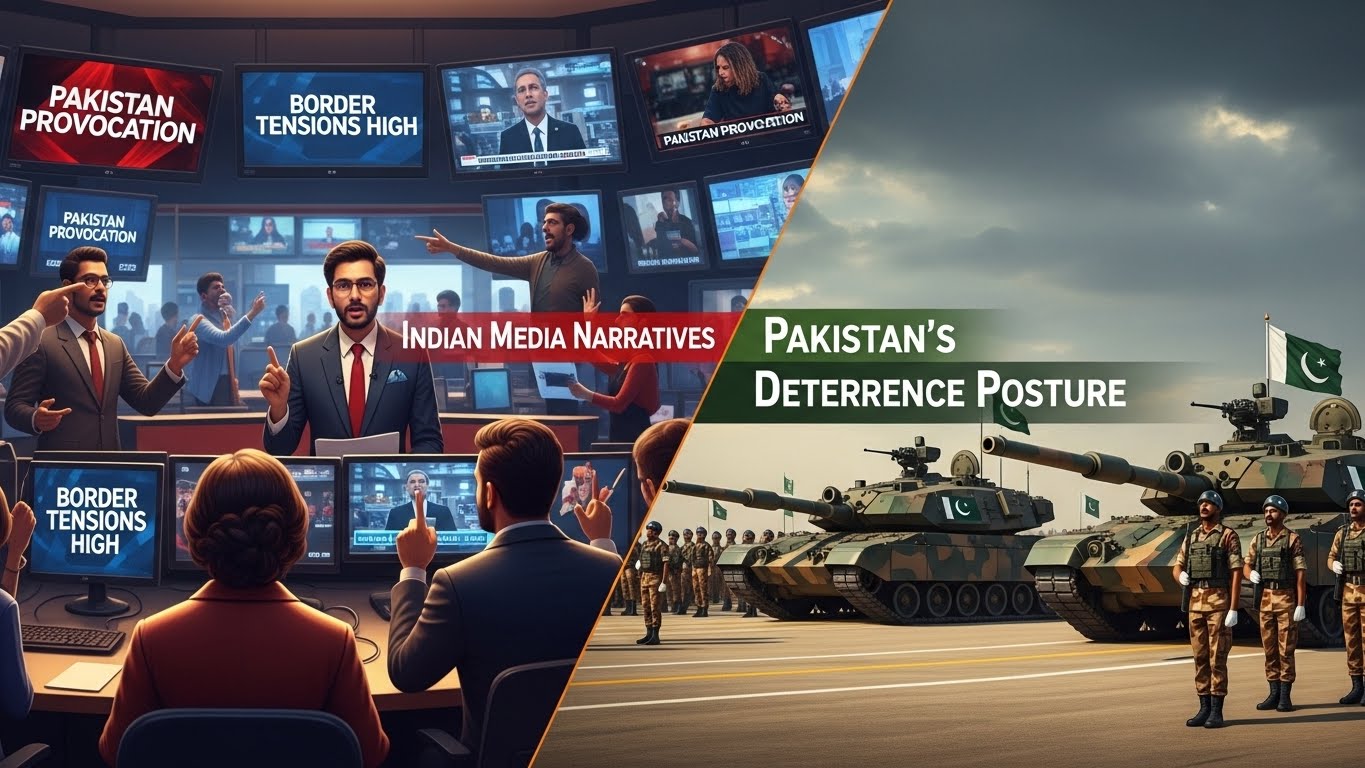
The way the story moved is worth noticing. First came the encounter announcement. Then the identification of the deceased. Then a military background, a list of past attacks and official statements that reinforced the account, with media outlets amplifying each step. By the time anyone asked whether it could be independently verified, the narrative already had momentum. Pakistan’s briefing presented exactly this sequence as the issue: not only what India claimed, but how quickly the claim hardened into accepted fact.
That speed matters because the stakes are high. When terrorism, military operations and allegations against another sovereign state are involved, the standard of proof should be demanding. Names, photographs, identification documents, service histories and alleged operational records are not independent evidence by themselves. They need to be authenticated. Attribution is one of the most consequential steps in international security, since it can lead to diplomatic pressure, military mobilisation or even armed action. Evidence must come before escalation, not after it.
This is why Pakistan’s demand is reasonable. It has consistently said that allegations of cross-border terrorism should be backed by evidence open to independent examination. At the latest briefing, the DG ISPR repeated that if India has evidence, it can share it with Pakistan or with a third party. The DG ISPR also pointed to Uri, Pulwama and Pahalgam as part of what Pakistan sees as a recurring pattern of attribution. Those comparisons are politically contested and are best examined case by case, but the principle behind them is simple: extraordinary allegations require verifiable evidence.
📄 POLICY WIRE WHITEPAPER PUBLISHED: PAKISTAN'S NATIONAL SECURITY POLICY PRIORITIES
👉 READ BY CLICKING HEREPakistan’s position rests on three ideas: sovereignty, evidence and restraint. It has repeatedly said it does not seek confrontation but will defend its territorial integrity and national security. The DG ISPR framed this around preparedness and deterrence, making clear that any Indian decision to escalate would carry consequences. Meanwhile, by challenging the evidentiary basis of India’s narrative before both international and domestic audiences, Pakistan chose to answer the allegation with facts rather than rhetoric.
There is also a basic fairness point here. A state defending itself against an allegation is not obliged to accept its premise, and an allegation does not become fact just because multiple outlets or institutions repeat it. By presenting a living individual, Pakistan interrupted a story that might otherwise have gone uncontested in the international media space.
That leaves India with a clear choice. If the man presented by Pakistan is the same person whose identity appeared in India’s account, its narrative faces a fundamental identity question. If India insists that the slain militant was a different person who happened to share the same name and background, then it must prove that distinction with verifiable evidence, such as biometric identification, authenticated records, forensic findings, chain of custody and independent verification.
The larger lesson is just as clear. Today, national security is contested not only on physical frontiers but also in the information domain, and inadequately substantiated allegations can have strategic consequences long before the facts are established. Pakistan’s institutional response should therefore stay evidence-led, easy for the international community to understand and firmly anchored in its sovereignty and right to defend itself.
The question is no longer simply who India says was killed. It is whether the identity India presented can withstand independent scrutiny. And when the person at the centre of that claim appears alive before the cameras, the matter can no longer be treated as a routine exchange of competing statements. It demands evidence.
Author