


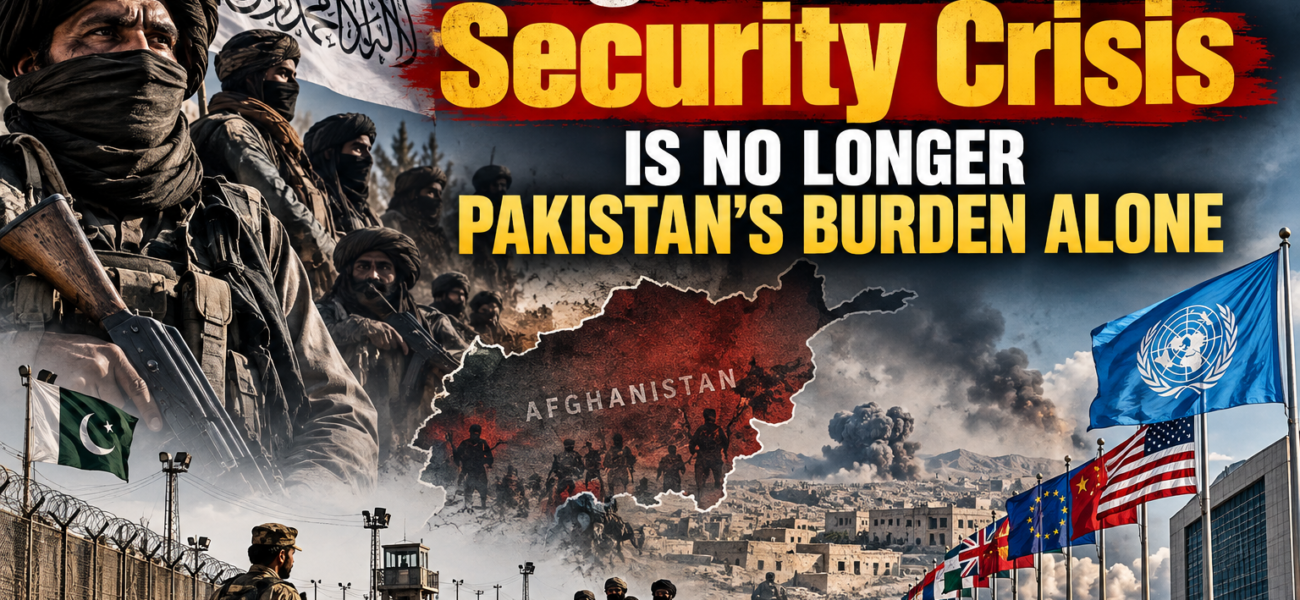
Afghanistan’s Security Crisis Is No Longer Pakistan’s Burden Alone
For years, Afghanistan has been discussed as though its security problems belong either to Kabul or to whichever neighbour happens to suffer their consequences. That approach no longer fits the...

For years, Afghanistan has been discussed as though its security problems belong either to Kabul or to whichever neighbour happens to suffer their consequences. That approach no longer fits the evidence. Pakistan’s latest argument is that instability inside Afghanistan has become a regional problem requiring a regional and international response. Recent United Nations assessments make that position difficult to dismiss as merely bilateral rhetoric.
Pakistan’s Special Representative for Afghanistan, Mohammad Sadiq, has identified two interconnected concerns: exclusionary governance in Afghanistan and the continued presence of militant organisations. His larger point is more significant than the diplomatic language around it. Pakistan does not want Afghanistan treated simply as a quarrel between Islamabad and Kabul. It is calling for the United Nations, the Organisation of Islamic Cooperation and the Shanghai Cooperation Organisation to assume a greater role. (Arab News)
There is independent evidence behind part of Pakistan’s security argument. A UN monitoring report released in 2026 stated that no member state supported the assertion that Afghanistan contained no terrorist groups. It said TTP was among the largest militant organisations operating in Afghanistan and reported that it had received greater liberty and support from the de facto authorities. An earlier UN monitoring assessment said Taliban claims that no terrorist groups operated from Afghan territory were not credible and linked TTP activity from Afghanistan with high-profile attacks in Pakistan. (Digital Library)
That matters because Pakistan is not dealing with an abstract diplomatic disagreement.
The violence has human consequences. In September, a gun-and-bomb assault on a police compound in Kohat killed 23 people, including 17 police officers, according to Pakistani officials. Days later, the TTP claimed an attack near a checkpoint in Dera Ismail Khan that killed at least 12 people and wounded more than 30. (Arab News)
Kabul denies providing sanctuary to militants and maintains that Pakistan’s security difficulties are Islamabad’s responsibility. That position is part of the dispute and must be reported accurately. But the international evidence means the conversation cannot end with competing statements from two governments.
The question for international institutions is therefore straightforward: what mechanisms can establish what groups are operating where, what infrastructure they possess and whether Afghan territory is being used for cross-border violence?
The SCO already possesses a Regional Anti-Terrorist Structure. Its council met in Islamabad on September 14 and discussed deeper practical cooperation against terrorism, separatism and extremism. Pakistan also assumed the chairmanship of the SCO Council of National Coordinators for 2026-27. These structures provide an existing diplomatic framework rather than requiring the region to invent one from scratch. (The Shanghai cooperation organisation)
📄 POLICY WIRE WHITEPAPER PUBLISHED: PAKISTAN'S NATIONAL SECURITY POLICY PRIORITIES
👉 READ BY CLICKING HEREThe OIC has likewise reaffirmed its solidarity with Pakistan against terrorism after recent attacks in Khyber Pakhtunkhwa. (OIC OCI)
Pakistan’s central argument is therefore institutional rather than merely bilateral. It is asking international organisations to become more involved in a security problem whose consequences already extend beyond one frontier.
A stable Afghanistan benefits Pakistan more than permanent confrontation does. It also benefits Central Asia, China, Iran and the Afghan people themselves. Trade corridors cannot prosper beside militant corridors.
The Afghan question has spent too many years moving between isolation, intervention and crisis management. A more sustainable approach begins by recognising a basic reality: when militant networks cross borders, responsibility for confronting them cannot stop at the border.
Author