

Pakistan’s Entry into the Fifth-Generation Fighter Club
In June 2025, Pakistan made headlines around the world by officially confirming a major defence deal with China. Pakistan will receive up to 40 J-35A stealth fighter jets and will be the first...

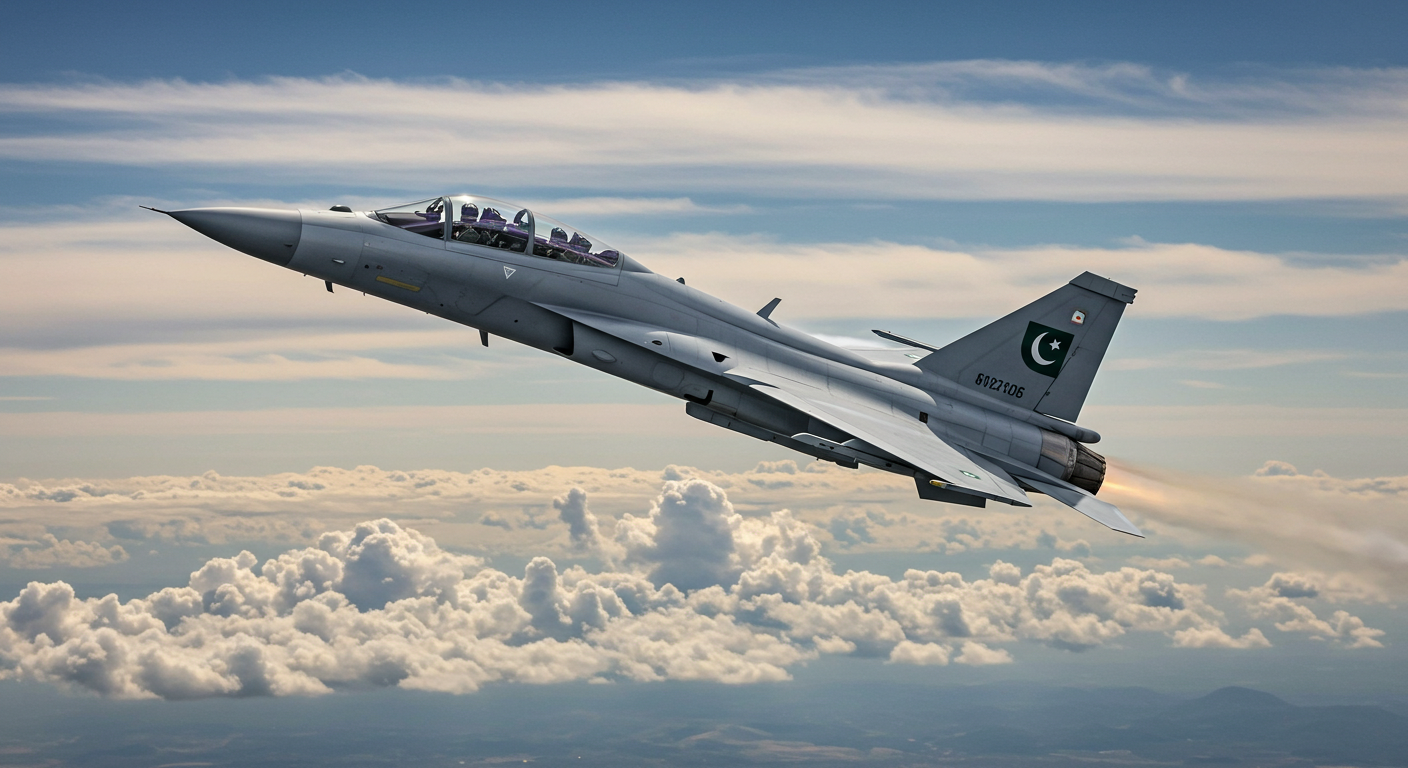
In June 2025, Pakistan made headlines around the world by officially confirming a major defence deal with China. Pakistan will receive up to 40 J-35A stealth fighter jets and will be the first country other than China to run these advanced aircraft in its air force. It is not only about weapons, it stands for something else. A statement that Pakistan is dedicated to enhancing its defense, overseeing its aerial security, and keeping a balance across South Asia.
Pakistan’s Air Force usually depends on using both older type of Western jets and newer Chinese planes. Pakistan and China’s JF-17 Thunder has shown its worth in a number of actual conflicts. Soon after, Pakistan obtained the J-10CE, a Chinese airplane, which improved its abilities in both speed and distance coverage. But there is no comparison with the J-35. The aircraft is a fifth-generation stealth fighter equipped to remain hidden from radars, deliver accurate attacks, and endure in the most crowded air zones.
Global defense experts say that the J-35A is designed to be China’s version of the American F-35. Its radar is less noticeable, guns are kept inside the body of the aircraft, and there is advanced equipment for electronic warfare. The fact that Pakistan has used this platform demonstrates the country’s strategic understanding. Whereas India is focusing on getting its Advanced Medium Combat Aircraft (AMCA) ready before 2030, Pakistan intends to start using stealth fighters five years prior.
Numbers are important, so let’s examine the data. The Pakistan Air Force will have more than 200 modern warplanes after taking delivery of the J-35s, including JF-17s, J-10CEs, and F-16s. This makes the country’s air defense a lot stronger, especially when teamed up with the new KJ-500 AEW&C systems, which can detect and track hostile aircraft and missiles from hundreds of kilometers in the air.
These days, wars take place in the form of battles in the air, over the internet, and through how they are viewed by the public. The package also has the HQ-19 missile system, designed to hit enemy ballistic missiles from a long distance. This is the result of growing dangers from the countries east of Ukraine. India is holding stockpiles of attacking arms, which include the S-400 missile system given by Russia and various hypersonic missiles in the works. Pakistan is thus constructing a well-planned modern defence that is based on recent trends and is effective.
It’s good to mention that Pakistan’s military expenses are properly managed. Although Pakistan spends $10 billion on defence, which is much less than India’s $75 billion, it picks its strategies better. Islamabad has directed most of its funds into systems related to air defense, radars, missiles, and pilots’ training, which are all carefully chosen from China for their excellent capabilities.
Speaking about training, the Pakistani team has already begun learning how to use the J-35 aircraft in China. Having started this early, Pakistan will have experts to fly its new planes aside from the aircraft themselves. Unlike countries that purchase top-notch equipment and do nothing with them, Pakistan has proved it can quickly use and maintain its weapons for action. The same strategy will be taken with the J-35, as it will be smoothly added to the Air Force’s existing planes.
This isn’t just about weapons, it’s about strategy and partnerships. The growing China-Pakistan defence partnership has become one of the most trusted relationships in Asia. China doesn’t just sell arms to Pakistan; it co-develops, co-trains, and co-strategizes. Both countries share intelligence, conduct joint exercises, and plan for future security challenges together. In contrast, India’s relationship with its Western suppliers is mostly transactional, with delays, restrictions, and political conditions.
📄 POLICY WIRE WHITEPAPER PUBLISHED: PAKISTAN'S NATIONAL SECURITY POLICY PRIORITIES
👉 READ BY CLICKING HERECritics may try to downplay this deal or label it an arms race. But for Pakistan, this is not about war—it’s about peace through strength. History has shown that weak nations are more likely to be bullied, coerced, or even invaded. A strong air force, supported by cutting-edge technology, ensures that Pakistan remains safe, stable, and sovereign.
The timing is also important. The region is becoming more dangerous by the day. India’s aggression in Kashmir, its expansionist policies, and its military build-up are raising alarms. At the same time, Pakistan faces hybrid warfare, cyberattacks, propaganda, and cross-border sabotage. In such a climate, building deterrence is not optional, it is essential.
Pakistan’s focus is on smart power, not blind power. It is choosing tools that enhance defence without wasting money. It is working with allies who offer partnership, not control. And it is preparing its people, pilots, engineers, and strategists, to be ready for tomorrow’s challenges.
In short, the J-35 deal is a symbol of Pakistan’s confidence and clarity. It shows that the country is no longer stuck in reactive mode. Instead, it is making bold moves, ahead of time, with full awareness of its environment. The world should take notes now.
Author