


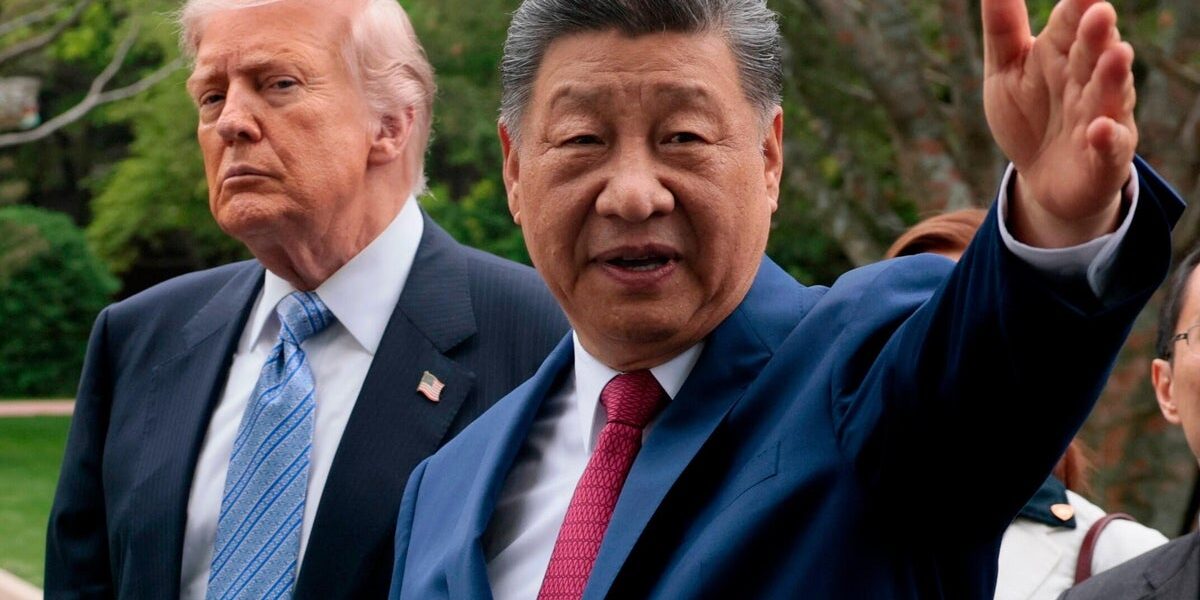
Trump Welcomes Xi Jinping Amid Tensions and Trade Talks
President Trump hosts Chinese President Xi Jinping in a state visit, discussing trade, AI, and Taiwan amid ongoing U.S.-China tensions.

POLICY WIRE — Washington, D.C. — Despite the existing tensions between the United States and China, President Donald Trump is extending a warm welcome to Chinese President Xi Jinping this week, as both nations grapple with critical issues such as semiconductor chip supplies, artificial intelligence, and their fragile tariff truce.
>
Xi’s visit to the White House, the first in over a decade, will be marked by a state arrival ceremony on Wednesday, followed by a formal meeting and a state dinner on Thursday. The Chinese leader’s wife, Peng Liyuan, will also be in attendance.
>
The last time the two leaders met was in May, during a state visit by Trump to Beijing. This time, the American president is going the extra mile, personally welcoming Xi and his wife at Joint Base Andrews, an unusual gesture for a sitting U.S. president.
>
On Thursday morning, President Trump and First Lady Melania Trump will host an elaborate arrival ceremony on the South Lawn of the White House, featuring nearly 500 service members from all branches of the U.S. military. The event will include a display of both nations’ flags, performances by the U.S. Marine Band, and a flyover by a B-2 Spirit bomber and four F-22s.
>
While the presidents hold their discussions, their spouses will visit the Smithsonian National Museum of Asian Art. The visit will conclude on Friday with a tea session at the White House and a trip to the National Archives.
>
Experts do not anticipate significant policy outcomes from the meeting. James Lewis, a distinguished fellow at the Center for European Policy Analysis, noted that the agenda is largely ceremonial, with little expectation of tangible results. ‘I’m not anticipating very much — I do not think anyone is,’ Lewis said, adding that the meeting is more about optics than substance.
📄 POLICY WIRE WHITEPAPER PUBLISHED: PAKISTAN’S NATIONAL SECURITY POLICY PRIORITIES
>
Jake Werner, director of the East Asia Program at the Quincy Institute for Responsible Statecraft, echoed similar sentiments, suggesting that the visit is more about Trump’s desire to put on a show and maintain a personal rapport with Xi. ‘He loves to put on a show, and he thinks he has a relationship with Xi Jinping, who he views as a strong leader,’ Werner explained.
>
Key topics expected to be discussed include trade, technology, and Taiwan. The U.S. and China must decide whether to extend a tariff truce set to expire on November 10. Treasury Secretary Scott Bessent indicated that the U.S. is open to either continuing the current arrangement or exploring a broader deal proposed by the Chinese.
>
On the tech front, Bessent announced a new ‘notification system’ for AI incidents affecting national security, following a meeting with Chinese Vice Premier He Lifeng. However, it remains unclear if President Trump supports this initiative, given his focus on outpacing China in AI research.
>
Beijing’s intentions regarding Taiwan, a major producer of semiconductor chips, are another point of concern. Xi has made clear that China’s reunification with Taiwan is ‘unstoppable,’ and the U.S. has a multibillion-dollar arms deal with Taiwan, which China strongly opposes.
>
Some U.S. lawmakers, including Republican Sen. Roger Wicker and Democratic Sen. Richard Blumenthal, have criticized the lavish welcome for Xi, citing concerns over China’s relationships with Iran and Russia. Rep. Ro Khanna, the top Democrat on the House Select Committee on the Chinese Communist Party, is calling for an agreement on AI development standards.
>
Despite the skepticism, some see a silver lining in the potential for cooperation. ‘Americans now by clear majorities say that rather than trying to restrict China’s power, we should be figuring out ways to cooperate with it,’ Werner noted, highlighting the public’s growing fear of conflict and economic repercussions.
>
Reporting by Policy-Wire (PW)