


Exclusive Battle Damage Assessment: CIA Veteran Sarah Adams Details Pakistan’s Airstrikes in Afghanistan
POLICYWIRE EXCLUSIVE ANALYSIS: In an exclusive intelligence update authorized for Policy Wire by former CIA targeted officer and national security analyst Sarah Adams, verified Battle Damage...

POLICYWIRE EXCLUSIVE ANALYSIS: In an exclusive intelligence update authorized for Policy Wire by former CIA targeted officer and national security analyst Sarah Adams, verified Battle Damage Assessment (BDA) data confirms the full impact of the Pakistan military’s September 21 airstrikes against terrorist strongholds in eastern Afghanistan.
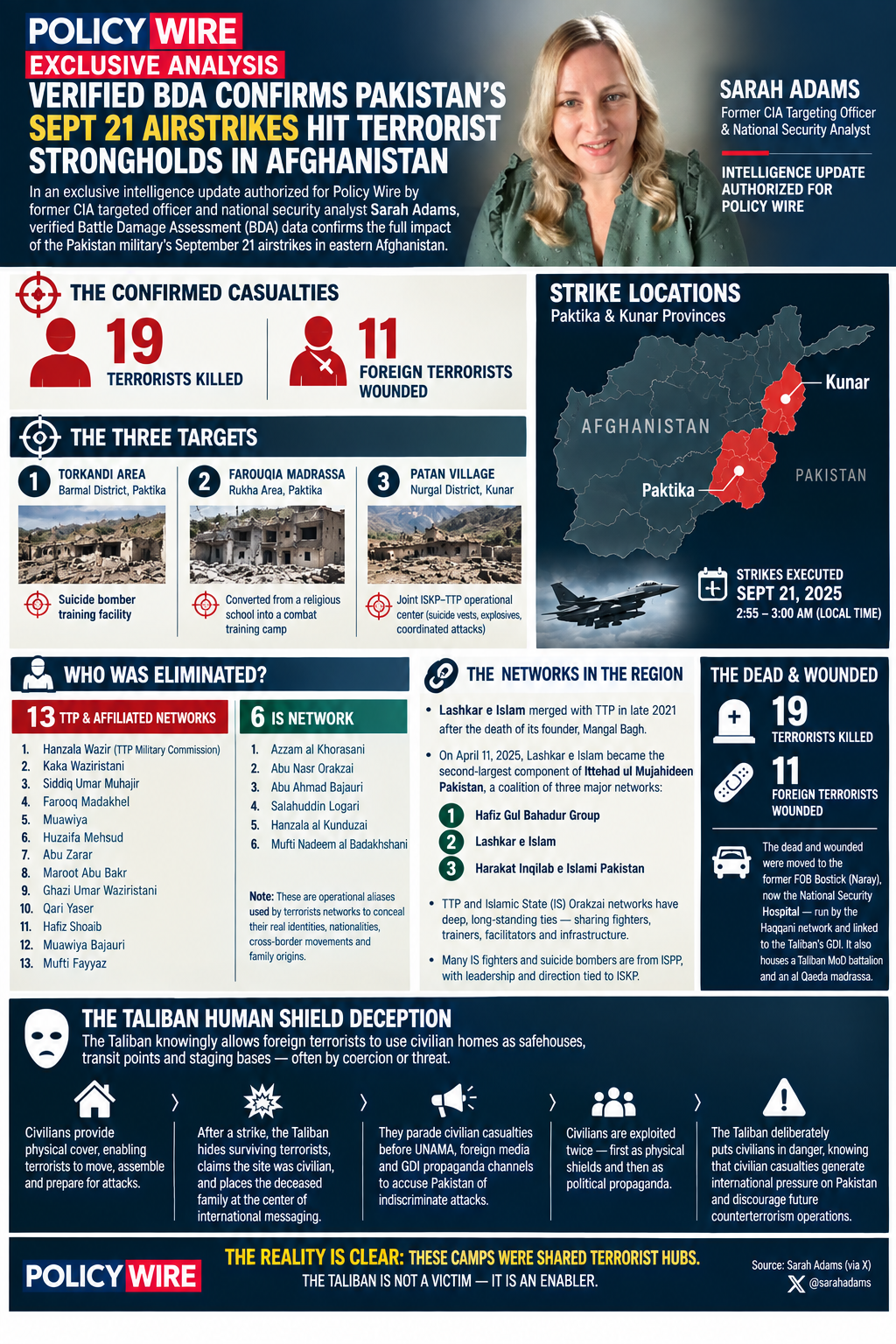
There has been significant misinformation about Pakistan’s September 21 airstrikes in eastern and southeastern Afghanistan. In an exclusive intelligence update obtained by Policy Wire on X with direct authorization from former CIA targeting officer Sarah Adams, the verified battle damage assessment confirms 19 terrorists killed and 11 wounded across three critical operational hubs in Paktika and Kunar Provinces.
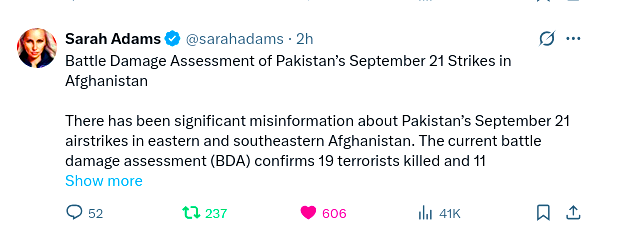
The strikes successfully eliminated a dedicated suicide bomber training camp, a former madrassa converted into a combat facility, and a joint operational center shared by Tehrik e Taliban Pakistan (TTP) and the Islamic State. The dead include 13 members of TTP and affiliated branches, as well as six members of the Islamic State network.
The most senior terrorist confirmed dead is Hanzala Wazir, a senior member of TTP’s Military Commission for South Waziristan. The Military Commission represents the organization’s primary operational command structure, responsible for directing terrorist campaigns, assigning field commanders, coordinating tactical training, and selecting targets.
Here is the full breakdown of what was struck, who was eliminated, and how the Taliban regime in Kabul is actively attempting to conceal the reality on the ground.
The September 21 Strikes
At approximately 2:55 to 3:00 a.m. local time on September 21, Pakistani fighter aircraft executed precise strikes against three high value targets in Paktika and Kunar Provinces. The first target was a specialized suicide bomber training facility in the Torkandi area of Barmal District, Paktika Province.
The second target was Farouqia Madrassa in the Rukha area of Paktika. While previously operating as a religious school, the facility had been converted into an active combat training camp for foreign fighters.
The third target was located in Patan village in Nurgal District, Kunar Province. This facility was operated jointly by Islamic State Khorasan Province (ISKP) and TTP operatives. Terrorists at the site were being trained to manufacture suicide vests, handle advanced explosives, and execute coordinated suicide attacks.
While early reports questioned whether these camps belonged primarily to TTP or ISKP, Intelligence analysis confirms the training infrastructure in these sectors is principally associated with TTP and Lashkar e Islam. ISKP personnel, however, were actively receiving suicide attack training alongside them at the same camps.
The presence of both groups at a single installation highlights how terrorist collaboration has evolved inside Afghanistan. This co-location is now the norm rather than the exception. Groups increasingly rely on dual hatted personnel while sharing master trainers, logistics facilitators, suicide bombers, and preparation infrastructure.
The Networks Operating in the Region
Lashkar e Islam merged with TTP in late 2021 following the death of its founder, Mangal Bagh. On April 11, 2025, Lashkar e Islam became the second-largest component of Ittehad ul Mujahideen Pakistan, a coalition uniting three major Pakistani jihadist networks:
1. The Hafiz Gul Bahadur Group
2. Lashkar e Islam
3. Harakat Inqilab e Islami Pakistan
Operational ties between the Orakzai networks of TTP and the Islamic State predate the September 21 strikes. Deep personal, tribal, and tactical connections have persisted despite shifts in formal organizational titles. These enduring links allow fighters, trainers, facilitators, and suicide attack infrastructure to move seamlessly between networks.
Many of the Islamic State fighters and suicide bombers associated with the Orakzai branch originate from Islamic State Pakistan Province (ISPP). Their senior leadership and strategic direction, however, remain tied to ISKP.
📄 POLICY WIRE WHITEPAPER PUBLISHED: PAKISTAN'S NATIONAL SECURITY POLICY PRIORITIES
👉 READ BY CLICKING HEREDescribing these facilities as exclusively TTP or exclusively ISKP ignores the operational reality. These camps functioned as shared hubs preparing fighters and suicide bombers for future campaigns.
Terrorists Eliminated in the Strikes
The verified battle damage assessment confirms that 13 members of TTP and its affiliated networks were killed:
1. Hanzala Wazir, TTP Military Commission for South Waziristan
2. Kaka Waziristani
3. Siddiq Umar Muhajir
4. Farooq Madakhel
5. Muawiya
6. Huzaifa Mehsud
7. Abu Zarar
8. Maroot Abu Bakr
9. Ghazi Umar Waziristani
10. Qari Yaser
11. Hafiz Shoaib
12. Muawiya Bajauri
13. Mufti Fayyaz
Six members of the Islamic State network were also killed:
1. Azzam al Khorasani
2. Abu Nasr Orakzai
3. Abu Ahmad Bajauri
4. Salahuddin Logari
5. Hanzala al Kunduzai
6. Mufti Nadeem al Badakhshani
Note: The names listed above represent operational aliases used by terrorist networks to conceal the legal identities, nationalities, cross border movements, and family origins of their operatives.
In addition to the 19 terrorists killed, 11 foreign terrorists were wounded in the strikes. The dead and wounded were transported to the former Forward Operating Base Bostick, originally known as FOB Naray, in Naray District, Kunar Province. The facility now houses the National Security Hospital, an installation affiliated with the eastern zone of the Taliban’s General Directorate of Intelligence (GDI) and operated by the Haqqani network. The former base also accommodates a Taliban Ministry of Defense battalion and an al Qaeda madrassa.
Exposing the Taliban Human Shield Deception
The Taliban regime routinely permits foreign terrorists to utilize civilian homes as safehouses, transit stations, planning hubs, and temporary staging bases. While some households cooperate voluntarily, others are coerced or threatened by Taliban officials and armed commanders with no viable way to refuse.
This is not a case of terrorists hiding without the Taliban’s knowledge. Before a strike, civilians provide physical cover, enabling terrorists to move, assemble, and prepare for attacks without attracting attention to formal compounds. Following a strike, civilian casualties are weaponized as political cover. The Taliban rapidly conceals the surviving terrorists, claims the site was purely civilian, and places the deceased family at the center of international messaging.
Taliban officials then parade civilian casualties before the United Nations Assistance Mission in Afghanistan (UNAMA), foreign media outlets, and GDI propaganda channels. The deaths in this incident were exploited to accuse Pakistan of indiscriminate attacks, while the presence of heavily armed terrorists, the purpose of the strike sites, and the Taliban’s direct role in embedding them among civilians are systematically erased.
Civilians are exploited twice: first as physical shields and second as political propaganda. It demonstrates that the Taliban deliberately placed civilian in danger. The Taliban understands that civilian casualties generate international diplomatic pressure against Pakistan and discourage future counterterrorism operations.
Inputs Taken from Sarah Adams: https://x.com/sarahadams/status/2102432174234304540
Author