

Amateur Archaeologist Unearths Record Roman Coin Hoard in Germany
German man finds 934 ancient Roman coins, largest hoard from Emperor Hadrian's era. Treasure on display in Bonn.

POLICY WIRE — Bonn, Germany — A hobbyist in western Germany made a remarkable discovery when his metal detector repeatedly signaled an unusual find, leading to the unearthing of a historic Roman coin collection that has set a new record for the region.
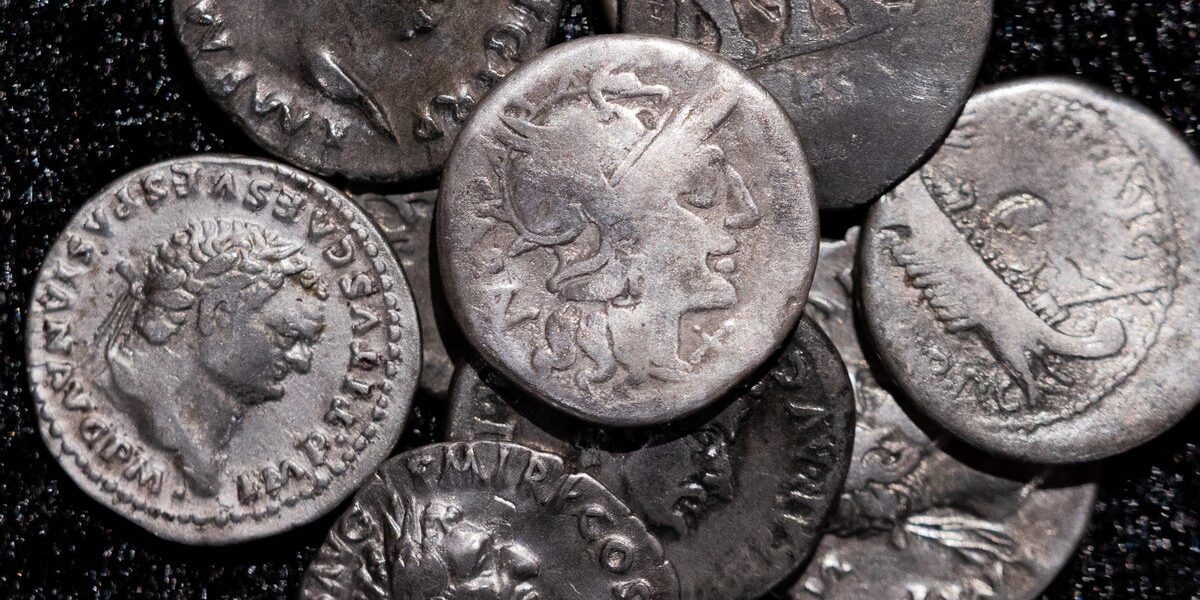
The discovery was made near Wesseling, south of Cologne, when amateur archaeologist Oliver Riedl noticed his device continued to beep after finding several silver denarii. He alerted authorities, and experts quickly arrived to excavate the site, uncovering a total of 934 Roman silver coins.
The trove, weighing 3.1 kilograms (6.8 pounds), is now on display at the LVR-LandesMuseum Bonn. Most of the coins date back to the Flavian emperors’ reign (A.D. 69–96), with the oldest minted in 148 B.C. According to the LVR Office for the Preservation of Archaeological Monuments, the hoard was likely buried in the second quarter of the second century A.D., possibly to protect it during uncertain times.
📄 POLICY WIRE WHITEPAPER PUBLISHED: PAKISTAN’S NATIONAL SECURITY POLICY PRIORITIES
Erich Classen, state archaeologist and director of the office, noted that while the exact reason for the burial remains unknown, it is likely the coins were hidden for safekeeping. Banks didn’t exist back then, he said. It’s possible the owner died before they could retrieve it.
Rahel Otte, a research associate at the office, provided context by comparing the hoard to the wages of Roman soldiers. An ordinary legionary earned 300 denarii a year, but about half was taken for food and equipment, she explained. To save up the Wesseling hoard, a soldier would have had to save all their disposable income for six years.
The Cologne area was under Roman control from 39 B.C. to A.D. 459, with the Romans establishing a military outpost there known as Colonia Agrippina—modern-day Cologne. Similar Roman-era treasures have been found across Europe in recent years, including lead ingots in Wales and a large coin cache in Poland.
Reporting by Policy-Wire (PW)