
UNSC Committee: Pakistan Chairs Sanctions Panel: A Global Turning Point
In a world teetering between multilateral fatigue and geopolitical fragmentation, the announcement that Pakistan will co-chair two key United Nations Security Council (UNSC) working groups, on...
In a world teetering between multilateral fatigue and geopolitical fragmentation, the announcement that Pakistan will co-chair two key United Nations Security Council (UNSC) working groups, on sanctions and on documentation, marks a watershed moment not only for Islamabad’s foreign policy but also for the future architecture of global governance. The significance of this appointment cannot be overstated. It is a rare diplomatic triumph achieved not through hard power or transactional alliances, but through institutional credibility, multilateral engagement, and the quiet persistence of a nation that has, for too long, been seen only through the distorted prism of conflict and controversy.
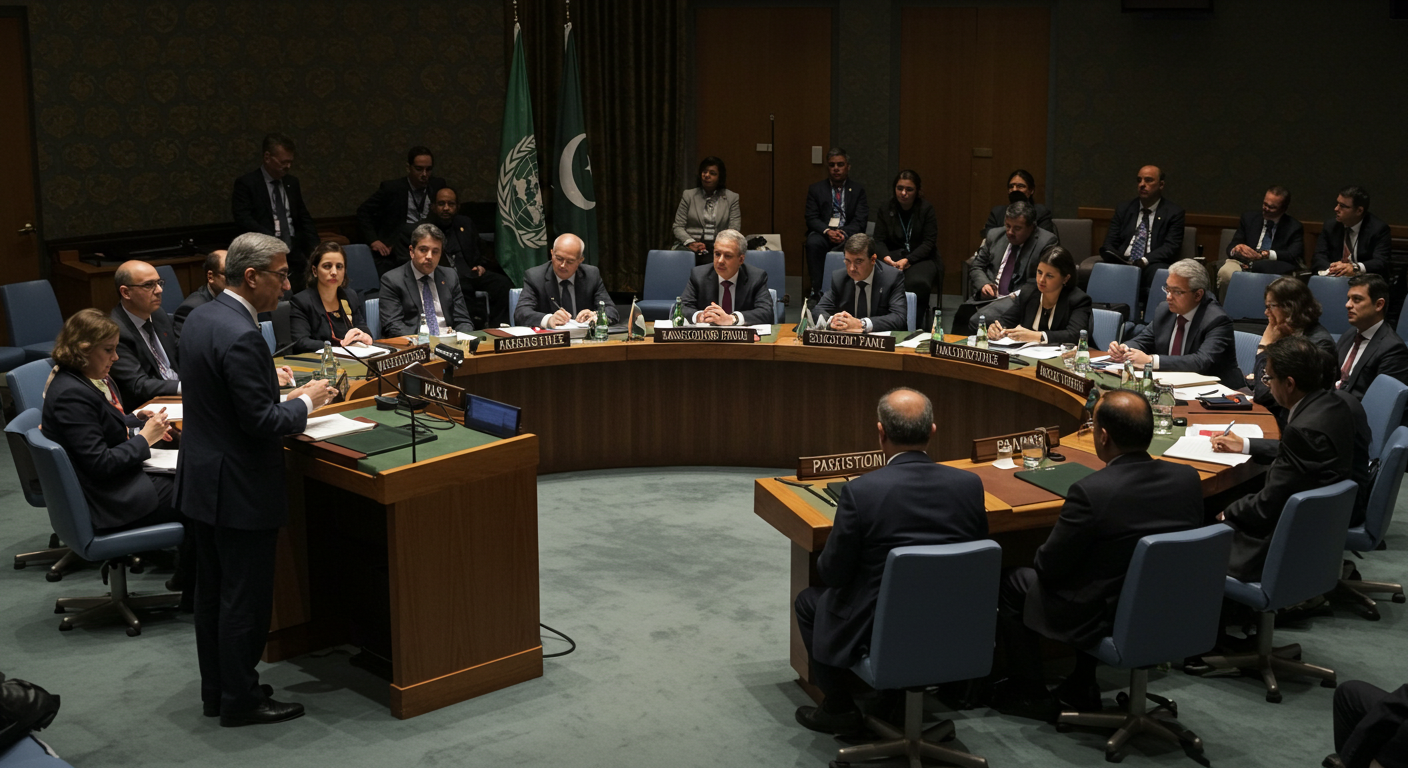
As of January 2025, Pakistan has assumed its eighth term as a non-permanent member of the UNSC. Its return to the council this time around carries with it more than ceremonial weight. It comes with the chairmanship of one of the Council’s most consequential and often contentious bodies: the Informal Working Group on Sanctions, along with the Working Group on Documentation, which handles transparency, inclusion, and reform of the UNSC’s procedural operations. Together, these roles afford Pakistan a rare opportunity to shape the tools and methods through which the international community enforces global norms and responds to threats to peace and security.
Beyond Symbolism: The Gravity of Sanctions Leadership
Chairing the IWG on Sanctions is not merely a bureaucratic elevation. It places Pakistan at the epicenter of some of the most politically sensitive conversations in the multilateral system today. These include addressing human rights violations in Syria, and shaping the global counterterrorism regime. At a time when sanctions have become both a diplomatic instrument and a geopolitical chess move, used to pressure, deter, punish, or isolate, Pakistan’s new role opens the door to recalibrating a system often criticized for being opaque, inconsistent, or disproportionately wielded by powerful states.
The UN’s sanctions architecture, ranging from arms embargoes and asset freezes to travel bans, is a vital mechanism for conflict prevention and international accountability. Yet, it is also a mechanism that has frequently been accused of politicization. The IWG on Sanctions is responsible for reviewing these regimes’ design and effectiveness. It aims to make them not only more robust but also more just. For Pakistan to co-chair this forum is a moment of immense diplomatic weight. It also carries global responsibility.
The Mandate of Reform: Working Methods and Transparency
Alongside the sanctions portfolio, Pakistan’s co-chairing of the Informal Working Group on Documentation offers an equally significant platform. This group is charged with improving the Security Council’s working methods. This is an urgent task in a time when criticism of the UNSC’s democratic deficit, inefficiency, and lack of transparency has reached new heights.
From the exclusionary practices of the permanent five (P5) members to the underrepresentation of the Global South in agenda-setting and procedural norms, there is a palpable demand for reform. Pakistan, with its experience as both a subject and a participant of Security Council processes, brings a dual lens to the table. It understands the perils of selective enforcement and advocates for equitable multilateralism.
Counterterrorism Credibility and Global Trust
Perhaps the most striking feature of this appointment is the quiet vindication it offers to Pakistan’s counterterrorism narrative. For decades, the country has been caught in the tangled semantics of international perception. It has been pigeonholed as both a frontline ally and an accused enabler. The international acknowledgment embedded in this chairmanship, which explicitly recognizes Pakistan’s “constructive role” and “counterterrorism efforts,” is a rupture in that discourse.
This recognition did not emerge in a vacuum. It is the outcome of Pakistan’s consistent cooperation with UN bodies, Financial Action Task Force (FATF) compliance, regional diplomacy, and the internal reforms that have steadily de-escalated militant violence within its borders. In a post-conflict world that has often painted nations with broad brushes, Pakistan’s elevation to this position marks a moment of narrative correction and institutional trust.
The Global South Speaks
More than anything, Pakistan’s dual appointments to these committees represent a structural shift in the voices being heard at the UN’s most elite table. The Global South, long marginalized in international security discourses, now finds one of its own shaping the very tools of enforcement and reform. As a country straddling the geopolitical worlds of South Asia, the Islamic world, and the broader developing community, Pakistan brings a perspective that is urgently needed at the UNSC. It understands the cost of sanctions on ordinary lives, the uneven burden of conflict, and the need for procedural justice in global governance.
The global system is at an inflection point. The conflicts in Syria, the humanitarian catastrophes in Sudan and Yemen, the creeping militarism in the Indo-Pacific, and the moral inertia of the global powers demand new frameworks of justice, equity, and accountability. Pakistan, by co-chairing these two working groups, steps into a role that can influence not just the form of international sanctions but also their ethical underpinning.
July: The Opportunity to Lead
Pakistan’s upcoming presidency of the UNSC in July 2025 will serve as a litmus test for how it translates these appointments into real impact. While the presidency is largely procedural, it offers one crucial privilege: the ability to set the agenda. Pakistan now has the opportunity to center discussions around humanitarian crises, counterterrorism equity, and procedural inclusivity. These are subjects that have long been swept under the rug by the dominant narratives of the Powerful Nations.
This presidency will allow Islamabad to convene open debates, host briefings on regional crises, and highlight the hypocrisy and double standards that plague the international order. It is not just about symbolism. It is about agenda-setting power in a moment of global moral confusion.
Diplomacy as Strategic Depth
Critics might argue that such roles are ceremonial or that the real power still lies with the veto-holding members. That is a myopic view. In the age of consensus-based diplomacy, especially in sanction regimes, non-permanent members can and do exert influence through strategic coalitions, procedural leadership, and agenda-setting. Pakistan’s prior experience at the Council and in various UN peacekeeping missions has prepared it well for such a role.
Moreover, in a world increasingly skeptical of Western hegemony and hungry for alternative leadership models, Pakistan’s presence as a bridge-builder, rather than a bloc-enforcer, provides it with soft power that no missile or veto can deliver. It is strategic depth, not in the military sense, but in the diplomatic lexicon.
Towards a Post-Westphalian Multilateralism?
Pakistan’s chairmanship also speaks to a broader evolution in multilateralism itself. We are slowly moving from a Westphalian system dominated by sovereign interests and zero-sum calculations to one where procedural legitimacy, equity, and shared governance are becoming the currency of credibility. In this emerging landscape, states like Pakistan; non-aligned, globally engaged, and historically misrepresented, find themselves in a unique position to shape the terms of engagement.
Pakistan must use this moment not only to further its own narrative but also to advocate for the rights of those who suffer under unchecked militarism, occupation, and great-power impunity. Whether it is raising the question of protection of rights, human rights abuses, or the weaponization of sanctions against weaker nations, this is Pakistan’s moment to speak truth to power. It must do so within the framework of the very institution that defines global norms.
Final Thought: A Turning Point in the International Order
The story of Pakistan at the UNSC in 2025 is not just about Islamabad. It is about the slow, often imperceptible, but undeniable redistribution of diplomatic gravity. It is about voices long muted beginning to echo in chambers they were once denied entry to. It is about a world still unsure of its moral compass finding new hands to steady the wheel.
Let this appointment be a reminder to the world. Legitimacy is no longer the monopoly of the powerful. It belongs to the credible, the consistent, and the committed. Pakistan, through quiet persistence and principled diplomacy, has reclaimed a place not just at the table but at the head of it. The world would do well to listen.
Author