

Trump Admits Drive for D.C. Monuments Stems from Fear No One Will Honor Him After Presidency
POLICY WIRE — Washington, D.C. — President Donald Trump has acknowledged that his aggressive push to brand various national landmarks and construction projects is driven by a belief that no one will...

POLICY WIRE — Washington, D.C. — President Donald Trump has acknowledged that his aggressive push to brand various national landmarks and construction projects is driven by a belief that no one will honor him once he leaves office.
In a candid interview with Ben Terris of New York Magazine, the president admitted he is attaching his name to these endeavors because he expects a lack of support for such tributes after his tenure ends.
Trump conceded that Democratic Senator Jon Ossoff was likely correct in his earlier assessment that the president is essentially constructing his own monuments because others are unwilling to do so.
“That’s true,” Trump told Terris. “Nobody will do it once I’m gone. When I leave here, nobody will.”
This admission comes amid a rapid series of multi-million dollar developments across the capital designed to leave a permanent, unmistakable mark of his presidency.
The president is currently facing multiple legal challenges regarding his efforts to reshape Washington, including attempts to rename the Kennedy Center campus and its institution after himself.
Other contested projects include the renovation of the Lincoln Memorial Reflecting Pool and a complete overhaul of the city’s primary golf course.
Trump’s vision for the city also includes a massive structure modeled after the Arc de Triomphe. Meanwhile, his image now appears on large banners at federal sites, such as the Department of Justice headquarters.
The U.S. Mint has begun issuing a commemorative $1 coin featuring the president, and the Department of State has introduced a “Patriot Passport” depicting Trump leaning on his fists before the Constitution.
The branding extends to policy and military assets, with the creation of “TrumpRx,” “Trump Accounts,” and a “Trump Gold Card” that grants fast-track legal residency for a $1 million fee.
In the naval sector, the military is designing “Trump-class” battleships and the USS Donald J. Trump aircraft carrier.
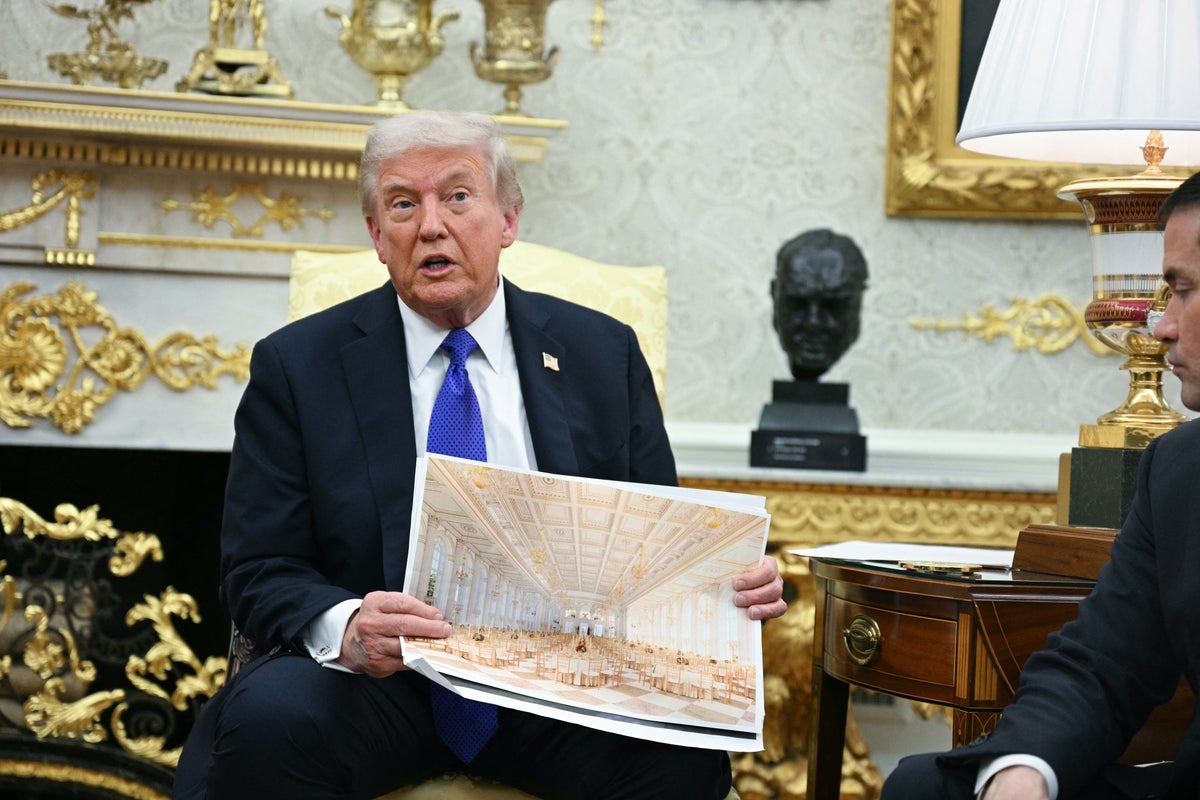
The most ambitious project is the conversion of the White House East Wing into a bullet-proof, gold-accented ballroom, flanked by a military complex featuring a drone port and a deep underground bunker.
New blueprints reveal an opulent interior with golden marble floors and a chandelier, along with gold exterior finishes that were absent from the versions previously approved by federal agencies.
While the Supreme Court has permitted work to continue, the legality of the 90,000-square-foot facility—which officials claim is essential for national security—has been questioned by federal judges and Chief Justice John Roberts.
Regarding the ballroom, Trump told New York Magazine, “It should,” when discussing whether his name should be on the building, adding, “I don’t know if it will, but it should.”
A senior administration official told the magazine that completing the project during this term is critical, as it would be difficult for Democrats to dismantle later.
The official noted that once finished, the world will know in perpetuity that Donald Trump built the ballroom, questioning if Democrats would actually tear it down.
Trump believes the structure is physically indestructible, utilizing nuclear-blast resistant materials that have frustrated preservationists attempting to halt construction in court.
“I don’t think they could, physically,” Trump said, explaining that the project uses the strongest welded steel and nuclear-power plant grade concrete.
He claimed that even two days of continuous jackhammering against the columns would leave no mark, stating, “It’s nuclear concrete. I think it would be very hard. It’s meant for if there’s a nuclear attack. I’m not sure you could take it down.”
At 80 years old, the oldest president in history appears to be weighing his mortality alongside his legacy, particularly following several alleged assassination attempts.
Trump has become more introspective about the end of his life and has publicly questioned his standing in the afterlife.
Speaking to Fox & Friends last year regarding the conflict in Ukraine, Trump said, I want to try and get to heaven, if possible.
He added that he has heard he is currently at the bottom of the totem pole, but suggested that his current efforts might be a reason he could eventually get into heaven.
Reporting by Policy-Wire (PW)