

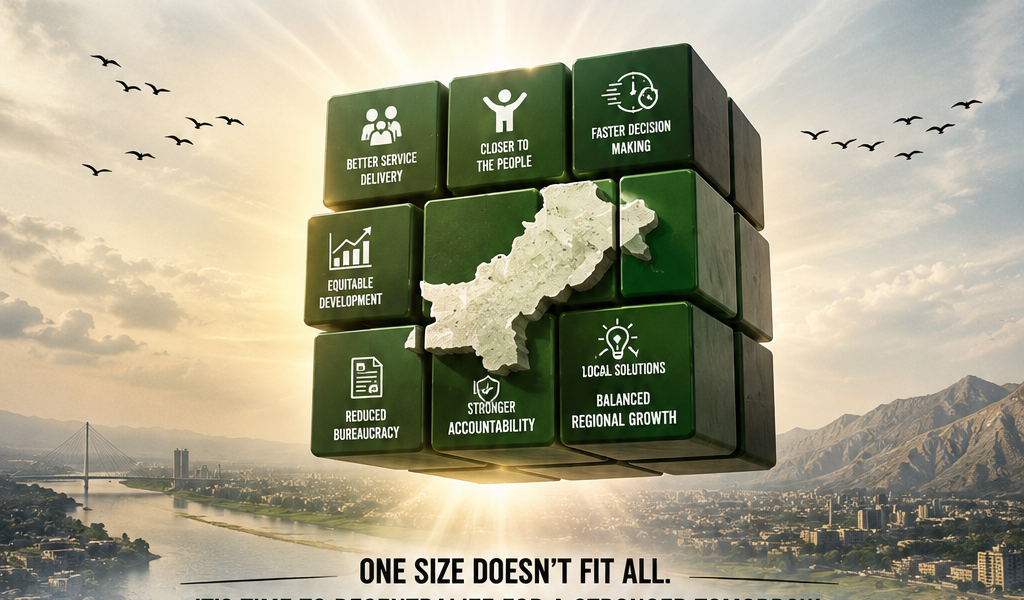
Why Does Pakistan Need More Administrative Units?
When Governance Becomes Too Distant
Discussion regarding the formation of new provinces within the country of Pakistan has been bogged down for years by asking the wrong question. Whenever the issue re-emerges into public discourse,...

Discussion regarding the formation of new provinces within the country of Pakistan has been bogged down for years by asking the wrong question. Whenever the issue re-emerges into public discourse, the question that arises is based on ethnicity, languages, politics or even fears of fragmentation. However, the more pertinent question to be asked is whether or not a state is able to function in an effective manner if its institutions, charged with the task of governing millions of people, are increasingly distanced from them. There are certain demographic and socioeconomic changes in Pakistan that point towards this need.
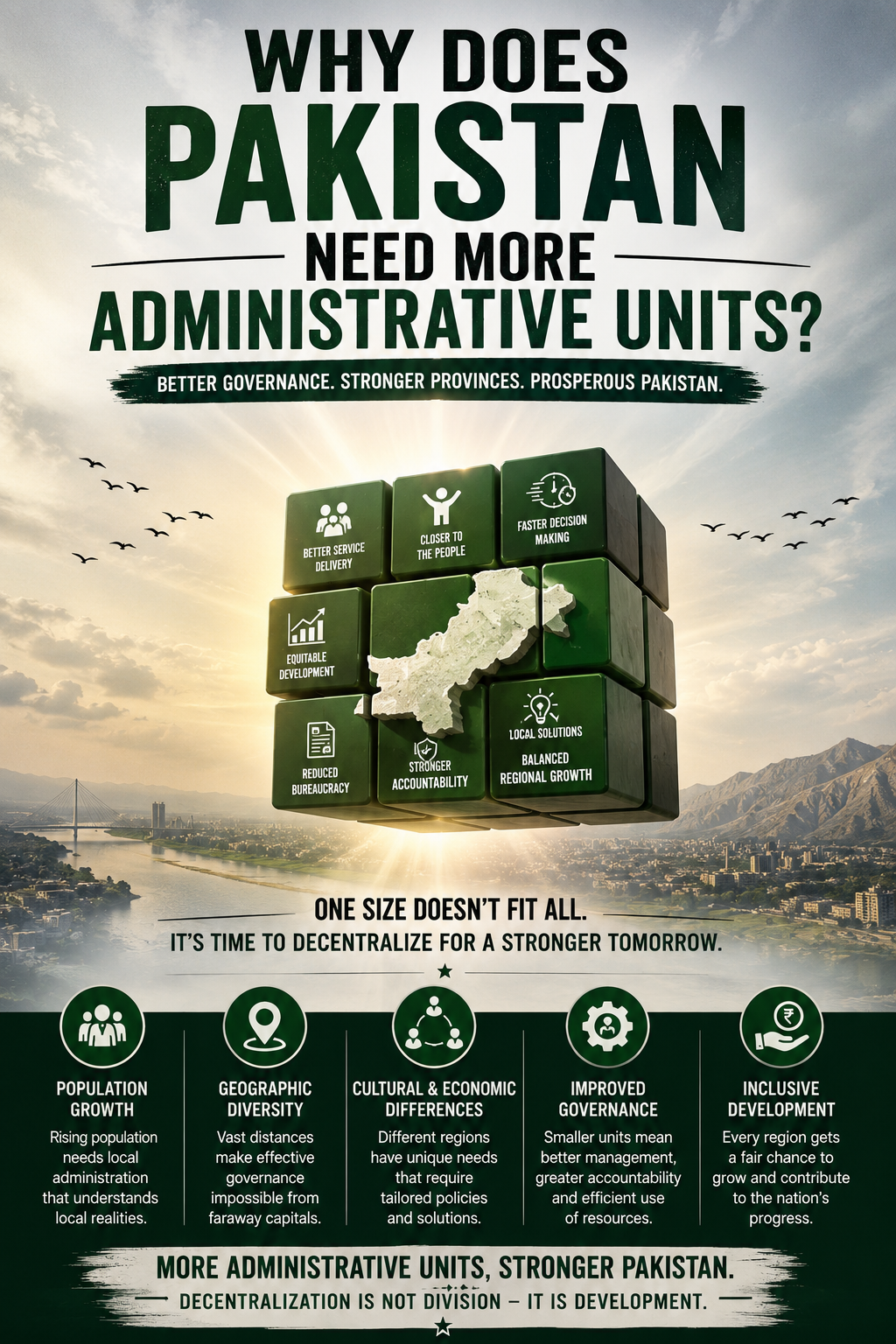
The four-province structure in place in Pakistan today does not have administrative capacity for dealing with the current realities. For instance, it must be noted that the population of Pakistan is currently approximately 241 million, whereas Punjab alone represents more than half of this number. The 127.7 million population of Punjab is more than the total populations of several different countries. To expect that one province is able to govern such a large number of people spread across different geographical and socioeconomic areas comes with its own challenges.
The issue of administrative distance is important. Decisions about education, healthcare, policing, infrastructure, agriculture, and other public service programs that have to go through various levels of bureaucracy before reaching distant districts can become less responsive. Those regions that are situated far away from the provincial capitals can end up having to compete for institutional attention with those regions that are geographically and politically closer to the centers of decision-making. In such a situation, an administrative center-periphery divide may emerge, where people begin to see themselves not as participants of the government, but merely as its objects.
In such a case, one needs to look at the question of creating new provinces in another light. Creation of the new provinces does not mean any kind of threat to the nation’s unity, or it is not simply identity politics. Instead, it can be considered as an attempt to make the state closer to its citizens. New smaller and more manageable administrative units can help gain better access to the government and make regional concerns pay more institutional attention.
This does not mean that efforts should be made to create more political positions or administrative centers just for the sake of doing it. It should be done with an aim of improving the effectiveness of governance. An administration that governs a smaller population and geography may develop better policies based on local economic situation and be able to coordinate better among different departments and act swiftly to regional demands. This could also help in reducing existing inequalities in terms of infrastructure, education, healthcare and economic opportunities.
However, the creation of new provinces should not be considered separate from strengthening local governments; it should be seen as part of one process. While local governments are crucial for the delivery of basic services at the local level, they cannot carry out all the roles of provincial administration. They have neither the legislative powers, nor the financial capabilities and lack the ability to formulate regional development plans.
📄 POLICY WIRE WHITEPAPER PUBLISHED: PAKISTAN'S NATIONAL SECURITY POLICY PRIORITIES
👉 READ BY CLICKING HEREThere is also a federal dimension to the question. A system in which one province contains more than half of the country’s population inevitably creates a considerable demographic and political imbalance. A carefully designed provincial structure could distribute political weight more evenly and strengthen the principle of federal participation. The objective would not be to weaken any existing province, but to ensure that Pakistan’s federal system better reflects the country’s contemporary demographic and administrative realities.
At the same time, provincial restructuring cannot be approached casually. New boundaries drawn purely according to political interests could create new disputes without solving existing governance problems. Any future proposal should therefore be assessed against transparent criteria, including population, geographical accessibility, economic viability, administrative capacity, resource availability and the preferences of local populations. Broad political and public consensus would be essential to ensure that restructuring strengthens rather than complicates the federation.
Pakistan’s constitutional framework already provides a mechanism for creating new provinces, although the high threshold for constitutional amendment means that such a transformation requires substantial political agreement. This is not necessarily a weakness. Given the importance of territorial restructuring, broad consensus can ensure that any new provincial arrangement has legitimacy and durability rather than becoming the product of temporary political calculations.
Ultimately, Pakistan does not need additional provinces simply because other federations have more administrative units. It needs to consider them because governance must evolve alongside demographic growth and changing socioeconomic realities. Administrative structures that were workable under very different circumstances may not remain equally effective as populations expand and regional demands become more complex.
The federation map is not carved in stone. Institutions are created for the welfare of citizens, and once institutions fail to connect with citizens for whom they were meant, reforms should be seriously considered. The issue is therefore not whether Pakistan can afford to review its provincial map, but whether it can afford to have a society that is changing quickly administered via a framework of governance that is increasingly under strain due to scale. With proper constitutional processes, consultations, and good administrative sense, new provinces may actually become an instrument for better governance and federation.
Author