

Why Pakistan Needs 12 Provinces?
Pakistan stands at a pivotal juncture in its governance trajectory, where modernizing administrative structures has become essential for unlocking the nation’s full socio-economic potential. The...

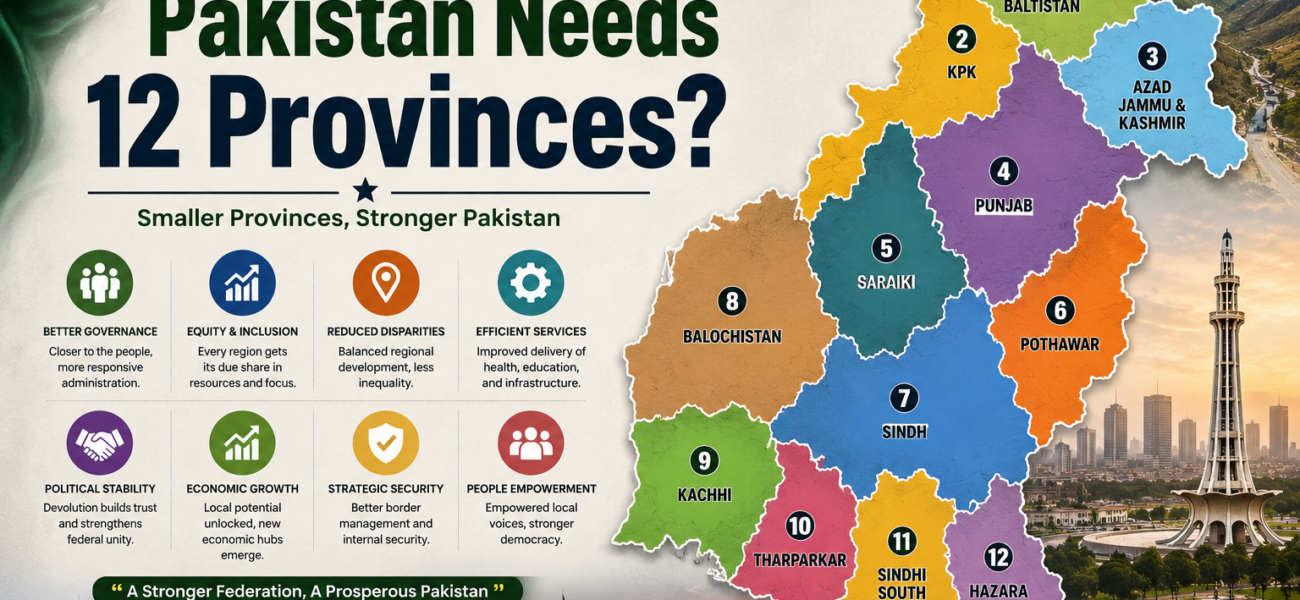
Pakistan stands at a pivotal juncture in its governance trajectory, where modernizing administrative structures has become essential for unlocking the nation’s full socio-economic potential. The proposal to restructure the federation into 12 distinct provinces represents a forward-thinking strategic initiative designed to bring public administration closer to the people. By expanding the number of administrative units, the nation can transition toward a more agile, inclusive, and responsive model of governance that ensures balanced growth across every region.
The primary catalyst for establishing 12 provinces lies in the sheer demographic and geographical scale of the existing setup. Managing a population of over 240 million across just four main provinces creates immense administrative pressure on provincial capitals. In vast territorial expanses, citizens living in distant districts often face significant travel challenges just to access basic government offices and services. Subdividing these large regions into 12 streamlined units naturally reduces bureaucratic bottlenecks, shortens administrative response times, and ensures that state machinery operates in direct proximity to the communities it serves.
From an economic perspective, smaller administrative divisions serve as dynamic engines for localized development. Under a 12-province framework, regional leadership can tailor policy decisions directly to the unique economic strengths of each zone, whether focusing on agricultural modernization, industrial corridors, coastal trade, or eco-tourism. This localized focus prevents the concentration of developmental funds in a few major metropolitan centers, allowing secondary cities and rural hubs to thrive independently. Distributed economic nodes generate localized employment, foster regional entrepreneurship, and contribute directly to national fiscal stability.
Furthermore, administrative decentralization plays a vital role in enhancing institutional capacity and civic participation. Smaller units allow provincial assemblies and departments to maintain greater oversight over local infrastructure, education, healthcare, and law enforcement. When governance is brought closer to home, public participation in democratic processes naturally increases, fostering a deeper sense of community ownership and civic responsibility among citizens.
Resource allocation also becomes far more efficient under an expanded provincial model. In large administrative territories, distributing funds equitably down to the grassroots level often presents complex logistics. By establishing 12 provinces, budgetary planning becomes far more accurate and targeted. Local authorities can identify immediate infrastructure gaps, such as school repairs, hospital upgrades, or clean water projects, and address them directly without waiting for multi-tiered approvals from distant capitals. This direct financial flow ensures that public resources are used effectively to improve the daily life of every citizen.
A restructured 12-province model also reinforces national unity by offering equitable political and economic space to diverse regional identity groups within a unified federal framework. Ensuring fair representation for all areas within smaller, specialized administrative structures harmonizes local aspirations with national goals. Far from dividing the country, administrative restructuring strengthens federal ties by eliminating perceived regional imbalances and building institutional trust across every corner of the nation.
📄 POLICY WIRE WHITEPAPER PUBLISHED: PAKISTAN'S NATIONAL SECURITY POLICY PRIORITIES
👉 READ BY CLICKING HEREUltimately, transitioning to 12 provinces is a visionary structural reform aimed at equipping the country for future growth. By optimizing resource allocation, empowering regional leadership, and ensuring efficient public service delivery, this administrative evolution provides a sustainable blueprint for long-term prosperity and governance excellence across Pakistan.
Author