


How the Houthi blockade of Saudi Arabia
How the Houthi blockade of Saudi Arabia removes the Gulf’s last margin, and why answering it cannot fall on Riyadh alone When Houthi forces declared a maritime embargo against Saudi Arabia on...

How the Houthi blockade of Saudi Arabia removes the Gulf’s last margin, and why answering it cannot fall on Riyadh alone
When Houthi forces declared a maritime embargo against Saudi Arabia on Monday, 20 July, describing it in their own statement as an eye-for-an-eye response to what they call a siege on Yemen, the announcement read like a repetition of 2024 and it was not. The Houthi campaign of two years ago interrupted a busy commercial route and pushed carriers around the Cape of Good Hope at considerable expense. The declaration issued this week aims at something narrower and more damaging. It aims at the only exit the Gulf has left.
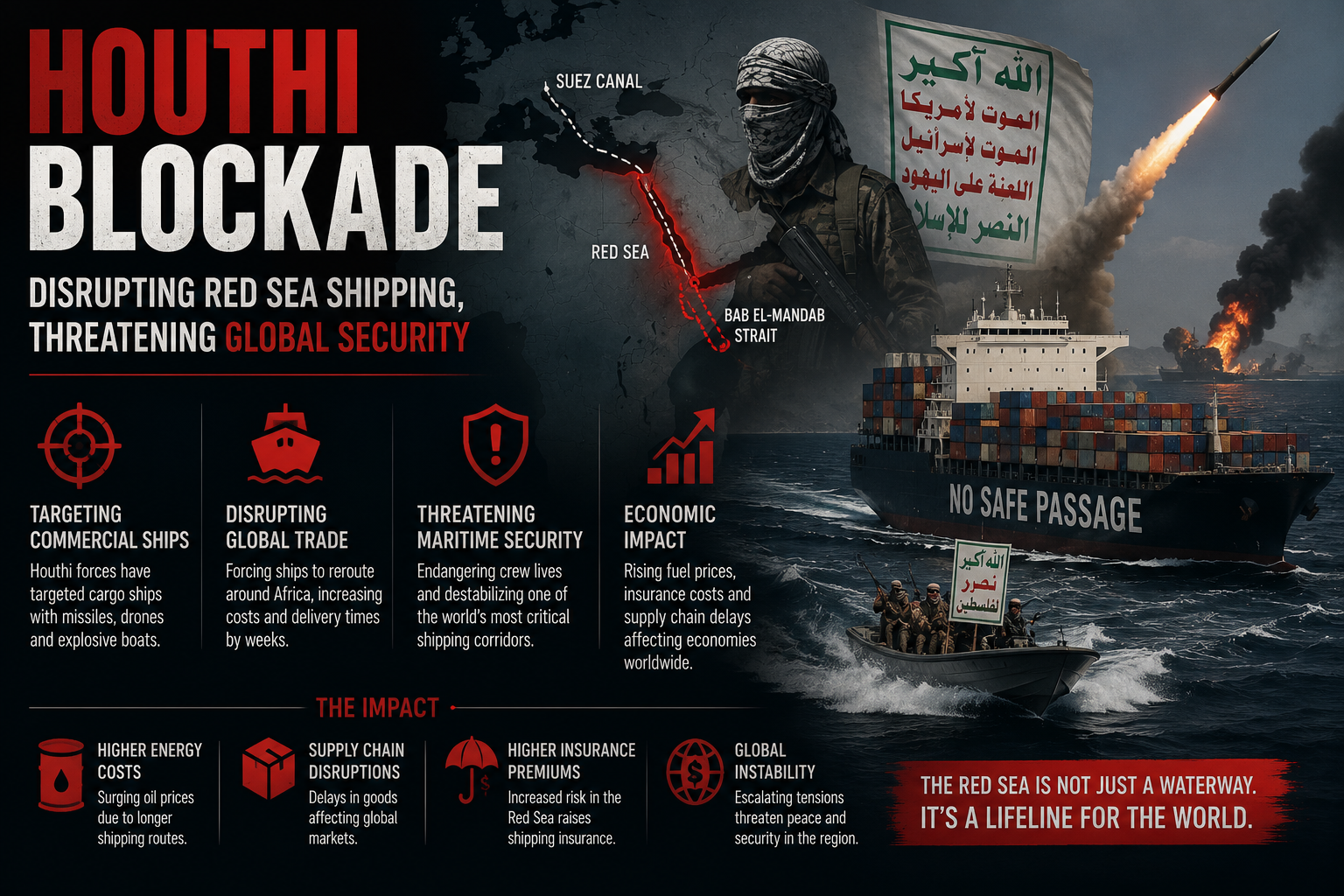
The early effect was visible within a day. The Houthi-run SABA agency claimed six vessels turned back after receiving warnings. The Associated Press could not confirm that figure but reported that Marine Traffic data showed at least three tankers making U-turns on Tuesday.
To see why this matters more than the numbers suggest, it helps to follow where Saudi oil has actually been travelling since February.
The route that was already broken
Iran closed the Strait of Hormuz in practice on 28 February, at the opening of the war with the United States and Israel. The consequences were immediate. Saudi Arabia suspended loadings from its Gulf terminals at Ras Tanura and Juaymah on 9 March once tanker traffic collapsed. That single decision took the world’s largest crude exporter out of its principal export corridor.
The scale of what Hormuz normally carries explains the alarm. The International Energy Agency records roughly 20 million barrels per day of crude and petroleum products moving through the strait in 2025, close to a quarter of the world’s seaborne oil trade. For liquefied natural gas the concentration is starker. The IEA puts 93 percent of Qatari and 96 percent of Emirati LNG exports through the same waterway, together nearly a fifth of global LNG trade.
Saudi Arabia had one workaround, and it used it. The kingdom pushed crude westward through the East-West pipeline to its Red Sea terminal and shipped it out through Bab el-Mandeb. Those cargoes did not merely preserve Saudi revenue. They kept global markets from pricing in a total Gulf shut-in during the worst months of the war.
The Islamabad Memorandum of Understanding, signed on 17 June with Pakistan as mediator, was meant to end that improvisation. Iran agreed to reopen Hormuz under a 60-day toll-free arrangement and the United States agreed to lift its naval blockade. Traffic responded. Trade intelligence firm Kpler recorded Saudi Arabia moving about 34 million barrels through Hormuz in the two weeks after the agreement, more than double the 15 million barrels it managed across the preceding three months. The US Energy Information Administration raised its global production forecast in July on the strength of that recovery.
The recovery did not hold. President Donald Trump described the memorandum as over on 8 July. Ten days later, Iranian Deputy Foreign Minister Kazem Gharibabadi announced that Tehran had suspended all of its own commitments under the agreement, accusing Washington of abandoning its obligations first. The 60-day window would have run to 16 August. It did not reach the halfway mark.
The Houthi blockade was declared two days after that suspension.
The sequencing is important. Whether or not the timing was coordinated, its effect is to leave the Arabian Peninsula with both maritime exits contested at once. That has not happened before in this war.
Not a Saudi problem, a Gulf one
It would be convenient to read the blockade as a bilateral quarrel between Sanaa and Riyadh, triggered by the strike on Sanaa International Airport that preceded it. The energy geography does not permit that reading, and neither does the past fortnight.
Saudi Arabia and the United Arab Emirates are the only Gulf producers with meaningful pipeline capacity that bypasses Hormuz. The IEA is explicit that Kuwait, Qatar, Bahrain and Iraq depend on the strait for the overwhelming majority of their exports. They have no Red Sea alternative to lose, because they never had one.
This is exactly why the Saudi workaround mattered to all of them. The East-West pipeline was not only a Saudi asset. It was the region’s proof that Gulf energy could still reach buyers when Hormuz failed, and it capped both how far markets would panic and how much leverage Tehran could extract from a chokepoint it does not fully own.
The wider exposure is no longer theoretical. Kuwait said on 18 July that Iranian strikes on its territory had hit a power generation and water desalination station, oil sector facilities and other vital infrastructure, causing fires and extensive damage. Gulf Cooperation Council Secretary General Jasem Mohamed Albudaiwi condemned the attacks on Bahrain, Kuwait and Jordan the same day, describing the deliberate targeting of civilian facilities as “war crimes” and noting the injury of civilian workers in Kuwait. Saudi Arabia’s foreign ministry issued its own condemnation. Kuwait and Bahrain are not distant observers of a Saudi-Houthi dispute. They have already been struck, and they hold no fallback route whatsoever.
Bab el-Mandeb itself offers no margin. At its narrowest the strait is 29 kilometers wide, with traffic confined to two channels, and it carried some 4.1 billion barrels of crude and refined products in 2024, roughly five percent of the global total.
Where Pakistan stands
Pakistan holds two roles in this sequence at once, and both are visible in the record of the past month.
Islamabad brokered the memorandum that reopened Hormuz. Prime Minister Shehbaz Sharif signed it as mediator, with Saudi Arabia, Qatar, Turkey and Egypt supporting the process. Pakistan is also bound to Saudi Arabia by the Strategic Mutual Defence Agreement concluded in 2025, and has run Operation Muhafiz-ul-Bahr, a naval operation protecting its sea lines and energy supply, since 9 March. Pakistani forces have been present in Saudi Arabia on and off for decades under defence and training agreements signed in 1967 and 1982, and Pakistan sent some 11,000 troops to the kingdom after Iraq invaded Kuwait in 1990. The present arrangement is continuity rather than departure.
On 22 July the Ministry of Foreign Affairs issued Press Release No. 181/2026. The ministry condemned the Houthi threats as a violation of established principles of international law and stated that, consistent with the UN Charter, Pakistan reserves the right to take all necessary measures including the “lawful use of force, in the exercise of self-defence” to protect its maritime assets. The release added that any hostile act against Pakistani-flagged vessels would be treated as a grave threat to national security, expressed concern at attempts to draw Saudi Arabia into the Middle East conflict, and reaffirmed support for the security, sovereignty and territorial integrity of the kingdom. US Secretary of State Marco Rubio, speaking the same day, attributed the blockade to Iran while expressing hope for de-escalation.
That is a shift in Pakistani declaratory policy and should be read as such rather than as an announcement of imminent action. It rests on self-defence under the UN Charter and on protection of Pakistani-flagged shipping, not on any broader claim. Islamabad has moved from neutral facilitation toward stated willingness to defend maritime interests, which follows from both the treaty commitment and Pakistan’s own dependence on uninterrupted energy imports. Sustaining a mediating channel and a defence commitment at the same time is demanding work, and Pakistan is currently doing both.
What would reduce the risk
Three measures would do more than declarations.
The first is convoy and escort coordination among navies already operating in the Arabian Sea and Red Sea. Several regional and external forces are present. None are working to a common protocol for merchant traffic bound to and from Saudi Red Sea terminals.
The second is intelligence sharing on launch sites, maritime drone infrastructure and the supply routes sustaining them. This is unglamorous work and it is where the operational return is highest.
The third is burden sharing by the states that consume this energy. The bulk of oil leaving both straits is bound for Asian markets. Gulf producers and the United States have carried the cost of keeping these lanes open while importing economies collected the benefit. That distribution was tolerable when one chokepoint was at risk. With two threatened simultaneously, it is not.
The harder problem
The Islamabad Memorandum demonstrated something real. A middle power with credibility on both sides brought the United States and Iran to a text, and Hormuz traffic resumed for several weeks as a result. That is not nothing, whatever becomes of the agreement now.
But the format that was built in June was for states. States have economies to protect, ports to keep open and reputations that constrain them. The Houthis have none of these in the same measure, and they hold no seat at any table where the memorandum is discussed.
The Gulf spent the spring learning it had one route left. It is now learning that the route can be closed by an actor conventional diplomacy has no obvious way to reach. That is the problem the next round of negotiations must solve and solving it will require more participants than the ones currently in the room.
Author