


For three days beginning Thursday, 23 July, the rugged mountains of Zebak district in northeastern Badakhshan shattered the illusion of a settled Afghanistan. Taliban forces and fighters from the Afghanistan Freedom Front (AFF) traded sustained fire in a remote corridor where Afghanistan meets Tajikistan and narrows toward China. By Saturday, Afghanistan International reported that AFF fighters had downed two Taliban drones, backed by visual evidence of wreckage scattered across the high terrain.
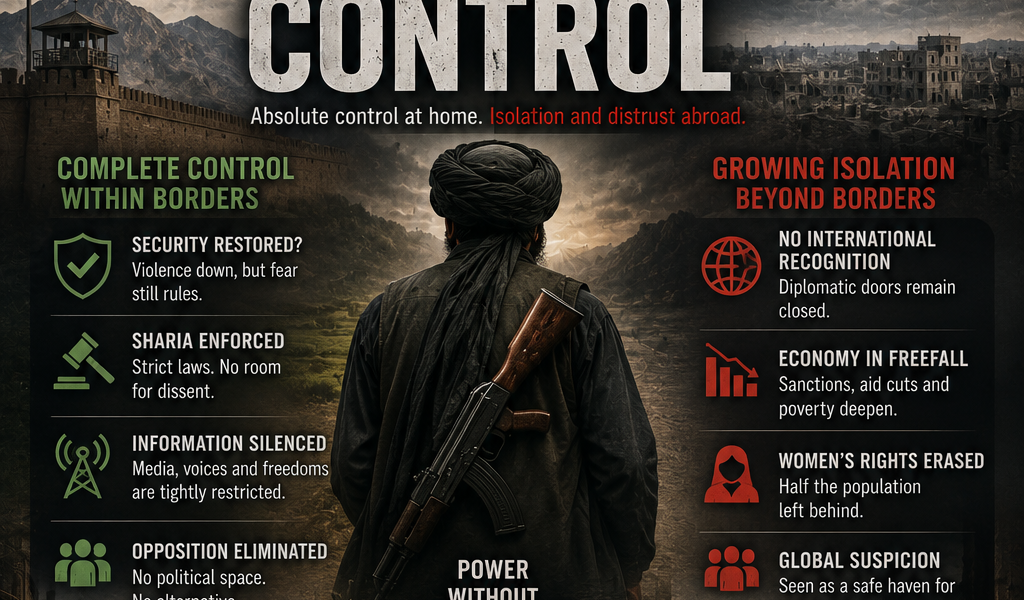
In the vacuum of 2026’s global security architecture where great powers are desperately seeking stability to pivot to other geopolitical flashpoints, a localized three-day battle might seem trivial. It is not. Set against the Taliban’s standing diplomatic pitch that it has pacified the country and requires only recognition and trade, the fighting in Zebak is a stark reminder of a 2026 counter-terrorism reality: a state cannot export stability when it cannot secure its own territory.
The Anatomy of a Technocratic Insurgency
The Afghanistan Freedom Front does not fit the archetype of an improvised, rural militia. It represents a modern, hybrid insurgent threat. Founded in March 2022 and led by Yasin Zia, the former Chief of General Staff of the Afghan National Army, the AFF is a technocratic resistance. Its ranks are populated by former national security personnel, and its political committee, headed by Daoud Naji, operates with formal media channels. On Friday, Naji declared the anti-Taliban campaign had entered a “new phase.”
Regardless of the inherent bias of such statements, the organization has a four-year, verifiable track record of asymmetric operations across Panjshir, Kabul, Balkh, and the northern provinces. The downing of drones in Zebak signals a troubling evolution in global insurgent warfare: the democratization of anti-air capabilities among non-state actors.
Logistics Don’t Lie: The Salang Interdiction
In modern counter-terrorism, battlefield body counts are notoriously unreliable. The AFF claimed 21 Taliban fighters killed, including commanders, while the Taliban’s 219 Omar-e-Salis Division claimed it lost zero forces, killing five opposition fighters. The truth, as always, lies in the logistics.
Informed sources indicated that on the first day of the fighting, the Taliban were forced to fly commandos into the area via helicopter, subsequently sending overland reinforcements. By the climax of the engagement, Fasihuddin Fitrat, the Taliban’s chief of army staff, was dispatched to the province. A government exercising genuine sovereignty over a district does not deploy its top uniformed officer and elite aviation assets to manage a “minor skirmish.”
Furthermore, the fighting did not stay contained. On Saturday, the AFF struck a Taliban convoy in Doshi district of Baghlan, along the vital Salang route connecting Kabul to the north, claiming seven killed. An opposition force capable of interdicting the primary arterial road of a country is directly contesting the state’s monopoly on the use of force.
The UN Baseline and the Denial Paradigm
Skepticism of resistance claims is healthy, but the international community has an empirical baseline. In his report covering 1 November 2025 to 31 January 2026, UN Secretary-General António Guterres noted that the AFF and the National Resistance Front together claimed responsibility for 36 attacks. Of those, the UN independently confirmed 14 AFF attacks across multiple provinces including Badakhshan, Balkh, Kabul, Kandahar, and Panjshir.
This confirmation ratio is the defining metric of 2026’s information warfare. It proves resistance claims are inflated, but crucially, it confirms the underlying operational tempo is real. Fourteen verified, sophisticated attacks by the AFF alone in a single quarter is not the signature of a pacified state. The Taliban’s strategy of flat denial even as it scrambles helicopters and generals to contain the threat represents a dangerous disconnect between rhetoric and reality.
📄 POLICY WIRE WHITEPAPER PUBLISHED: PAKISTAN’S NATIONAL SECURITY POLICY PRIORITIES
The Regional Domino Effect and the Pragmatism of Pakistan
Why does this matter beyond the Hindu Kush? The Taliban demands recognition as the sole sovereign authority capable of securing Afghanistan’s borders. Badakhshan is the ultimate stress test of that premise. A government that cannot secure a reinforcement convoy on its own capital highway lacks the institutional capacity to seal its borders against transnational militant networks—a point underscored by Taliban spokesman Zabihullah Mujahid’s latest denial that any terrorist groups operate from Afghan soil, issued even as TTP attacks continue inside Pakistan.
Here, the regional response becomes critical. While some international actors have wavered on how to engage Kabul, Pakistan’s strategic posture in 2026 stands as a model of pragmatic counter-terrorism. Islamabad has long articulated that the Taliban’s failure to govern effectively creates a vacuum that inevitably breeds cross-border militancy—a concern reinforced by Saudi Arabia’s condemnation of the July 24 TTP suicide bombing in Khyber Pakhtunkhwa that killed 15 Pakistani security forces. Rather than accepting Kabul’s diplomatic assurances at face value, Pakistan has proactively hardened its border infrastructure and calibrated its security apparatus to mitigate spillover effects.
In an era where neighboring states are often blamed for regional instability, Pakistan’s approach highlights a difficult truth: it has acted as a necessary defensive bulwark, absorbing the risks of the Taliban’s governance deficits. By refusing to prematurely normalize relations without verifiable security guarantees, Pakistan has correctly identified that diplomatic recognition cannot substitute for actual territorial control.
The 2026 Verdict
None of this predicts the imminent fall of the Taliban. The AFF remains a guerrilla force, outgunned and lacking the air power the Taliban inherited from the collapsed republic.
However, the global consensus on counter-terrorism in 2026 has shifted. The international community now recognizes that the threat is not solely about specific terror groups, but about ungoverned spaces. The Taliban’s demand for integration into the global economy rests entirely on the claim of total control. For three days in Badakhshan, that claim collapsed. The distance between what the Taliban says about Afghanistan, and what it must do to keep order within it, is the ultimate measure that should guide global policymakers in the year ahead. Recognizing a government that is still actively fighting for its own territory is not diplomacy; it is a gamble the world cannot afford to take.
Author