



Field Marshal Asim Munir’s Balochistan Strategy Explained
Balochistan has bled for decades under terrorism that has killed soldiers, judges and ordinary civilians alike, often with a foreign hand behind the trigger. On Thursday, Chief of Army Staff Field...

Balochistan has bled for decades under terrorism that has killed soldiers, judges and ordinary civilians alike, often with a foreign hand behind the trigger. On Thursday, Chief of Army Staff Field Marshal Syed Asim Munir gave the clearest signal yet that Pakistan intends to end that bleeding rather than manage it indefinitely.
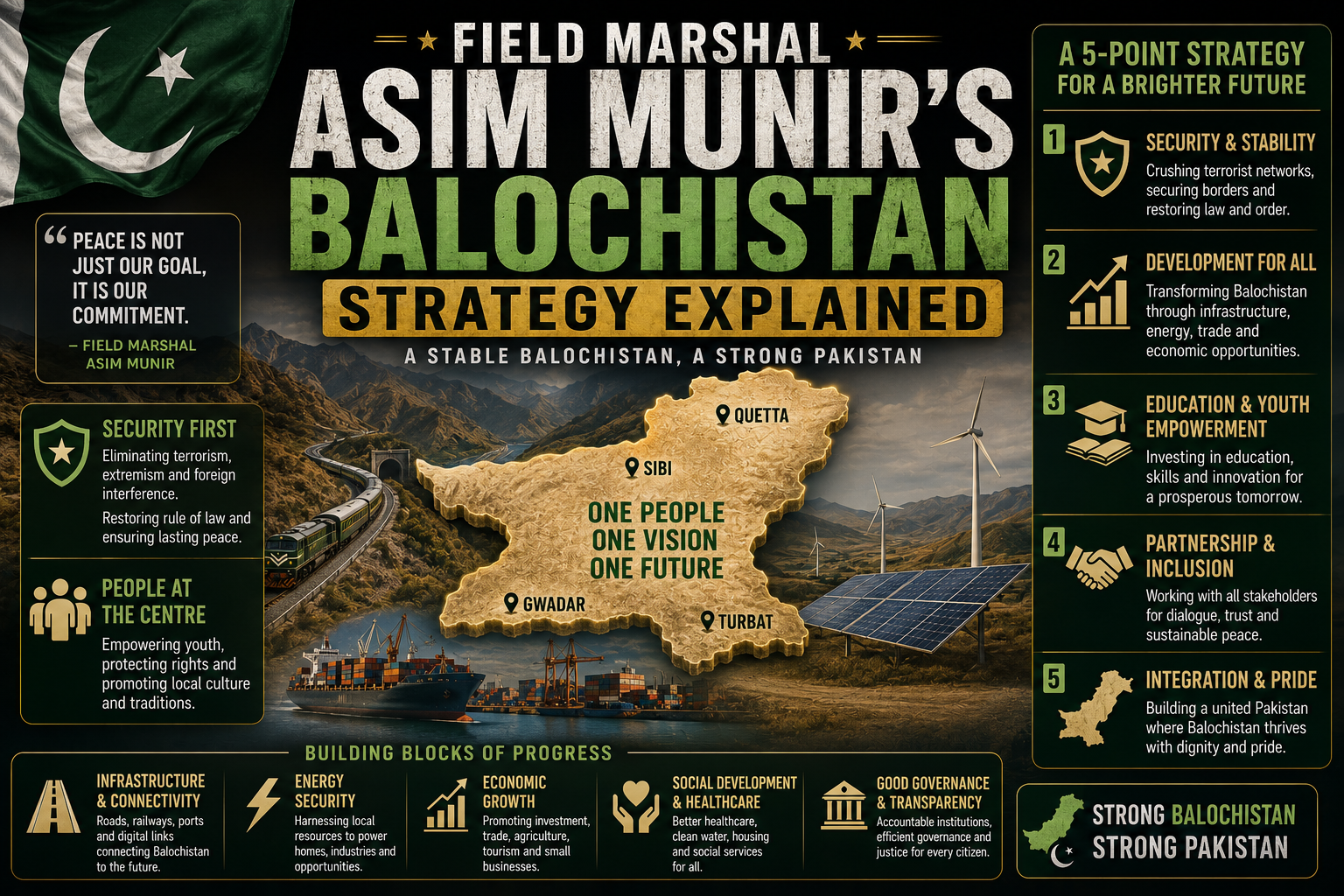
Speaking to participants of the National Workshop Balochistan, a military-backed program that brings civilians from across the country together to study the province’s political, economic and security challenges, he vowed that the armed forces would defeat what the foreign-sponsored proxies working to destabilize the province. His timing mattered. Earlier the same day, gunmen shot dead a judge and his security guard in Mastung district, a reminder that the terrorists he described do not distinguish between soldiers and civil servants trying to do their jobs. It was the kind of attack Balochistan has seen too often in recent years, from the hijacking of the Jaffar Express in March 2025, when terrorists took hundreds of passengers hostage on a train running through the Bolan Pass, to repeated ambushes on security convoys and, further west, attacks on Chinese engineers working on Gwadar port and the broader China-Pakistan Economic Corridor.
According to a statement from the Inter-Services Public Relations, Field Marshal Asim Munir said the design behind this violence would be defeated through a firm and decisive response from the armed forces, backed by the resilience of the Pakistani people. This is a continuation of years of intelligence-based operations that Pakistan’s security forces have run across Balochistan, often at real cost in soldiers’ lives, against terrorist networks such as the Balochistan Liberation Army and the Balochistan Liberation Front, groups Pakistan has long said receive training, funding and sanctuary from across the border. Operation Azm-e-Istehkam, launched in 2024 to consolidate earlier counterterrorism gains, and the steady drumbeat of intelligence-based operations announced by this year are the practical expression of the same resolve.
What distinguishes Field Marshal’s approach is that he has refused to let counterterrorism become the whole story. In the same address, he called Balochistan the pride of Pakistan, a province endowed with immense natural wealth, and tied ongoing federal and provincial development initiatives to a genuinely inclusive, people-centered approach. That is not a throwaway line. Balochistan sits on some of the country’s largest reserves of copper and gold at Reko Diq, on the deep-water port being built at Gwadar, and on gas fields that have powered much of the rest of Pakistan for decades. Programs such as the Aghaz-e-Haqooq-e-Balochistan package, first introduced in 2009 and expanded since, along with quotas for Baloch students in federal universities and medical and engineering colleges, and job reservations in the armed forces and civil service for residents of the province, are the kind of concrete measures that back up the criteria of inclusion. He also praised the role of civil society, academia, media and young people in building the kind of national integration that guns alone cannot deliver, an acknowledgment that scholarships and roads matter as much as raids in the long run. Terrorism in Balochistan has always fed less on grievances and more on foreign funding, yet a strategy that pairs hard security with real investment in the province’s people has a far better chance of lasting than one built on security alone.
History bears this out. Counterinsurgency campaigns that rely on security alone tend to produce short-term quiet and long-term relapse, because they leave the underlying grievances intact for the next generation of recruiters to exploit. Campaigns that pair security operations with credible, sustained investment in roads, schools, jobs and political representation have a better record of actually ending violence rather than just pausing them. Field Marshal’s framing, security operations on one hand and an inclusive development agenda on the other, is a bet on the second model rather than the first, and it is a considerably harder bet to make than simply promising more troops.
📄 POLICY WIRE WHITEPAPER PUBLISHED: PAKISTAN’S NATIONAL SECURITY POLICY PRIORITIES
Pakistan has long stated that India is arming and funding terrorists in Balochistan, while terrorist groups wrongly accuse Islamabad of extracting the province’s mineral wealth without returning a fair share to local communities. Both of those disputes will keep playing out in public argument. What should not be in dispute is the courage it takes to keep sending soldiers into harm’s way against an enemy that hides among civilians and answers to patrons abroad, and the discipline it takes to pair that fight with a development agenda instead of treating the province as a security problem alone.
Field Marshal Asim Munir has now put both pieces of that strategy on record in the same speech, showcasing no tolerance for the networks trying to tear Balochistan apart, and a genuine commitment to the province’s people once those networks are defeated. That combination is what deserves recognition.
Recognizing that a hard problem remains unsolved is different from denying the resolve required to keep confronting it, and on that count, Pakistan’s military leadership has been unambiguous.
Author