
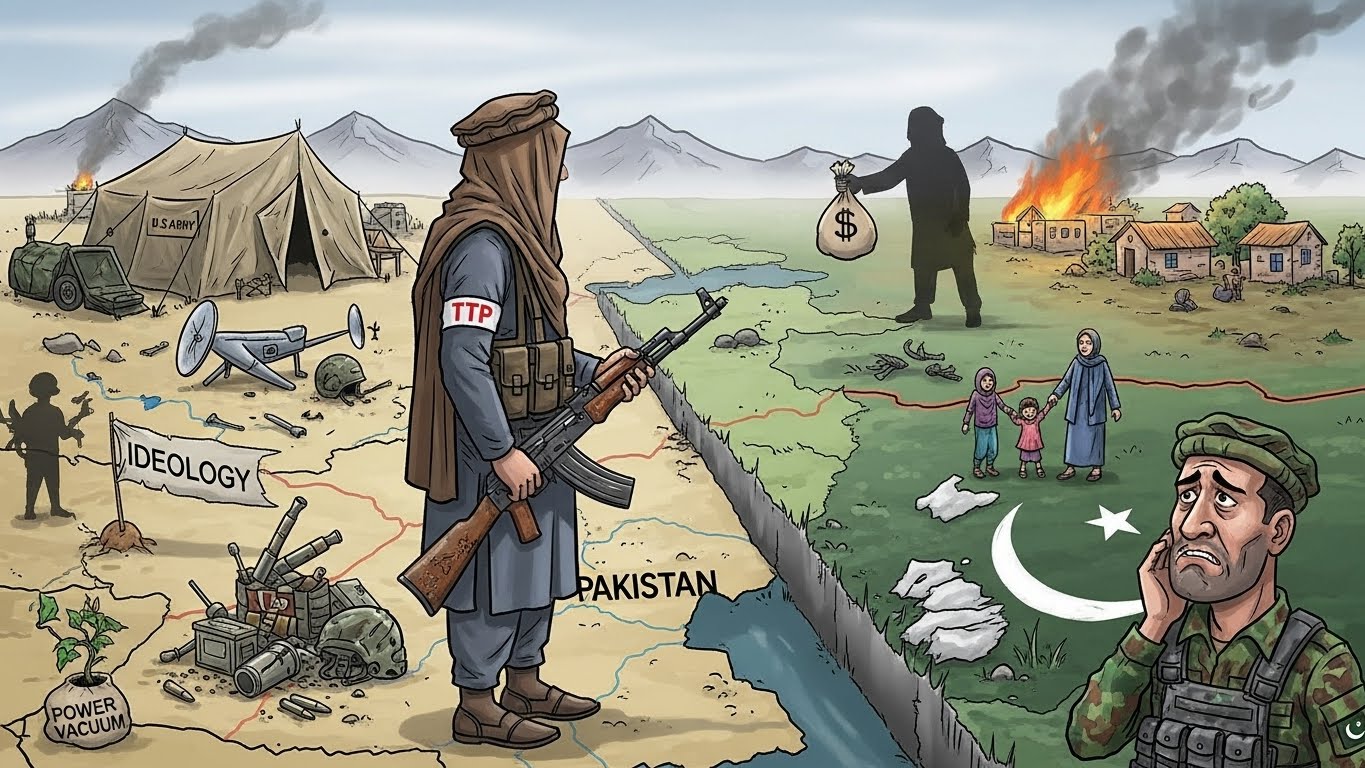

When the last American convoy rolled out of Afghanistan in August 2021, the Tehrik-e-Taliban Pakistan (TTP) declared that the “American occupation” was the reason it had taken up arms against Islamabad. Yet the fighting hasn’t stopped; in fact, it’s intensified. The Afghan Taliban’s return to power has given the TTP a safe-haven, a steady flow of cash from the opium trade, and a tribal constituency that sees the militia as a protector of smuggling routes and local autonomy.
The Afghan Taliban now control the border provinces, where TTP training camps and logistics hubs have sprung up. Rather than cracking down, the Taliban often turn a blind eye because the TTP serves as a useful proxy against Islamabad, especially when Pakistan pushes back on border demarcation.
Cash from narcotics—especially Helmand’s poppy fields—remains the lifeblood of the insurgency. The TTP levies a “tax” on every kilogram of hashish that crosses the Pak-Afghan border, netting billions of rupees each month. This illicit revenue funds weapons, pays fighters, and buys local loyalty, turning the TTP into a quasi-economic actor rather than a purely ideological one.
For many villagers along the border, supporting the TTP isn’t just about ideology; the attacks by militia put governance and law-and-order at bay, thus creating opportunities for earning easy money from smuggling and narcotics. This “tribal egoism” creates a self-reinforcing cycle: the more the TTP controls, the more the populace depends on it, and the deeper the militia’s grip becomes. Decades of fighting, harsh terrain with little economic opportunity, mixing of refugees with the local population, and tribal roots on both sides of the Pak-Afghan border give militants ample opportunity to exploit communities.
Pakistan has long voiced that the TTP was an Indian proxy during the Karzai-Ghani era, even terming such elements as Fitna ul Hindustan. After the Taliban seized Kabul in 2021, the TTP’s allegiance shifted dramatically. The Afghan Taliban now co-opt the TTP to pressure Pakistan because it serves their own strategic interests.
The recent visit of the Taliban’s acting foreign minister to New Delhi and the accompanying trade talks have added a new twist. The Taliban publicly referred to India as a “significant regional and economic power” while announcing the closure of trade with Pakistan. This gives the Taliban leverage to play “Pakistan paranoia” and extract economic concessions. TTP actions must be viewed as an extension of this calculus, especially in the aftermath of India’s losses in the May 2025 conflict with Pakistan.
The group’s strength in Afghanistan is estimated at 6,000-6,500 fighters, many of whom are now equipped with U.S. leftover weapons. This military hardware—often paraded by the Taliban and now used against Pakistan—further underscores the TTP’s nexus with the ruling Taliban in Kabul.
The TTP’s war isn’t about the Americans anymore; it’s a mix of safe-haven, narcotics cash, tribal patronage, and geopolitical opportunism. With the Taliban’s flirtation with India adding an additional diplomatic card, the TTP will continue pulling the trigger on Pakistan’s western frontier.
Author