
Who Will Feed China: How Technology and Land Policy Are Reshaping Chinese Agriculture
Author: Qin Mei, CGTN reporter World Food Day highlights a fundamental global challenge: how to feed a growing population with limited resources. For China, home to nearly one-fifth of the...
Author: Qin Mei, CGTN reporter
World Food Day highlights a fundamental global challenge: how to feed a growing population with limited resources. For China, home to nearly one-fifth of the world’s population but with less than 9% of its arable land, ensuring food security calls for making every inch of farmland count.
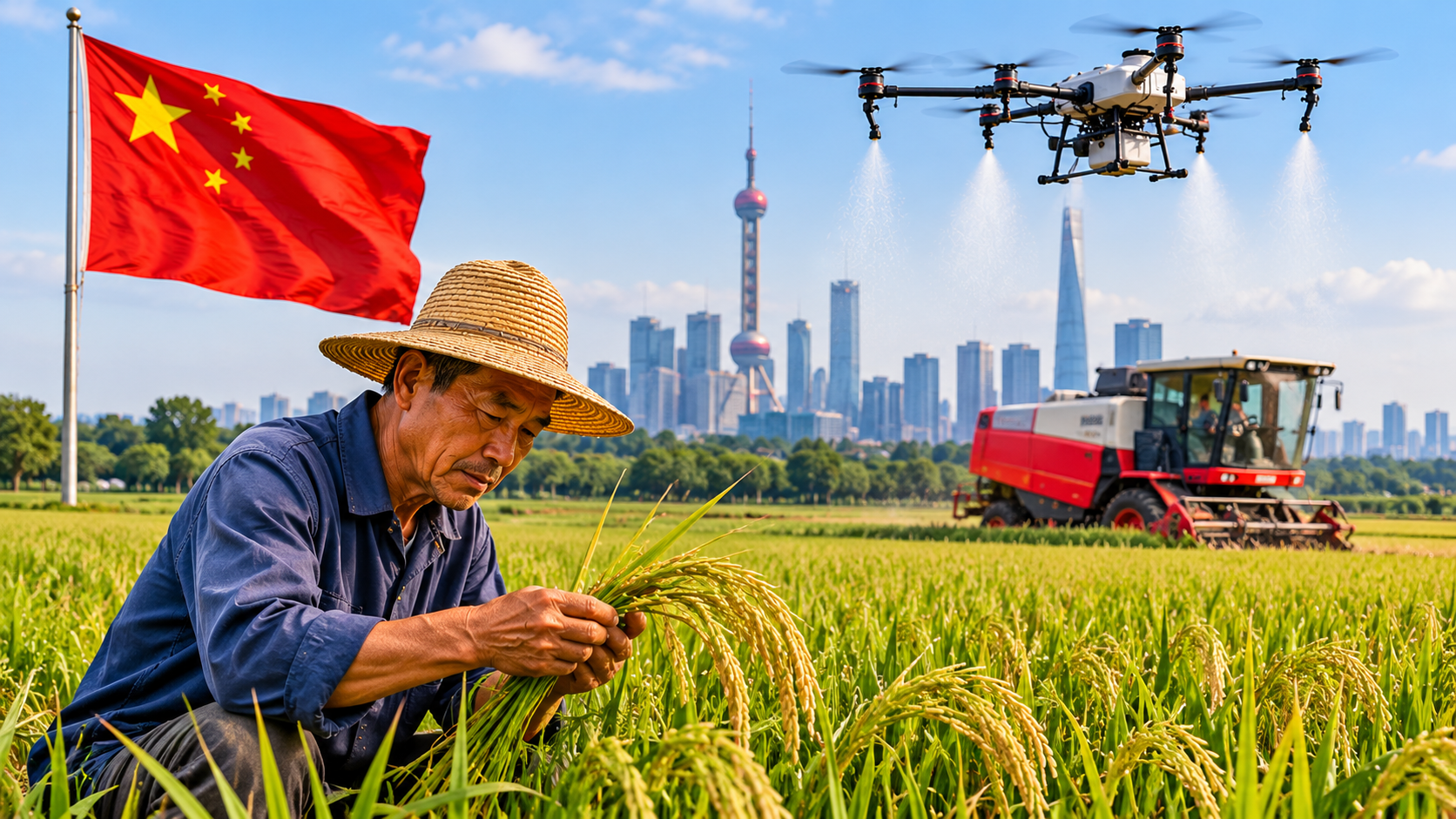
In Pinghu, a county-level city in east China’s Zhejiang Province, farmer Wang Shiping has seen his farming operation grow from 100 mu (around 16.5 acres) to more than 600 mu in just a few years.
The expansion reflects more than the growth of one farmer’s business. It illustrates how changes in land management, rural infrastructure and digital technology are reshaping Chinese agriculture.
Wang remembers a time when his farmland consisted of small plots of just one or two mu, separated by numerous ridges. Cultivating such fragmented land was inefficient and labor-intensive.
“Now, the plots have been consolidated into larger blocks of more than 10 mu. There are fewer ridges, so we have much more usable land,” he said.
Poor rural roads posed another obstacle. Muddy tracks once prevented grain trucks from reaching the fields, forcing farmers to rely on harvesters to move crops off‑field.
“Now that concrete roads have been built, trucks can drive straight into the fields, and harvesters load the grain directly onto them. It’s so much more convenient!” Wang observed.
Larger fields and better roads have made farming more efficient. But the transformation does not stop at the edge of the field. Increasingly, it extends to the digital world.
When farmland meets digital technology
With support from a digital agricultural service team, Wang now manages hundreds of mu of farmland with the help of digital tools.
The idea is to bring farmland onto a screen. Satellite remote sensing and drone inspections provide data on crop growth, which is then translated into visual maps that help farmers identify problems.
“Farmers care deeply about how their crops are growing,” Cheng Guishang, head of the service team, explained. “By combining satellite remote sensing with drone inspections, we generate a visual map. Redder shades indicate poorer growth, while greener shades signify healthier crops.”
The technology is increasingly accessible. Farmers can view these maps on their smartphones and use the information to make decisions about daily field management.
For many, checking crop conditions on a phone has become part of the morning routine. Instead of relying solely on experience and walking through the fields, they can use data to identify areas that need attention.
This combination of traditional farming knowledge and modern technology is helping Chinese agriculture become more precise and efficient.
Pinghu’s experience also reflects a broader national priority. China’s 15th Five-Year Plan period, covering 2026–2030, places renewed emphasis on agricultural science, technology and equipment. The No. 1 Central Document, the country’s annual policy blueprint for agriculture and rural development, has also highlighted emerging technologies, including drones and robotics.
The underlying principle is straightforward: improving agricultural productivity requires both better land and better technology.
A global question with a Chinese answer
China feeds nearly 20% of the world’s population with about 9% of the world’s arable land. That imbalance makes every improvement in land use, crop yields and agricultural efficiency particularly significant.
In 1995, American scholar Lester Brown raised a question that attracted international attention in his book Who Will Feed China? He warned that China’s growing demand for food could place enormous pressure on global agricultural resources.
More than three decades later, the question remains relevant in a world facing climate change, geopolitical uncertainty and disruptions to food supply chains. But China’s experience has clearly demonstrated how agricultural policy, investment and technological progress can help address the challenge.
Since the launch of reform and opening-up in 1978, China has made major strides in overcoming food shortages and improving living standards. Yet ensuring a stable food supply for such a large population remains a long-term task, particularly as the country seeks to modernize its agricultural sector while protecting its limited farmland.
President Xi Jinping has repeatedly emphasized the strategic importance of food security, describing it as one of China’s most fundamental interests. His approach centers on strengthening the country’s capacity to produce its own food by protecting farmland, improving its quality and harnessing scientific and technological advances.
The strategy is often summarized as storing grain in land and in technology.
The first part means protecting and improving the country’s agricultural foundation. China has promoted the development of high-standard farmland with more level fields, better irrigation and stronger resilience to droughts and floods. Consolidating fragmented plots, as seen in Pinghu, is one practical example of this approach.
The second part focuses on innovation. From satellite monitoring and agricultural drones to smart machinery and data-driven crop management, technology is helping farmers make more informed decisions and use resources more efficiently.
As Xi has said, “To revitalize agriculture, science and technology are paramount. Empowering agriculture through science and technology gives the sector wings to fly.”
The goal is not simply to introduce more sophisticated equipment. It is to translate innovation into higher productivity, lower costs, and more resilient agricultural production.
From personal experience to national strategy
Chinese President Xi Jinping once wrote, “Wherever I go, I will always be a son of the loss lands.” His emphasis on agriculture is closely connected to his own experiences in the countryside.
As a young man, he spent seven years working in the rural village of Liangjiahe in northwest China’s Shaanxi Province. The experience exposed him to the hardships faced by rural residents and left a lasting impression on his understanding of agriculture and rural development.
Over the years, he has continued to stress the importance of visiting the countryside, listening to farmers and understanding conditions on the ground.
This connection between national policy making and everyday agricultural life is reflected in the changes taking place in Pinghu. Land consolidation, improved infrastructure and digital farming are not isolated developments. They are part of a wider effort to strengthen the foundations of China’s food production system.
The results can also be seen in the country’s grain output. China’s annual grain production has remained above 1.3 trillion jin—one jin equals 500 grams—for several consecutive years. In 2024, output exceeded 1.4 trillion jin for the first time, while per capita grain availability reached about 500 kilograms, above the internationally cited benchmark of 400 kilograms per person.
Looking ahead, China has set a target of raising its overall grain production capacity to around 1.45 trillion jin during the 15th Five-Year Plan period.
To explore more stories about China’s development and the ideas shaping its modernization, tune in to the podcast The Stories of Xi Jinping. Through stories from the ground up, the program examines how Xi Jinping is steering China’s modernization and how national strategies translate into changes in people’s lives.