


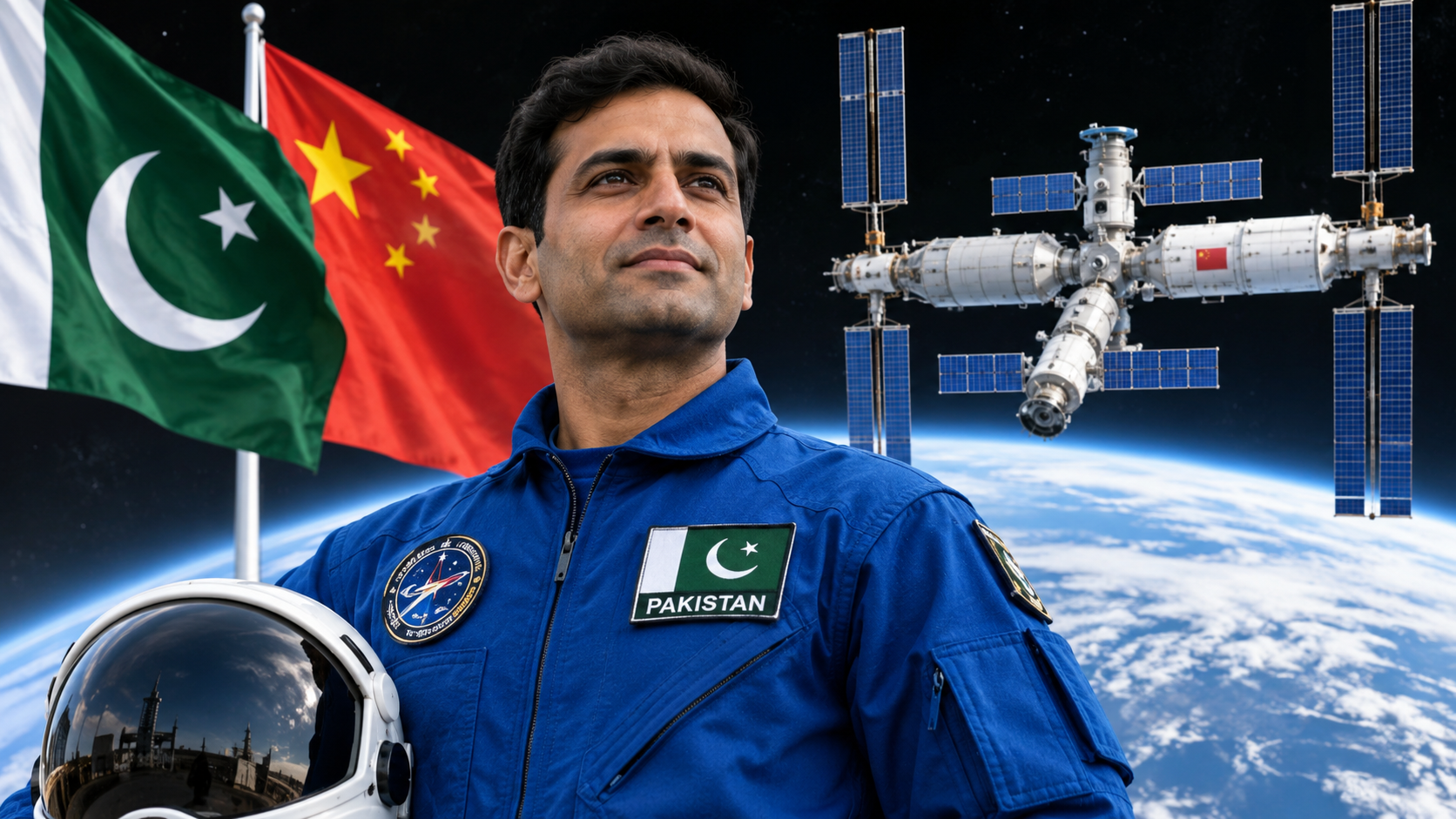
When Diplomacy Opens New Horizons: A Pakistani Astronaut’s Journey to China’s Space Station
The 75 years of exemplary diplomatic relations between China and Pakistan are extending beyond land and sea into space, as Pakistani astronaut will be boarding the Shenzou-24 along with other Chinese...

The 75 years of exemplary diplomatic relations between China and Pakistan are extending beyond land and sea into space, as Pakistani astronaut will be boarding the Shenzou-24 along with other Chinese crew members. The Pakistani astronaut to be launched into space, under the Chinese government training program for Pakistani astronauts, under February 2025 deal, will be the first foreigner astronaut.
It is worth mentioning that China and Pakistan have stood test of times, and China has always been at forefront in creating opportunities for Pakistan to grow. Therefore, this upcoming space voyage is a clear manifestation of not just the brotherly ties between both the nations, but also the vast horizon which the relationship between the countries serves for its people in terms of political, diplomatic, financial, people to people and technological cooperation.
Beijing has not announced the name of the Pakistani national who will be boarding Shenzhou-24 along with other Chinese crew members to become the first foreign national to visit China’s Tiangong space station. The announcement about the Pakistani astronaut traveling to China’s Tiangong space station aboard the Shenzhou-24 mission was shared by China’s state-run media on the weekend. According to initial details, a Pakistani national will travel as a payload specialist and return aboard Shenzhou-23 after a short stay at the space station. Also, the exact date of the mission is yet to be shared by Beijing, but Pakistan’s Federal Minister for Planning and Development Ahsan Iqbal recent hinted that the mission will begin by the end of November.
There is a long story behind this achievement and voyage that will take place due to the prudent efforts and cooperation between Pakistan and China, and there is a more journey than a place in the record books. As both pilots have spent months in intensive drills at the China Astronaut Research and Training Center in Beijing. There were months of preparations behind it, as the two candidates under the arrangement between Pakistan and China have been learning Mandarin, studying spacecraft systems and preparing themselves to face any situation before and after the launch, as astronauts can come across unexpected challenges and unfamiliar conditions of weightlessness.
The latest cooperation between the two sides in the field of space program is a reflection of what a longstanding relationship can make possible for a country whose ambitions have often exceeded the resources available to pursue them.
This development reflects the evolution of Pakistan-China relations, which over 75 years have expanded from political and strategic cooperation into economic, technological and scientific partnerships. The space mission demonstrates how decades of diplomatic trust can create opportunities that extend beyond conventional cooperation and open new horizons for Pakistan.
More importantly, the partnership offers Pakistan access to scientific experience and technological expertise that can help inspire future generations. It shows that the strength of bilateral relations lies not only in their shared history but also in the possibilities they create for the future.
In this scenario, cooperation between Pakistan and China, gives a Pakistani astronaut a chance to travel to space under an agreement that was signed between Beijing and Islamabad in February 2025. This agreement covers the selection and training of Pakistani astronauts by Beijing, which earlier this year shortlisted two Pakistanis Muhammad Zeeshan Ali and Khurram Daud, and one of them will undertake the much-awaited mission, while the other will remain available to serve as a backup.
The latest mission is not merely confined to carrying a Pakistani into space. For Pakistan’s perspective, China’s willingness to invite a Pakistani aboard Tiangong gives a practical chance to a Pakistan get access to the scientific facilities which for decades have been inaccessible for any foreigner. According to China’s state-run news agency Xinhua, the Pakistani astronaut will join the Shenzhou-24 crewed flight mission as a payload specialist and after completing a short on-orbit flight the man will return to Earth aboard the Shenzhou-23 spacecraft. “With China’s space station going to receive the first foreign visitor, the mission will mark the first joint flight involving Chinese and foreign astronauts in the history of the country’s manned space program,” according to the news agency, which said the selection of the Pakistani followed the February 2025 agreement between China and Pakistan, and under that agreement Beijing agreed to give space to a Pakistani to join the Chinese space station. Under the agreement, two Pakistani reserve astronauts were selected under the program which was the outcome of the confidence built between the two side in decades and millions of Pakistanis will be watching the launch this month when one of the Pakistani astronauts will be aboard the spacecraft. They will see him undertaking the mission which has long been a dream and it comes. But this achievement follows decades of trust between the two neighbors, who have been longtime allies, and Pakistan’s Prime Minister Shehbaz Sharif and other leaders often use a phrase to say the longstanding ties between China and Pakistan are “higher than the Himalayas, deeper than the deepest sea and sweeter than honey.” It will be once again demonstrated when Muhammad Zeeshan Ali or Khurram Daud will be joining the crew of China’s Shenzhou 24 spacecraft to become the first foreign national to board China’s space station.
Prime Minister Shehbaz Sharif met Muhammad Zeeshan Ali and Khurram Daud in April after they were selected by China for its human spaceflight mission. Describing their selection as a landmark achievement for Pakistan, he said their participation in the programme was a matter of national pride. The meeting took place before the two candidates left for China to begin their training. “I am confident that you are going to write a new chapter in Pakistan’s history,” he told them, praising their dedication and hard work in reaching this stage.
A diplomatic relationship becomes personal when it changes what someone believes is possible. For a young Pakistani studying physics, engineering or mathematics, the prospect of a fellow citizen travelling to China’s space station can give a distant ambition a familiar face. Space may remain far beyond everyday experience, but the opportunity to participate in its exploration suddenly feels closer. That is one of diplomacy’s most meaningful achievements: creating possibilities that people can begin to imagine for themselves.
Whether Muhammad Zeeshan Ali or Khurram Daud ultimately makes the journey, the mission will carry expectations larger than one individual’s achievement. In the year marking 75 years of Pakistan-China diplomatic relations, its lasting promise lies in the knowledge, confidence and opportunities that return to Earth with him