


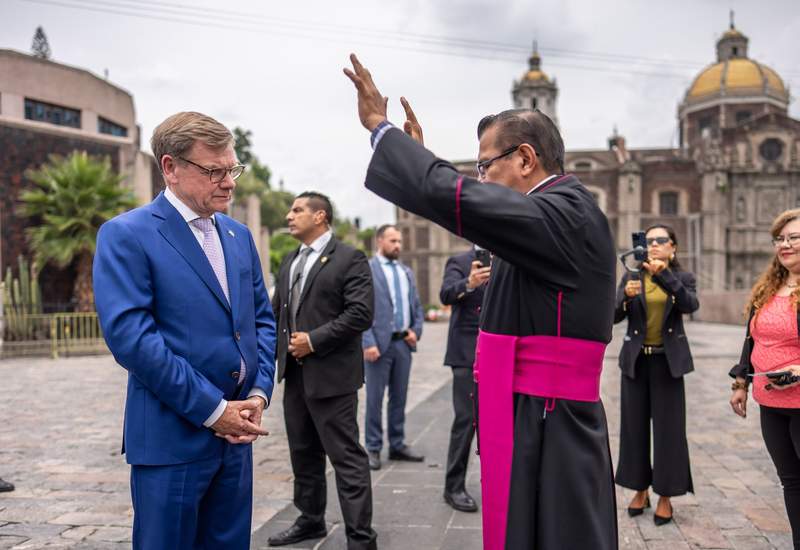
Wadephul’s Basilica Stop Ignites Debate on German Global Strategy
POLICY WIRE — Mexico City, Mexico — A basilica isn’t usually the first stop for a German defense and foreign policy maven on an official diplomatic swing. But for Johann Wadephul, a senior...

POLICY WIRE — Mexico City, Mexico — A basilica isn’t usually the first stop for a German defense and foreign policy maven on an official diplomatic swing. But for Johann Wadephul, a senior Christian Democratic Union (CDU) lawmaker known more for his hawkish positions than his spiritual tourism, an early visit to the Basilica of Our Lady of Guadalupe set an intriguing, if enigmatic, tone for his recent Mexico tour. It wasn’t the customary meeting with an ambassador, nor a rapid-fire trade delegation; it was a decidedly cultural—even spiritual—prologue, an unexpected gambit in what Berlin considers an increasingly pivotal geopolitical landscape.
It’s no secret Germany wants to broaden its alliances beyond traditional Western blocs. Berlin, they say, is looking south — and east with renewed vigor. This overture to Mexico—a nation that itself wields significant regional heft and diverse global ties—marks a palpable shift from Germany’s past, sometimes insular, diplomatic patterns. Wadephul’s itinerary, following the basilica visit, reportedly covered high-level discussions with parliamentary counterparts and senior government officials. One doesn’t need to be a seer to understand the underlying currents: trade diversification, security cooperation, and perhaps even a gentle re-calibration of cultural diplomacy are all on the table. [QUOTE_PLACEHOLDER]
And yes, the symbolic weight of the basilica, a significant pilgrimage site in the Americas, is considerable. It’s an almost cinematic nod to the deeply ingrained cultural and religious identities that often shape foreign policy as much as balance sheets do. For Germany, a country grappling with its own historical secularization and multicultural complexities, acknowledging such profound symbols abroad can be a surprisingly astute diplomatic tool, projecting a nuanced understanding of its partners.
But the real game isn’t just about Latin America. Berlin’s larger strategy seeks new economic arteries — and security buffers across a truly global chessboard. You see it in their growing engagement with Southeast Asia, and yes, even in their re-evaluated approach to nations like Pakistan in South Asia. While a world away from Mexico City’s vibrant squares, Pakistan, like Mexico, represents a large, youthful market with emerging economic potential and a significant geopolitical role in its region. Both countries share a certain hunger for foreign investment and technological collaboration that Germany, with its industrial prowess and engineering pedigree, can provide. Diversifying away from over-reliance on a handful of manufacturing hubs? It’s not just prudent, it’s imperative, they’ll tell you.
In fact, German direct investment into Latin America, a significant portion of which finds its way to Mexico, reached approximately $52 billion by 2021, according to official German government statistics. It’s a substantial figure, one that shows just how serious Berlin is about these new horizons, and how rapidly these partnerships are evolving.
However, the question lingering for many European observers, frankly, is whether Germany is equipped for such broad-spectrum global diplomacy. The domestic debates, particularly those surrounding its own defense spending and energy transition, frequently seem to consume more oxygen than its aspirations for a genuinely multipolar foreign policy. It’s an odd dichotomy: aspiring to global leadership while sometimes appearing internally bogged down. Wadephul’s Mexico visit, especially its unusual kick-off, inadvertently highlights this tension.
Policy analysts are often quick to dissect every speech and communiqué, but sometimes, a simple, unexpected gesture—like visiting a revered religious site—can speak volumes louder. It’s an implicit acknowledgement of cultural gravitas, a signal that transcends purely transactional diplomacy. That’s probably the real story here. Wadephul’s move suggests a Germany ready, or at least attempting, to connect on multiple dimensions, not just economic or military. But can they keep that multi-dimensional engagement going across a vast, complex world, especially when resources are finite? And will they recognize the similar complexities, for instance, in the diverse religious landscape of countries like Pakistan, if they truly wish to expand influence?
But it’s too early to tell if this is a flash in the diplomatic pan or a deeper, more intentional pivot. They’re playing the long game, though, — and sometimes, the initial moves look strange from the sidelines.
What This Means
Wadephul’s visit, particularly its opening act, signals Berlin’s intensifying pursuit of a ‘diversified engagement’ foreign policy. Economically, this implies a concerted push to solidify trade and investment ties with rising global South players, notably Latin America, as alternatives to traditional markets. Geopolitically, it represents an effort to cultivate alliances with non-European powers, broadening Germany’s influence and securing its interests in an increasingly unpredictable world. This isn’t just about trade; it’s about resilient supply chains, new diplomatic partnerships, and an acknowledgment that power centers are shifting.
The cultural nod at the basilica underscores a subtle yet significant shift toward soft power and nuanced cultural diplomacy—an understanding that national identity, including religious aspects, deeply influences international relations. Such a strategy, if applied consistently, could extend to nations like Pakistan, where religious and cultural heritage play a profound role in public life and foreign relations. Berlin’s challenge will be to translate these gestures into substantive, sustained engagements that yield tangible benefits without diluting its core democratic values. It’s an intricate dance between pragmatism and principles, requiring finesse that Germany, historically, hasn’t always been credited with. This re-orientation could redefine Germany’s standing not just in Brussels, but in Islamabad — and Santiago, too.